You've got a renovation scheduled, a contractor waiting on a start date, and a report that says “asbestos inspection” in one place and “assessment” in another. For a lot of property owners in Los Angeles, that wording is where the confusion starts. The terms sound interchangeable, but in practice they point to different levels of work, different documentation, and different decisions.
That difference matters because asbestos work isn't just about finding a material. It's about knowing whether a building record review, visual survey, bulk sampling, or air monitoring is the right next step, and whether the result supports maintenance, renovation planning, demolition planning, or ongoing oversight. Federal guidance grew out of the EPA's asbestos rule framework from the 1970s and 1980s, including the 1973 asbestos NESHAP and later federal repromulgation, while OSHA's early asbestos standards shaped exposure controls and sampling practice as well EPA asbestos guidance.
If you're trying to keep a project moving in Southern California, the key question isn't just “Do I need asbestos testing?” It's “What kind of asbestos inspection and assessment does this property need, and what will the results let me do next?”
Table of Contents
- Introduction to Asbestos Testing Terminology
- What Is Asbestos Inspection and What Is Assessment
- Typical Procedures for Asbestos Testing and Sampling
- When Is an Asbestos Inspection Required versus an Assessment
- Report Deliverables and Documentation Outcomes
- Next Steps After Receiving Your Test Results
Introduction to Asbestos Testing Terminology
A homeowner planning a kitchen remodel in Los Angeles usually wants a simple answer. Can the work start, or does someone need to inspect the space first? A general contractor on a commercial tenant improvement project asks the same thing in different language, because a missed step can affect scheduling, notices, and who signs off on the file.
That's why inspection and assessment need to be separated. An inspection identifies and documents suspect and confirmed asbestos-containing materials, while an assessment goes further and judges what those materials mean in real terms, especially their condition, disturbance potential, and exposure risk.
A material can be present without being a pressing hazard, and it can also be in poor condition without looking dramatic from the doorway.
The confusion often comes from public-facing guides that use one word for both tasks. In practice, the scope changes the outcome. A survey done for maintenance planning is not the same as one done for demolition readiness, and a clearance-oriented review is not the same as a baseline management survey for an occupied building.
For property owners, that distinction changes more than the paperwork. It affects how a consultant frames sampling, what the lab receives, how the report is written, and whether the information is strong enough for a contractor or regulator to rely on. If the wrong process is chosen, the result can look complete while still leaving gaps.
Many readers also ask whether the answer is just “testing” or “not testing.” That's where terms get sloppy. The more useful question is whether the site needs a survey, an assessment, or both, and whether the findings will be used for compliance, planning, or day-to-day management. If you're also trying to improve the indoor environment while juggling multiple building concerns, resources like healthier indoor air with respirators can help you think about indoor exposure control in a broader way.
What Is Asbestos Inspection and What Is Assessment
Two different jobs, two different outputs
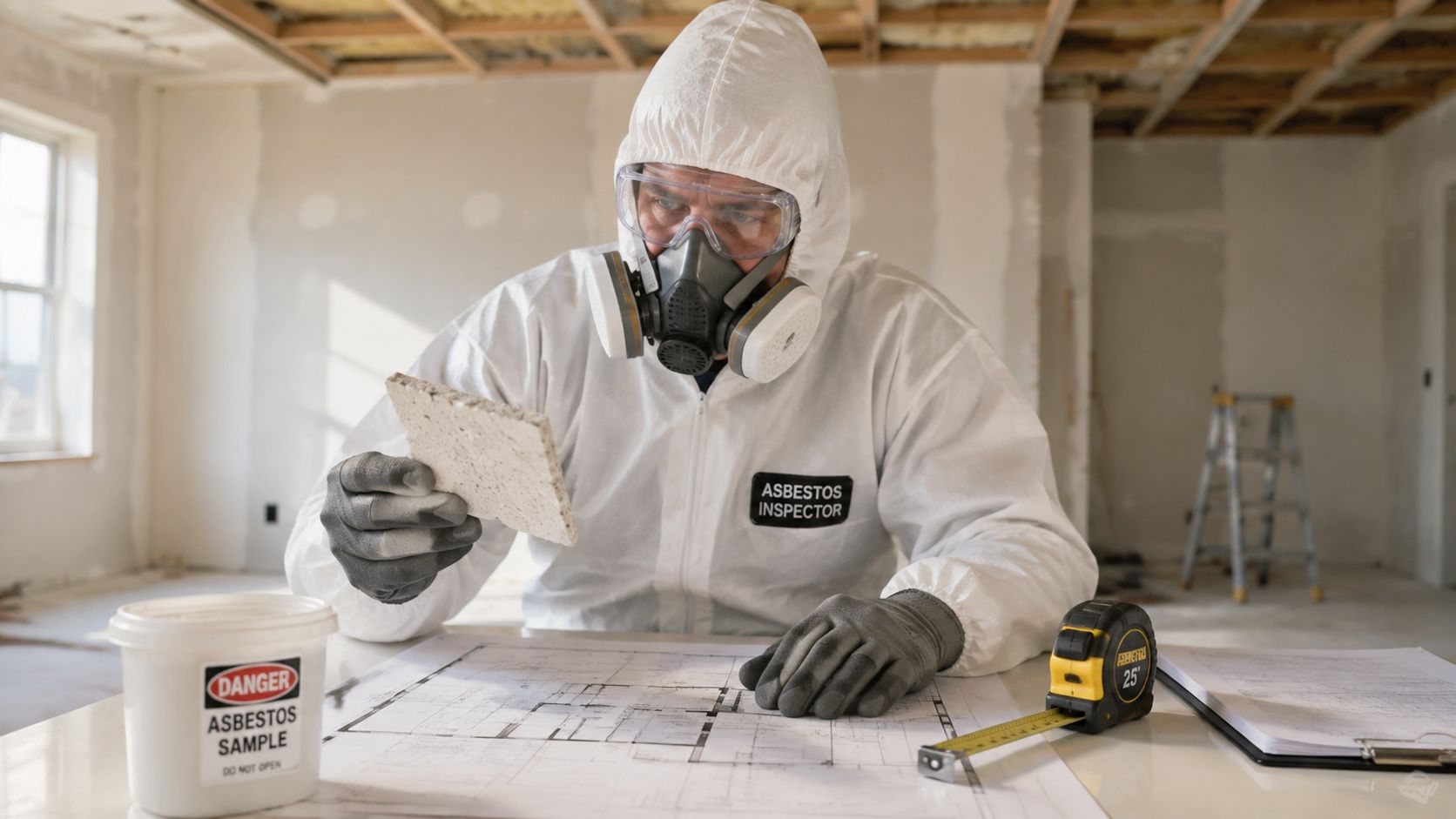
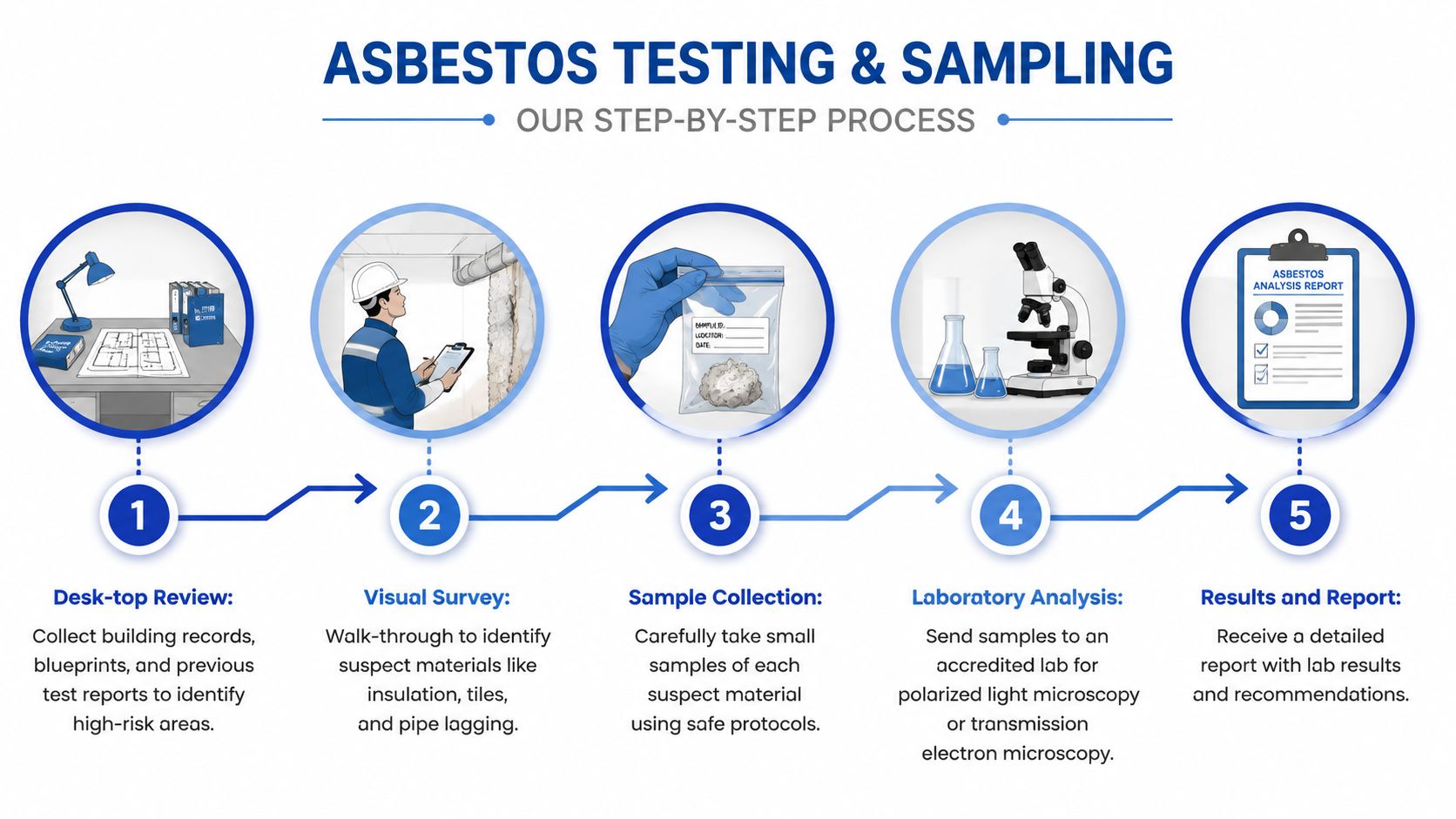
An asbestos inspection is the identification phase. A qualified professional reviews records, walks the property, finds suspect materials, and determines where sampling is needed so the presence of asbestos can be confirmed or ruled out with laboratory analysis. An assessment takes the next step and asks what the condition of those materials means, including whether the material is stable, damaged, friable, likely to release fibers, or suitable for management in place.
The process is akin to a medical visit. The inspection is the exam and the lab work that identifies what's there. The assessment is the clinical interpretation, the part that helps decide whether the finding is routine, urgent, or something that needs ongoing monitoring.
Inspection versus assessment at a glance
| Aspect | Inspection | Assessment |
|---|---|---|
| Purpose | Identify suspect and confirmed asbestos-containing materials | Evaluate condition, risk, and exposure potential |
| Scope | Records review, walkthrough, targeted sampling | Condition review, friability, disturbance potential, exposure context |
| Methods | Visual survey, bulk sampling, lab analysis | Condition grading, targeted air monitoring when needed, management review |
| Outcome | Survey report and mapped material locations | Risk-oriented documentation and management guidance |
The two jobs are related, but they're not interchangeable. Inspection answers “What is it, and where is it?” Assessment answers “What does it mean for the property right now?” If a ceiling tile looks intact but sits in a space that will be cut into next week, the assessment becomes more important than the label on the sample bag.
For owners trying to coordinate work in Los Angeles or nearby cities, that distinction helps avoid overreacting to a result while still taking it seriously. A positive sample does not automatically tell you what to do next. It tells you what's present, and the assessment helps decide whether the material can stay in place, needs more documentation, or requires a separate work plan.
Typical Procedures for Asbestos Testing and Sampling
How a professional survey starts
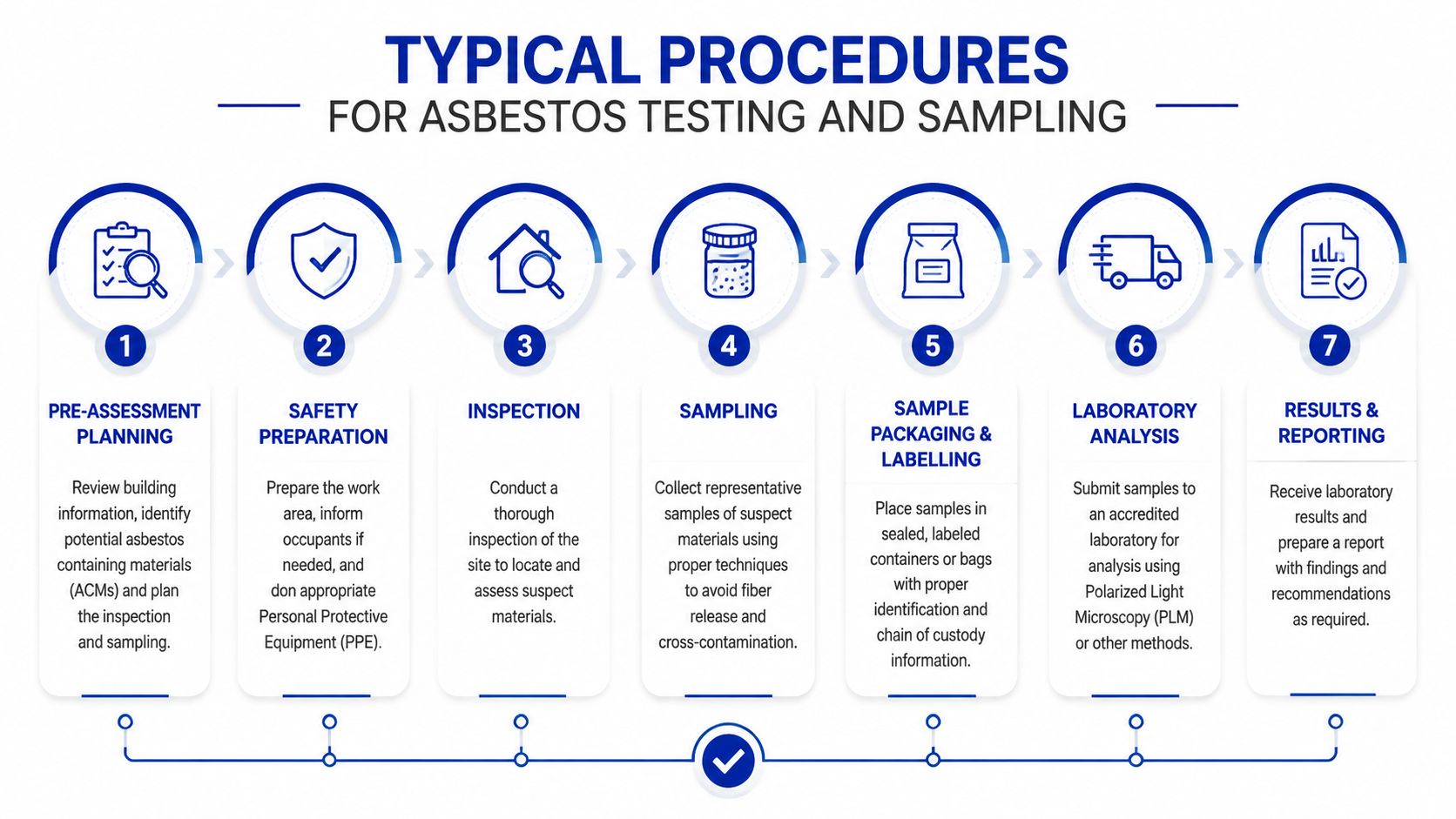
A good survey starts before anyone opens a sample bag. The consultant first reviews building records, old plans, prior reports, and renovation history to narrow down which materials are likely to contain asbestos. That record review helps turn a walkthrough into a focused search instead of a random spot check.
The visual survey then moves through suspect materials such as insulation, floor tile, pipe wrap, mastic, and textured finishes. Sampling is targeted, not casual. Public-sector guidance on asbestos surveys says sample points should represent the installed material, and bulk samples should only be taken from materials that will be disturbed before they go to a certified or accredited laboratory for analysis public-sector asbestos survey guidance.
A poor sample can be worse than no sample if it misses the layered material that actually contains the asbestos.
That warning matters because some building products are layered or mixed, so the visible surface does not always show the full story. A ceiling finish can hide backing material, and a floor sample can miss the adhesive layer below. For a practical example of how a single material type is sampled, see how to test for asbestos in a popcorn ceiling.
How assessment builds on inspection
Assessment begins after the material has been identified. The consultant then looks at condition, friability, likely disturbance, and whether the material's location changes the exposure picture. An item in good condition in a low-traffic space calls for a different judgment than the same material in a room scheduled for work.
Air sampling can also matter when the question is not only whether asbestos is present, but whether fibers are being released. The NIST handbook on asbestos sampling describes drawing a known volume of air through a 25-mm cassette and gives practical minimum volumes of 25 L for TWA compliance sampling and 48 L for 30-minute excursion-limit evaluations NIST handbook on asbestos sampling. If the volume is too small, low-level fiber concentrations can be missed.
For a homeowner, this is the point where the process becomes easier to picture. One sample answers what the material is, while the assessment asks what that result means for the building as it stands. The difference keeps the report tied to real use conditions, not just a lab result on its own.
When Is an Asbestos Inspection Required versus an Assessment
A renovation trigger is where the difference matters. If walls, ceilings, flooring, or pipe insulation will be disturbed, an inspection usually comes first because the team needs to know what materials are in place before work starts. If the building is already known to contain asbestos, an assessment may be needed to judge whether the material can stay managed in place or whether its condition changes the project plan.
For federal and public portfolios, oversight also depends on scheduled review. EPA guidance traces the early federal asbestos standards to OSHA and explains how those rules developed over time EPA asbestos guidance. More recent oversight gaps show why inspection intervals matter. In the GSA portfolio, federal buildings built before 1998 are required to receive asbestos inspections every 5 years, yet a 2024 GAO review found that many GSA buildings had not been inspected within that window, including some with no known inspection date and others that had gone more than a decade without inspection GAO review of GSA asbestos inspections.
Southern California regulatory triggers
SCAQMD Rule 1403 is direct about pre-work survey requirements. Any affected facility or component must be thoroughly surveyed before demolition or renovation begins, and that survey must include inspection, identification, and quantification of friable asbestos and Class I and Class II non-friable ACM SCAQMD Rule 1403. For demolition, the survey must cover all construction materials, including foundations, underground utilities, and materials that may be hidden or hard to reach.
AQMD's compliance advisory also describes a Los Angeles-area renovation exception. The survey requirement does not apply to renovation of a residential single-unit dwelling when less than 100 square feet of ACM surface area are removed or stripped, and the survey must be done by a Cal/OSHA-certified inspector or, in some cases, a facility employee with a valid AHERA Building Inspector certificate from a Cal/OSHA-approved course AQMD compliance advisory. For a fuller walk-through of those local triggers, see commercial renovation asbestos testing in Los Angeles.
If the scope is wrong at the start, the rest of the project can appear compliant while still missing the materials that matter.
That is why a refurbishment project, a demolition project, and an occupied-building management program do not all use the same level of review. An inspection answers the setup question. An assessment answers the risk question. Both may be needed, but for different reasons.
Report Deliverables and Documentation Outcomes
The paper trail matters as much as the sampling plan. A strong inspection usually produces an asbestos survey report that identifies suspect and confirmed materials, maps sample locations, records laboratory results, and classifies materials by location and condition. That document supports due diligence, project planning, and regulatory review, especially when contractors need clear boundaries before work starts.
An assessment adds another layer. The consultant may include condition ratings, risk prioritization, and management recommendations, and in some cases air-monitoring results if disturbance or degradation was part of the question. The value of that extra layer is simple. It tells the owner what the result means operationally, not just analytically.
AQMD Rule 1403 also makes the report itself part of the compliance pathway. The FAQ states that an asbestos survey report signed by an asbestos consultant is required before any demolition or renovation, and if suspected ACM is identified, it must be sampled and analyzed by a qualified laboratory unless the owner chooses to treat the material as ACM without analysis AQMD Rule 1403 FAQ.
How the documentation gets used
The report isn't just for filing. Contractors use it to plan access and sequencing. Property managers use it to track known materials over time. Owners use it to decide whether a material can stay in place, whether a future project needs a broader survey, or whether the building file needs an update before the next alteration.
In some cases, a consultant may be asked to coordinate with other indoor environmental work, such as lead or mold testing, so the owner doesn't treat one report as the whole story. Sensitive Environmental provides asbestos testing and related environmental assessment services for that kind of documentation-driven work, which is useful when a building team needs a single technical record for several hazards.
The report should make the next decision easier, not leave the owner guessing which material matters and why.
That's also where a well-organized file helps with repeat inspections. If the materials are already mapped and the condition is tracked, later work can focus on changes instead of starting from zero.
Next Steps After Receiving Your Test Results
A positive result doesn't automatically mean the building must be torn apart. It means the material has to be understood in context. The next step is to review the survey or assessment with a qualified environmental consultant and decide whether the material can remain managed in place, needs more testing, or requires a project-specific work plan before disturbance.
For occupied buildings, especially commercial and multi-tenant properties, the practical move is to build the result into a management program. Canada's federal standard requires an initial baseline survey, annual reassessment of identified asbestos-containing materials, and laboratory confirmation for suspected material GSA asbestos management guidance. That lifecycle approach is useful even outside federal facilities because it reminds owners that asbestos control isn't always a one-time event.
Keep the decision tied to the actual use of the space
If the space will be renovated later, the original survey may no longer be enough. If the material is damaged, the assessment may need to be updated. If a contractor plans to cut into a wall, the survey scope should match that disturbance, not just the visible portion of the room.
For owners juggling multiple indoor concerns, a broader indoor review can also be helpful. A service such as indoor air quality testing FL shows how occupants often think about air problems in layers, not silos, and the same logic applies here. Asbestos findings should be interpreted alongside the building use, the work scope, and any other environmental issues already on the table.
If you need a deeper understanding of the work sequence after a positive result, the safe asbestos removal guide can help clarify where testing ends and project planning begins.
For Los Angeles and Southern California properties, the smartest next step is to get documentation that matches the job in front of you, not a generic inspection that sounds complete but leaves compliance gaps. Contact Sensitive Environmental to schedule professional asbestos testing, a pre-renovation or pre-demolition survey, or a condition-based assessment for your property in Los Angeles and across Southern California.