You've got the contractor lined up, the dust walls are coming in, and someone on the team says, “We should probably check the ceiling first.” That instinct is right. In Los Angeles, asbestos testing is not a box to tick after demolition starts, it's part of the job planning that keeps a project moving without surprise stops, extra paperwork, or a messy regulatory problem.
The mistake I see most often is treating asbestos like an age issue alone. It isn't. In this market, the trigger is the planned disturbance of suspect materials, and that's why a proper survey matters before a wall comes out, a ceiling gets scraped, or a commercial interior gets opened up for tenant improvement work.
Table of Contents
- What Asbestos Testing in Los Angeles Actually Means
- Why SCAQMD Rule 1403 Drives Asbestos Testing Locally
- How a Professional Asbestos Survey and Lab Analysis Works
- Professional Asbestos Testing vs DIY Sampling
- Thresholds, Notifications, and Procedure 5 Clean-Up Plans
- What Property Owners Should Expect During the Testing Process
- Beyond Standard Surveys and Next Steps for Los Angeles Property Owners
What Asbestos Testing in Los Angeles Actually Means
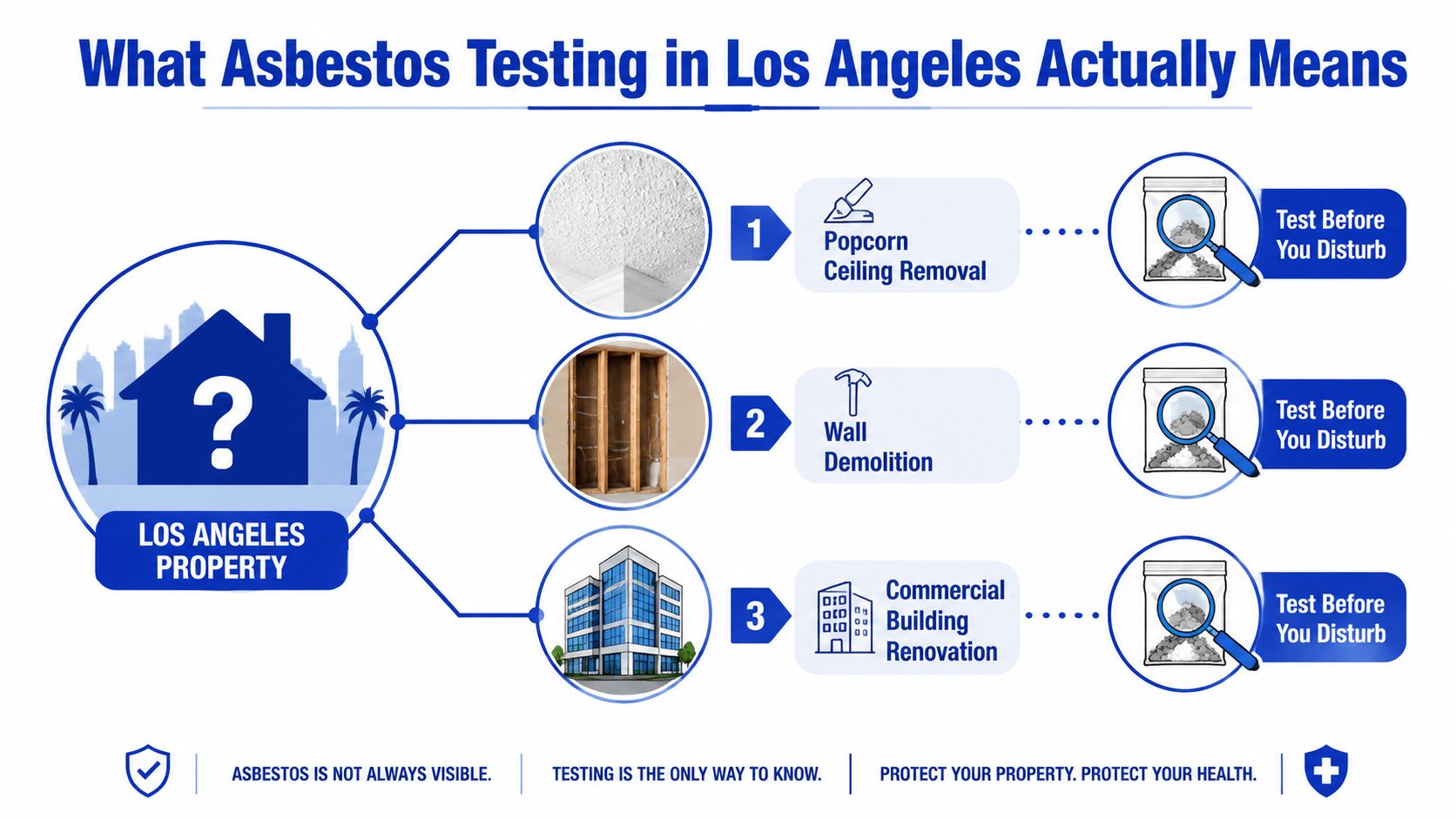
A homeowner in Sherman Oaks thinks they're just removing a textured ceiling. A property manager in Koreatown is opening walls for a unit turnover. A contractor in downtown Los Angeles is pricing a small demolition package and assumes the building's age will tell the whole story. That's where projects go sideways, because asbestos testing in Los Angeles is a pre-disturbance compliance step, not a visual opinion.
It starts before anyone cuts, sands, or demos
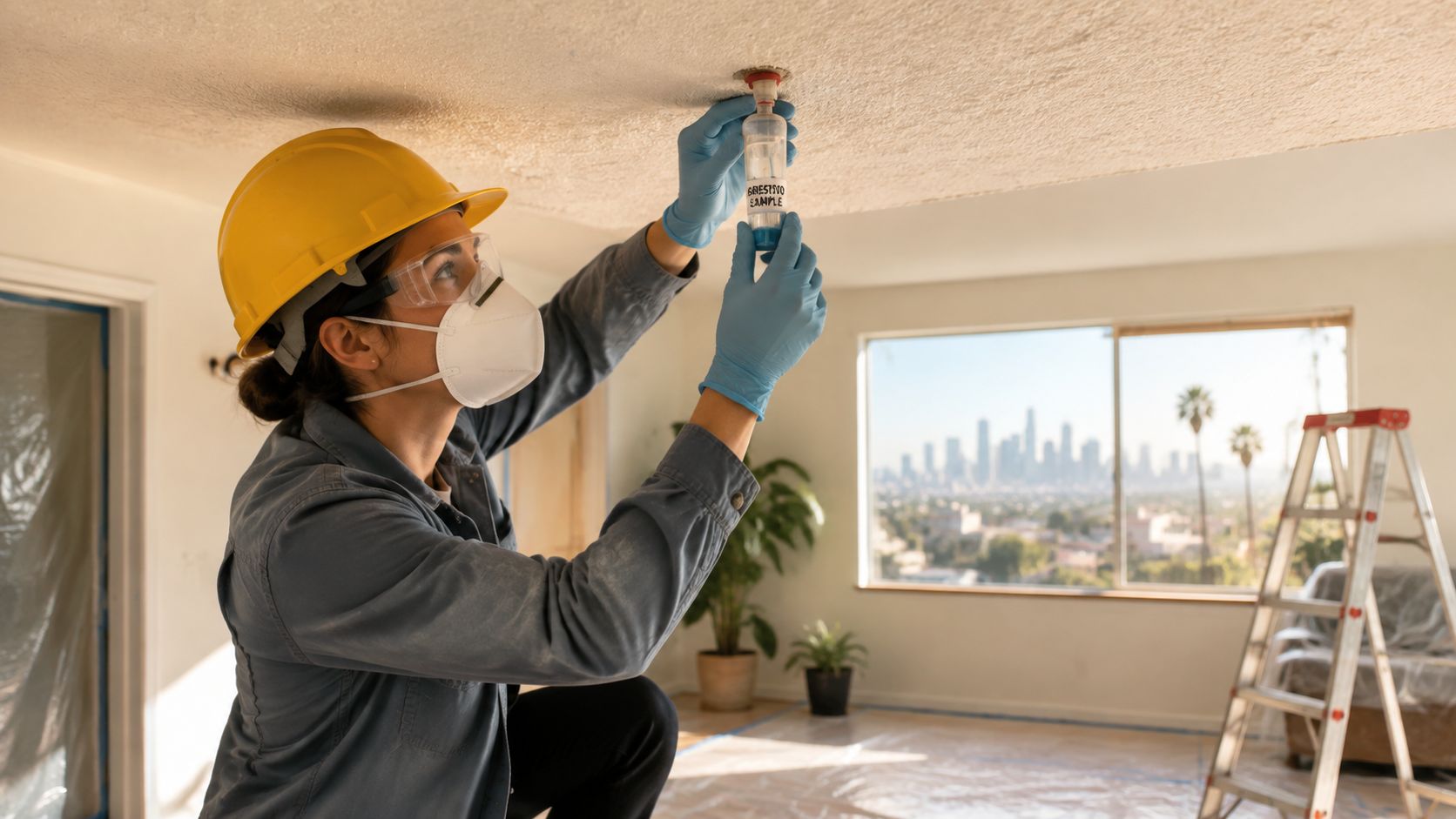
A proper asbestos test identifies whether suspect material contains asbestos before work breaks it apart. The consultant locates accessible suspect materials, collects representative bulk samples, and sends them for laboratory analysis, usually so the results can be used for renovation planning, regulatory notification, and contractor scoping. Under SCAQMD Rule 1403, that matters because the local framework drives when testing, surveying, and documentation have to happen before construction proceeds. SCAQMD Rule 1403 history and revisions
That test is not just about saying yes or no. It distinguishes asbestos from materials that look similar, like plaster, fiberglass, wood fiber, or old mastics, and it gives the project team enough information to decide what happens next. A defensible report should list sampled locations, material condition, results, assumptions, and limits, because a report that doesn't show where the samples came from is weak in a real jobsite dispute.
Practical rule: if the material is going to be disturbed, test it before anyone assumes it's harmless.
Rule 1403 also changed local practice by requiring asbestos surveys before demolition or renovation, and it later strengthened enforceability with added survey, oversight, notification, and recordkeeping requirements. That's the difference between a casual inspection and a real compliance workflow. If you need a wider view of how this plays out on occupied properties, the commercial-renovation context is laid out clearly in this Los Angeles commercial asbestos testing guide.
Why SCAQMD Rule 1403 Drives Asbestos Testing Locally
Los Angeles job sites do not get to treat asbestos as an afterthought. Rule 1403 is the local air-district rule that ties demolition and renovation work to asbestos identification, because the South Coast AQMD treats material disturbance as the compliance trigger, and the rule has been in place since the district adopted it on October 6, 1989, then revised it on April 8, 1994 to tighten enforceability, survey requirements, trained oversight, notification updates, and waste recordkeeping. Rule 1403 adoption and revision history
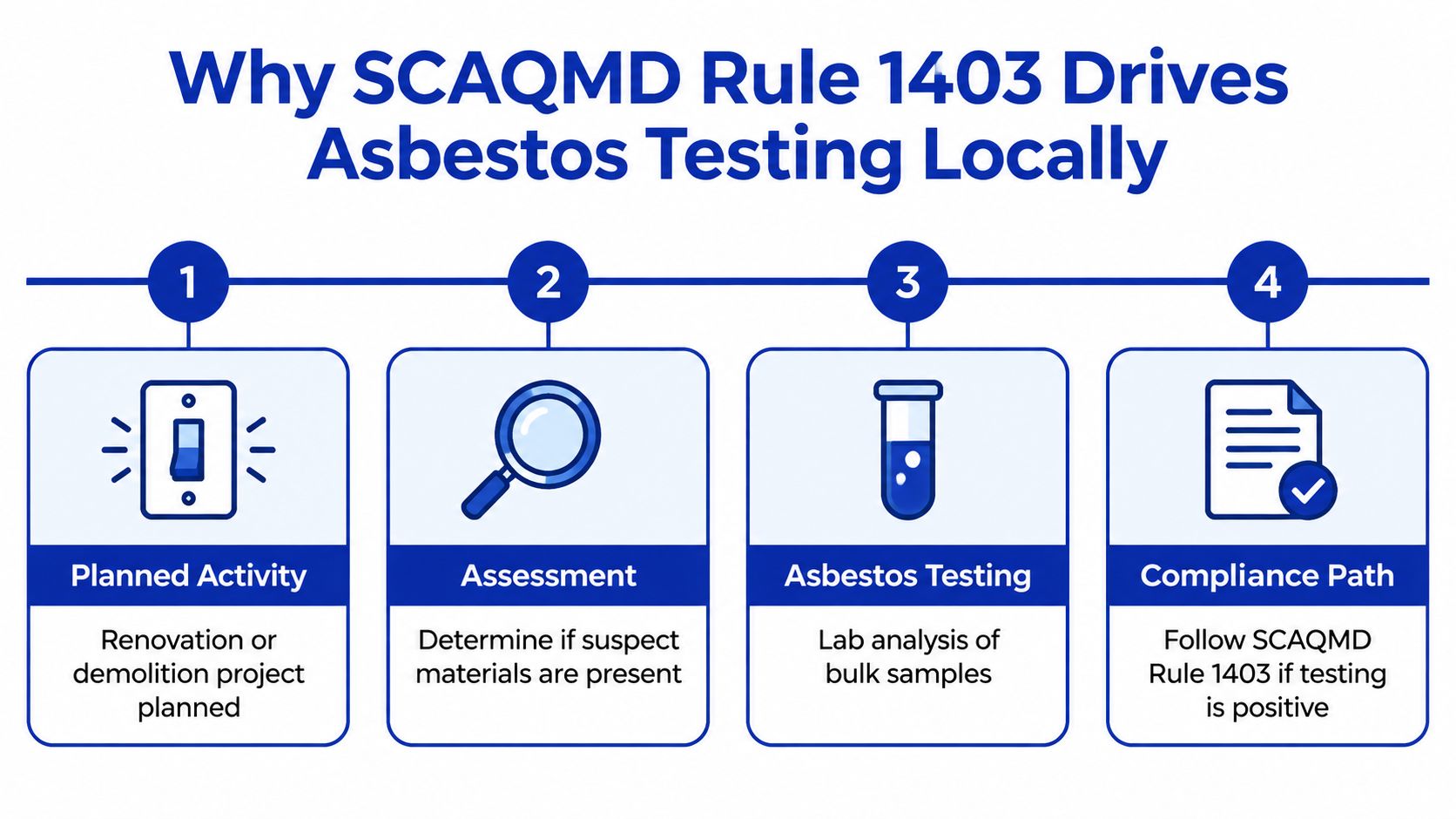
The rule follows the work, not the age of the property
That distinction is what owners miss on rushed projects. A pre-1980s building often gets attention because asbestos showed up in roofing, flooring, caulks, mastics, and insulation, but the compliance question stays centered on what will be disturbed and how much of it is involved. Rule 1403 requires survey and notification procedures for demolition projects and for removal of more than 100 square feet of intact asbestos-containing material, and the AQMD says it is the local enforcement authority for the federal asbestos NESHAP. AQMD asbestos demolition and removal guidance
That is why the smart move is to survey before bidding. A pre-disturbance survey gives the owner a defensible scope, gives the contractor a real basis for pricing, and keeps the project from stalling once suspect material turns up behind a wall or above a ceiling. If you wait until dust is already in the air, you have already lost control of the sequence.
Compliance is a workflow, not a single result
Property owners often ask whether building age decides the issue. It does not. The rule runs through the facility and the planned activity, so the practical sequence is survey first, notification when required, then work under the applicable controls. In occupied buildings, access, notice, and tenant coordination can shape the schedule, and California state tenant regulations are part of that planning.
Bottom line: if a project can disturb suspect materials, asbestos testing comes first, before permits, demolition, or tenant move-out planning.
For property owners, that sequence protects the schedule as much as it protects compliance. For contractors, it cuts down scope creep and the change orders that come from hidden material conditions. Los Angeles projects run better when the survey is treated as the planning document it is, not a formality. For a practical commercial-renovation example, see this Los Angeles commercial asbestos testing guide.
How a Professional Asbestos Survey and Lab Analysis Works
A proper survey starts with the work area, then the materials. A consultant walks the renovation or demolition zone, reviews what will be disturbed, and identifies homogeneous materials, meaning materials that are consistent enough in appearance and use to sample as one group. Ceiling texture, wall patch, mastic, and pipe wrap can all sit in the same room and still require separate handling.
Sampling has to be controlled and traceable
The consultant takes bulk samples using controlled methods, labels each one, and records the exact location and material type. South Coast AQMD guidance says Certified Asbestos Consultants may prepare Rule 1403 Procedure 5 clean-up plans, and California air-district rules require survey documentation to include sampled materials, the laboratory name, and the lab's qualification statement. South Coast AQMD survey guidance
The lab backbone is polarized light microscopy, or PLM. EPA method guidance says samples are examined with polarized light and crossed polars, commonly at 100x to 400x magnification, because optical properties help identify chrysotile and amphibole asbestos types. EPA PLM method guidance
A proper asbestos test identifies whether suspect material contains asbestos before work breaks it apart, distinguishing regulated material from visually similar substrates like plaster or fiberglass.
Why the report matters as much as the sample
A good survey report does more than say “positive” or “negative.” It ties each sample to a room, component, and material category, then states the method used, any limits on access, and anything the consultant could not reach. One negative sample does not characterize every similar-looking surface in a building, especially where materials were patched, layered, or changed over time.
A survey is only useful if another contractor can act on it without guessing.
That is the practical value. The report becomes the basis for estimating quantities, deciding whether Rule 1403 notifications are needed, and defining removal, containment, waste handling, and clearance requirements. If suspect material is mixed or concealed, repeat sampling may be necessary. A single chip from one patch of wallboard does not settle the whole floor.
Professional Asbestos Testing vs DIY Sampling
DIY kits look convenient because they promise a fast answer. In regulated Los Angeles work, that convenience is mostly false comfort. A homeowner can mail a chip, get a result on that one chip, and still have no compliant survey for the rest of the project.
| Factor | Professional CAC-Led Survey | DIY Home Test Kit |
|---|---|---|
| Scope | Reviews the full work area and identifies homogeneous materials | Tests only the piece the homeowner sends |
| Documentation | Chain of custody, room locations, material notes, and survey report | Basic lab result, often without project-level context |
| Regulatory use | Built for Rule 1403 planning and contractor scoping | Not a survey and not a substitute for compliance documentation |
| Lab method | Sent to an accredited lab for PLM analysis | May use a lab, but the sample still covers only one chip |
| Project value | Supports bidding, notification, and safe sequencing | Gives a limited answer that can still leave the job noncompliant |
What DIY can do, and what it can't
DIY kits can tell you whether one bulk chip contains asbestos. They cannot satisfy the survey requirement, cover all suspect materials, or create a defensible project file. If dust is generated later and the material wasn't documented, the result is effectively the same as no testing at all from a jobsite compliance standpoint.
That's why the better comparison is not “cheap versus expensive,” it's “usable versus useless for the work you're about to do.” Can you test for asbestos at home is a fair question, but in a Los Angeles renovation or demolition project, the answer is simple, home kits are not a substitute for a professional survey.
When the stakes include permits, contractor pricing, and potential agency review, undocumented testing is a gamble you don't want to take.
Thresholds, Notifications, and Procedure 5 Clean-Up Plans
A confirmed result only matters when it drives the right next step. In Los Angeles, that means checking the planned work first, then matching the testing results to the disturbance that will happen. California air-district asbestos guidance uses the 160 square feet on other facility components, 260 linear feet on pipe insulation, or 35 cubic feet of RACM threshold to decide when survey work and notification are required before the job starts. California air-district asbestos guidance
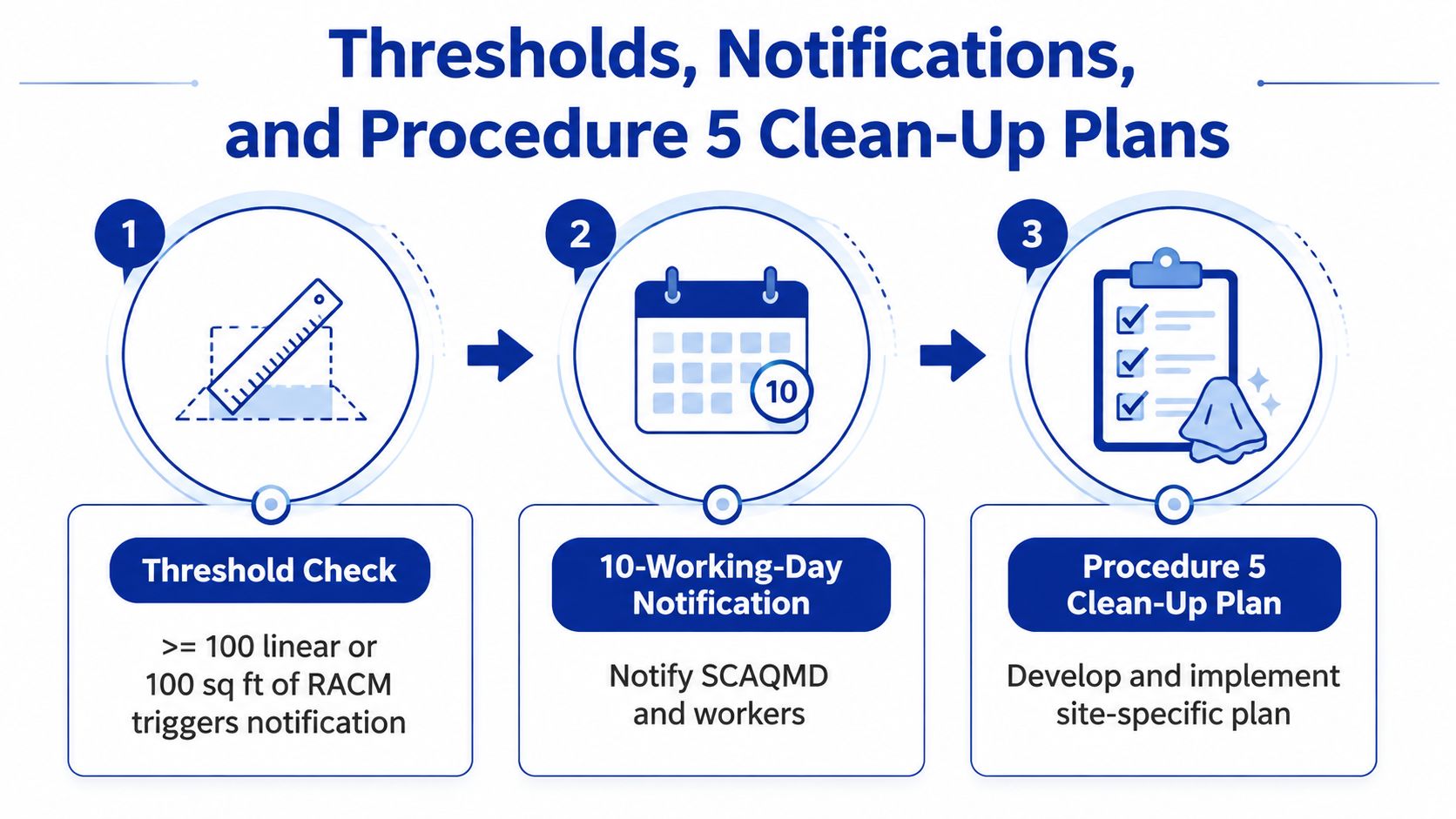
Notification comes before the work
SCAQMD's FAQ says asbestos demolition and renovation notifications must be submitted 10 working days, which it translates to 14 calendar days, before demolition or renovation so an inspector has time to schedule a site inspection if needed. SCAQMD Rule 1403 FAQ
That timing controls real projects. If a crew is about to demo a kitchen, remove ceiling tile, or replace pipe insulation in a multifamily building, waiting until the material is exposed can stop the job and force a schedule reset. The better approach is simple: test first, quantify the material, then file the notice before anyone locks in mobilization. The same rule set also affects California real estate asbestos disclosure obligations, because findings and notices can affect how a property is represented and managed during a sale or renovation.
Procedure 5 is a written plan, not a verbal promise
For damaged or disturbed ACM, SCAQMD says a Procedure 5 clean-up plan is required regardless of project size, and abatement of that damaged or disturbed ACM cannot begin until SCAQMD approves the plan in writing. SCAQMD Procedure 5 compliance advisory
That plan sets the controls on the job site, enclosure, negative-pressure containment, HEPA filtration, wet methods, waste handling, and clearance sampling that closes the project. In Los Angeles, that matters on drywall demolition, ceiling work, and pipe insulation replacement in older multifamily housing, where one wrong assumption can turn a small interior job into a compliance problem with more than one agency involved.
If the survey shows regulated material, the work plan has to match the material. Anything less is guessing with a permit on the line.
What Property Owners Should Expect During the Testing Process
The first call usually turns into a site walk quickly, because the consultant needs to see the actual work area, not just the permit drawings. For many projects, that walkthrough takes a couple of hours, sometimes longer if the building has multiple suspect materials, tight access, or occupied units that need scheduling around. The point is to identify the homogeneous areas and build a sampling plan that fits the project.
From access to chain of custody
Sampling is done with wet methods and proper PPE, then each sample is sealed and logged under chain of custody before it goes to an NVLAP-accredited lab for PLM analysis. When the work is scheduled properly, results can come back quickly, and the owner receives a typed survey report that lists the material, sample location, analytical result, and recommendations for next steps.
Property owners and landlords need to grant access to the affected area, including closets, utility rooms, attics, crawlspaces, or unit interiors if those spaces are part of the disturbance. That access isn't optional if the project is supposed to be compliant, because inaccessible areas can't be sampled and therefore can't be cleared by assumption.
Field advice: if the work area changes, the survey should be revisited. A new scope can mean new suspect materials.
What a valid report should give you
A usable report should tell you where the samples came from, what they tested as, and what the consultant could not evaluate. It should also be clear enough that a contractor can build a bid from it without improvising. As with the earlier survey discussion, one material result doesn't automatically represent another surface just because it looks similar.
For Los Angeles property owners, the practical move is simple. Get the survey before the renovation scope is finalized, keep the report in the project file, and use it to guide the next decision instead of treating it like a one-time checkbox. If the scope changes, assume the compliance picture may change too.
Beyond Standard Surveys and Next Steps for Los Angeles Property Owners
Asbestos testing is only one part of the hazard picture after a fire, a water leak, or a renovation that opens up old interiors. In Los Angeles, I've seen owners focus on one material and miss the bigger issue, ash and soot residue, smoke contamination, lead paint, or mold after water intrusion. Those conditions call for different testing and documentation, and a single asbestos result does not close out due diligence for a project.
When asbestos testing should be bundled with other assessments
A post-fire property often needs more than a traditional asbestos survey. Recent Los Angeles coverage around the Palisades fire showed schools being tested not only for asbestos but also for toxic metals and VOCs, which is a reminder that combustion events create multi-hazard questions, not single-issue checklists. Los Angeles Times coverage of post-fire school testing
The same logic applies after water damage or smoke intrusion. If materials are damaged, stained, or covered in residue, owners should consider asbestos testing alongside mold testing, indoor air quality testing, lead testing, or CBP testing for ash, soot, char, smoke residue, and heavy metals. That is especially important for schools, multifamily housing, commercial interiors, and insurance-driven assessments where documentation matters as much as the lab result.
Who else is part of the oversight picture
Los Angeles projects don't happen in a vacuum. SCAQMD is central for Rule 1403, but LAFD, LA County Public Health, and Cal/OSHA can all shape how the work is managed, especially when worker protection, fire damage, or occupant exposure concerns are involved. That's why the right testing partner has to think beyond a single sample event and understand how the survey fits the broader environmental file.
Sensitive Environmental provides asbestos testing, pre-renovation and pre-demolition surveys, lead testing, mold sampling, indoor air quality testing, and fire residue assessment for Los Angeles and Southern California properties. For a renovation or demolition project, the right move is to schedule the Rule 1403 survey before the final scope is locked, not after the contractor is already on site and the clock is running.
If you're planning renovation, demolition, or a post-fire assessment in Los Angeles, contact Sensitive Environmental for professional asbestos testing, surveys, and environmental inspections before the work starts. A proper pre-construction survey gives you the documentation, lab results, and compliance file you need to move forward without guesswork, delays, or avoidable regulatory problems.