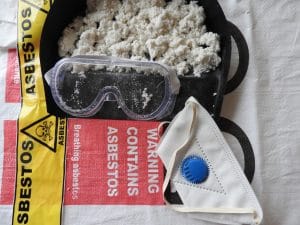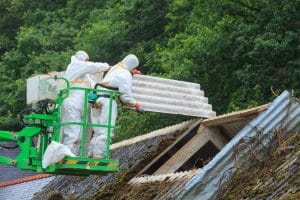
Yes, asbestos can be present in drywall systems, most often in joint compound, tape, or texture layers rather than the gypsum board itself. Historically, these finishing products contained about 3–15% chrysotile asbestos by weight, and pre-1980 walls deserve professional sampling before renovation or demolition.
You may be asking because a contractor is opening a wall in a Los Angeles bungalow, a commercial tenant improvement is about to begin, or a real estate inspection has raised a concern about original finishes. The wall may look ordinary, clean, and recently painted. That appearance doesn't answer the question.
The practical issue is that “drywall” often describes an entire finished wall system, not just the gypsum panel. The material that creates the seams, covers fasteners, smooths patches, and forms texture may be older than the visible paint. For homeowners, general contractors, property managers, developers, and facility teams, that distinction determines whether asbestos testing should occur before work begins.
Table of Contents
- Why the Question Is More Than It Seems
- What a Drywall Wall System Looks Like
- When Asbestos Was Used in Drywall Finishes
- How On-Site Decisions Are Actually Made
- What Professional Asbestos Testing Involves
- Los Angeles Area Rules That Trigger Testing
- A Practical Decision Framework for Property Owners
- Frequently Asked Questions and Next Steps
Why the Question Is More Than It Seems
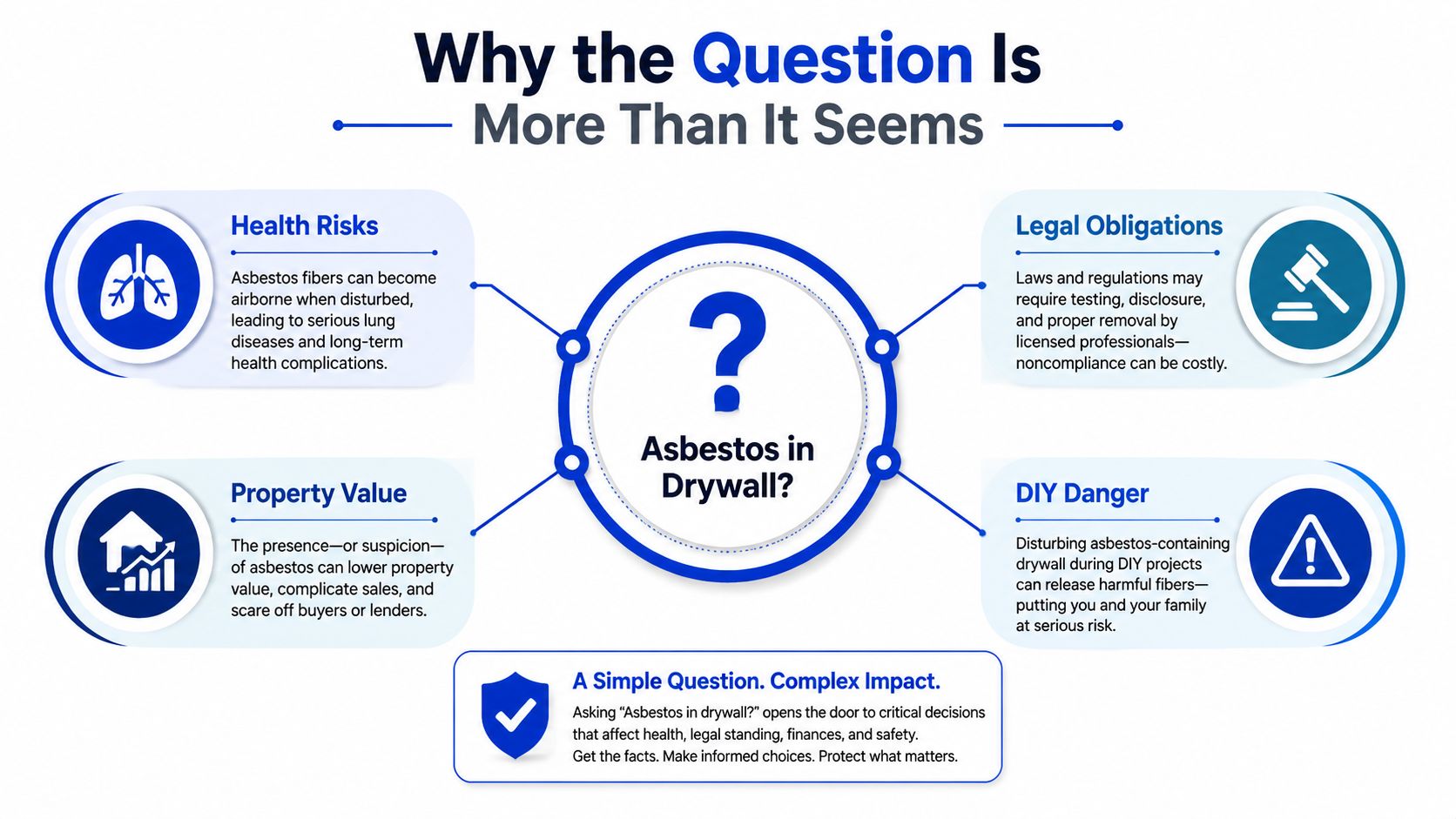
A homeowner sees a sheet of drywall. An environmental professional sees several materials assembled into one surface. The gypsum panel may be asbestos-free, while the joint compound spread across its seams or the texture applied over it contains chrysotile. That's why the answer to can asbestos be in drywall is yes, but the more useful question is, “Which part of the wall system could contain it?”
A 1960s bungalow undergoing electrical work is a straightforward example. The electrician may cut through a wall, but the renovation can also disturb seam compound, corner treatment, screw-covering mud, or a skim coat. A commercial tenant improvement creates the same issue on a larger project scale. A Notice to Comply, a property transaction, or planned demolition can turn an informal concern into a documentation requirement.
Think of the wall as a finished system
The gypsum board is the structural surface you recognize. The compound and texture are the “filling” between and over the panels. Historically, that filling carried much of the asbestos concern. A major review found that drywall finishing products, including joint compound, texture, and tape, historically contained approximately 3–15% chrysotile asbestos by weight (asbestos drywall history and material guidance).
That history explains why a newer-looking wall can still deserve investigation. New paint can cover an old layer, and newer board can be installed over older finishes. Visual inspection can identify construction features and likely disturbance areas, but it can't confirm asbestos content.
Practical rule: If renovation will disturb seams, patches, texture, or skim coats in an older building, treat identification as a laboratory question, not a visual one.
This principle applies across Los Angeles County and Southern California, whether the property is a single-family home, apartment building, school, hospital, office, retail space, or industrial facility. A professional asbestos survey gives the project team information before cutting, sanding, demolition, or other disturbance begins.
What a Drywall Wall System Looks Like
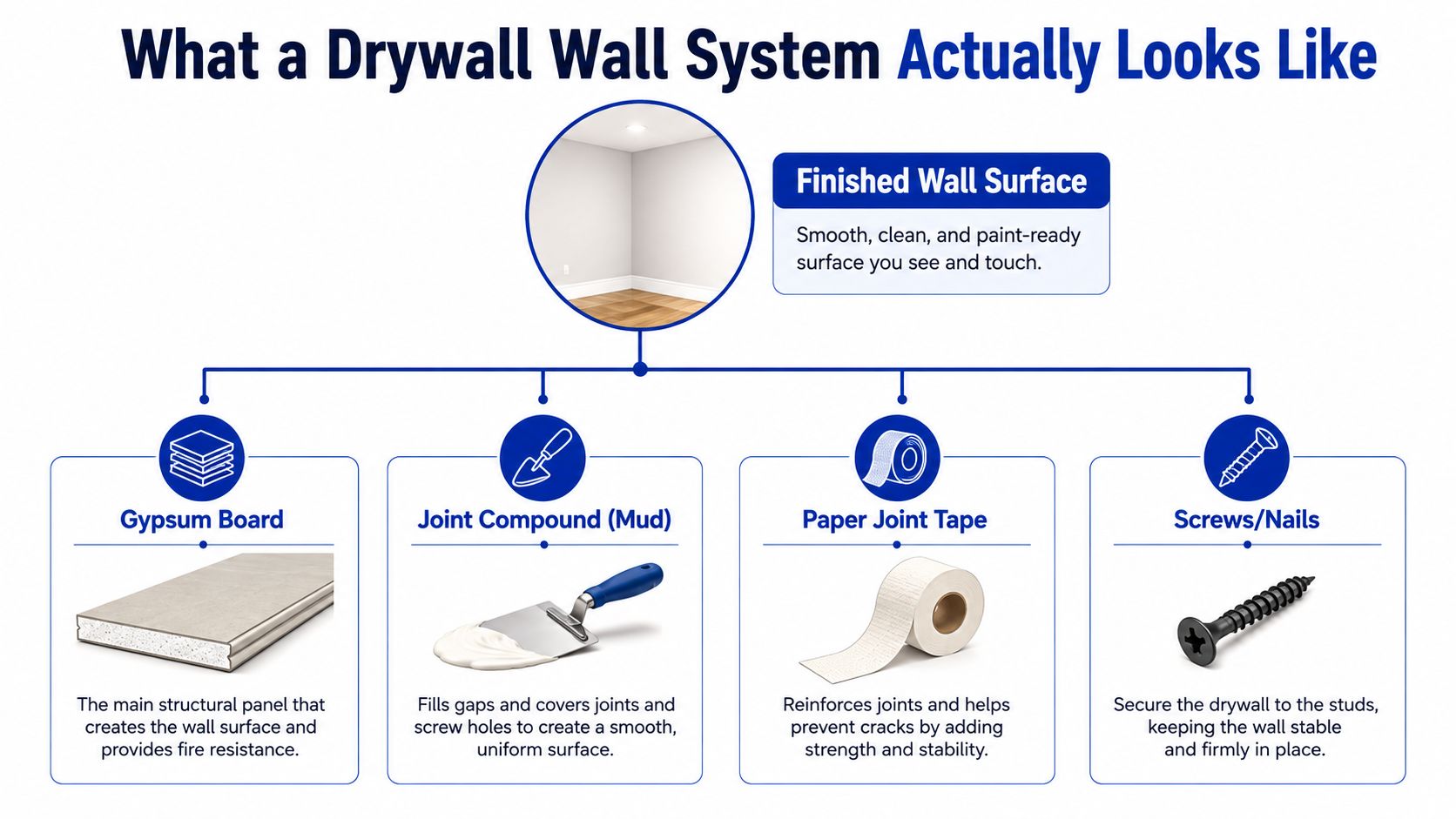
A wall is better understood as a finished system, not a single material. The gypsum board provides the broad surface, while several finishing layers create the continuous plane that receives paint. Each layer serves a different purpose, so renovation planning may require more than one sampling decision.
The gypsum board is the large panel fastened to wall framing. It contains a gypsum core with a paper face. The board itself was less often the primary asbestos concern than finishing materials, but the complete assembly still matters when the layers function together.
The joint compound, often called mud, covers panel seams, screw and nail heads, corners, and repairs. Workers can apply several coats before sanding or smoothing the surface. Older compound is a key sampling target because asbestos was historically used in drywall finishing products, including joint compound, texture, and tape (drywall product history and asbestos context).
The layers that matter during renovation
Paper or mesh tape reinforces the joints between panels. Because it may sit beneath compound, a sample taken only from the visible surface can miss it. Texture may be sprayed, rolled, or applied by hand. Later paint or skim coats can conceal older texture, leaving several materials bonded together below a uniform-looking finish.
For example, a remodeler opening a wall in an older building may see only modern white paint and smooth drywall. Beneath it could be a newer skim coat, an older texture layer, and original seam compound at the panel joints. The finished surface looks consistent because the layers have been sealed together over time. Sampling therefore needs to reflect the wall's construction history, not just its current appearance.
Why disturbance changes the question
An intact wall presents a different project question than one being sanded, scraped, drilled, cut, or demolished. Renovation work commonly disturbs seams and finished surfaces, so those areas deserve attention during planning. EPA guidance treats wallboard and joint compound as components of one wall system and recommends evaluating multilayer materials together where appropriate (EPA guidance for sampling multi-layered wall systems).
A visual review can show where work will occur, but it cannot confirm asbestos content. Reliable information about the materials in the disturbance area helps the project team choose appropriate next steps.
When Asbestos Was Used in Drywall Finishes
A remodeler may open an older wall and find modern paint over several hidden layers. Original joint compound could sit beneath a skim coat, texture, or later repair. The surface may look uniform, while the materials underneath reflect different construction periods. For that reason, the drywall board itself is only part of the question. Finishing materials, especially joint compound, texture, and tape, deserve separate attention.
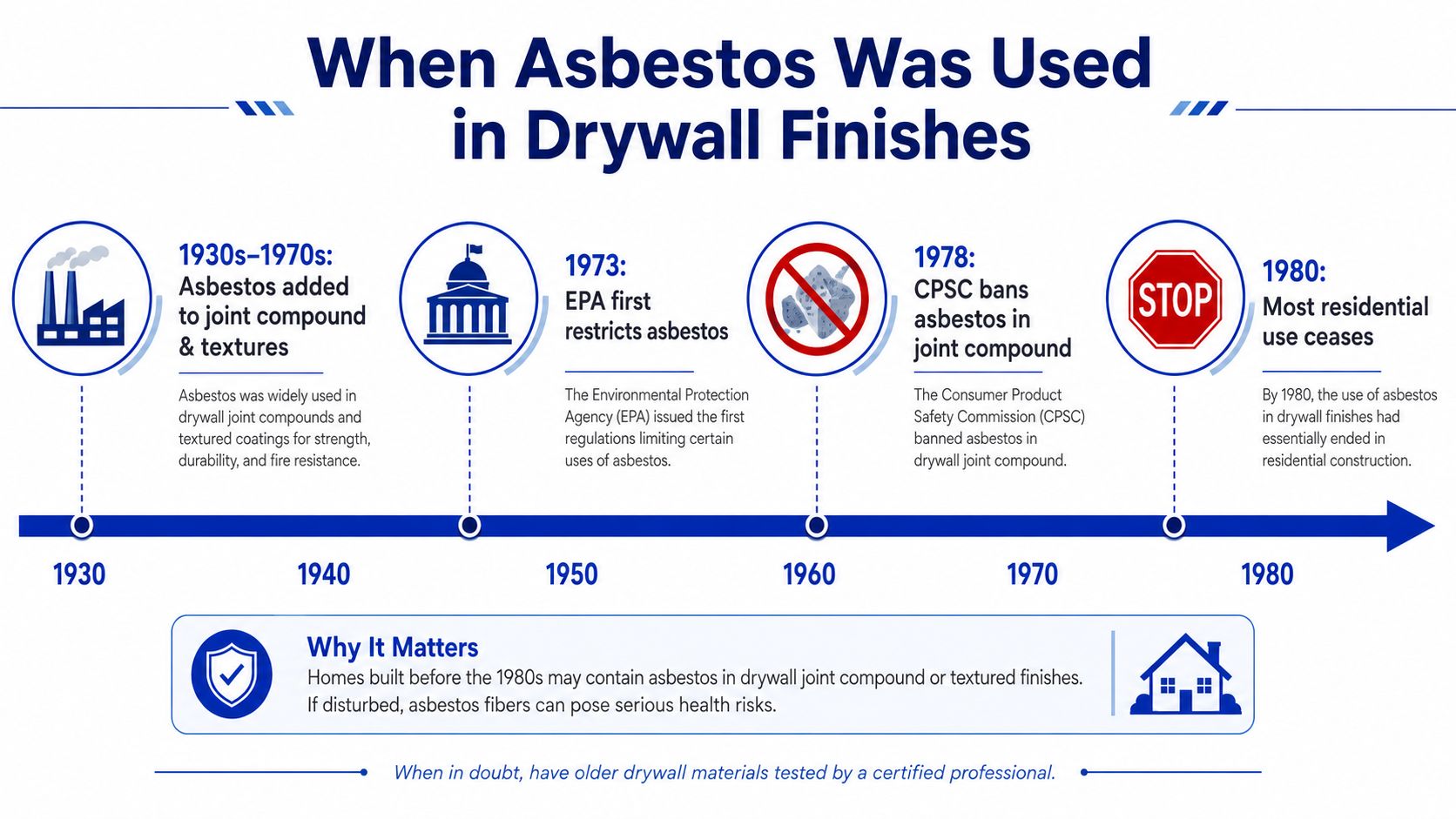
The main historical period for asbestos-containing drywall finishing products extended from the mid-1940s through the late 1970s. During that period, joint compounds, textures, and tape could contain chrysotile asbestos (historical drywall finishing material review).
The 1977 U.S. Consumer Product Safety Commission ban prohibited consumer wall-patching compounds containing respirable asbestos fibers, including joint compounds and drywall tape used in residences, schools, hospitals, and other public buildings (regulatory history of asbestos in drywall products). The change reduced asbestos use in newly manufactured consumer patching products. It did not remove products already installed in buildings.
A practical timeline for Los Angeles properties
Construction records can identify when a property was built, but they may not document later repairs. Original compound may remain beneath newer finishes, while undocumented patching can add materials of a different or unknown age. Homes built before 1980 warrant particular attention because asbestos may occur in many construction materials.
The EPA's 1989 final rule banned most asbestos-containing products, and a 2024 EPA action focused on chrysotile asbestos shows that regulatory development continued after the 1970s (EPA asbestos regulatory information). These milestones do not provide a visual cutoff for a specific wall. Paint color, surface condition, and a contractor's assumption cannot establish the material's contents.
For Los Angeles-area renovation work, the practical trigger is disturbance. SCAQMD Rule 1403 and Procedure 5 can make asbestos evaluation relevant when renovation affects suspect materials, including joint compound and texture layers. The board may be newer while the finishing layers are older, so compliance planning must follow the materials that will be disturbed.
Why age is a screening factor, not a verdict
A pre-1980 building deserves closer review when original walls, ceilings, patches, or textures will be disturbed. Field guidance may also treat pre-1990 drywall systems conservatively during renovation when records are incomplete, without treating that practice as a universal legal cutoff (conservative field guidance for older drywall systems).
Age identifies a reason to investigate. It does not identify asbestos by itself. Properly collected samples and laboratory analysis are needed to determine whether asbestos is present in the materials included in the project scope.
How On-Site Decisions Are Actually Made
A wall's appearance provides limited evidence. Fresh paint may cover original compound, new gypsum board may sit over an older wall, and a patch may contain a different product from the surrounding surface. An experienced inspector therefore maps the proposed disturbance area first, then identifies which layers could be affected.
The analytical question also matters. EPA guidance states that when a valid analysis of a homogeneous material shows more than 1% asbestos, the material is regulated. The guidance also says concentrations shouldn't be averaged across separate materials to dilute a result (EPA asbestos analytical interpretation guidance).
Homogeneous materials and composite sampling
A homogeneous material is a material that appears consistent in composition and application. A joint compound layer, texture layer, or patching product may each require separate consideration. Where layered wall materials are treated as one wall system, sampling must follow the applicable analytical approach rather than combining unrelated materials because they occupy the same wall.
A thin seam layer can contain a relatively small amount of asbestos by weight across the full wall assembly and still matter when tools disturb that seam. The question isn't whether the layer looks substantial. The questions are whether asbestos is present, whether the material is regulated, and whether the planned activity will disturb it.
The laboratory result answers “is it present?” The project scope answers “does it affect the work?” Owners need both answers before demolition or renovation proceeds.
Why this isn't a DIY decision
A contractor may recognize old texture or suspect joint compound, but recognition isn't identification. A home test kit can also encourage a person to scrape, drill, or break a sample without controlling dust or capturing every relevant layer. That approach can miss asbestos in tape or compound while creating an unnecessary disturbance.
Facility managers planning broader industrial hygiene work may also need to consider related hazards, such as respirable crystalline silica generated by cutting gypsum products. For a useful discussion of silica exposure limits and facility management concerns, review Facility Management Insights silica safety. Silica and asbestos are different hazards, so one test can't substitute for the other.
What Professional Asbestos Testing Involves
Professional testing begins with the planned work, not with a random scrape from the most noticeable patch. The inspector reviews the building's age, renovation history, drawings when available, and the exact areas that will be cut, sanded, removed, or otherwise disturbed.
From walkthrough to sample plan
The walkthrough may identify:
- Seams and fastener locations: Joint compound over panel joints and screws can be sampled where work will occur.
- Texture and skim coats: Surface layers may be sampled separately when they differ in appearance, age, or composition.
- Patches and repairs: A repair can represent a different product from the original wall finish.
- The gypsum panel: The board itself may be included when its composition is uncertain or the project will remove the panel.
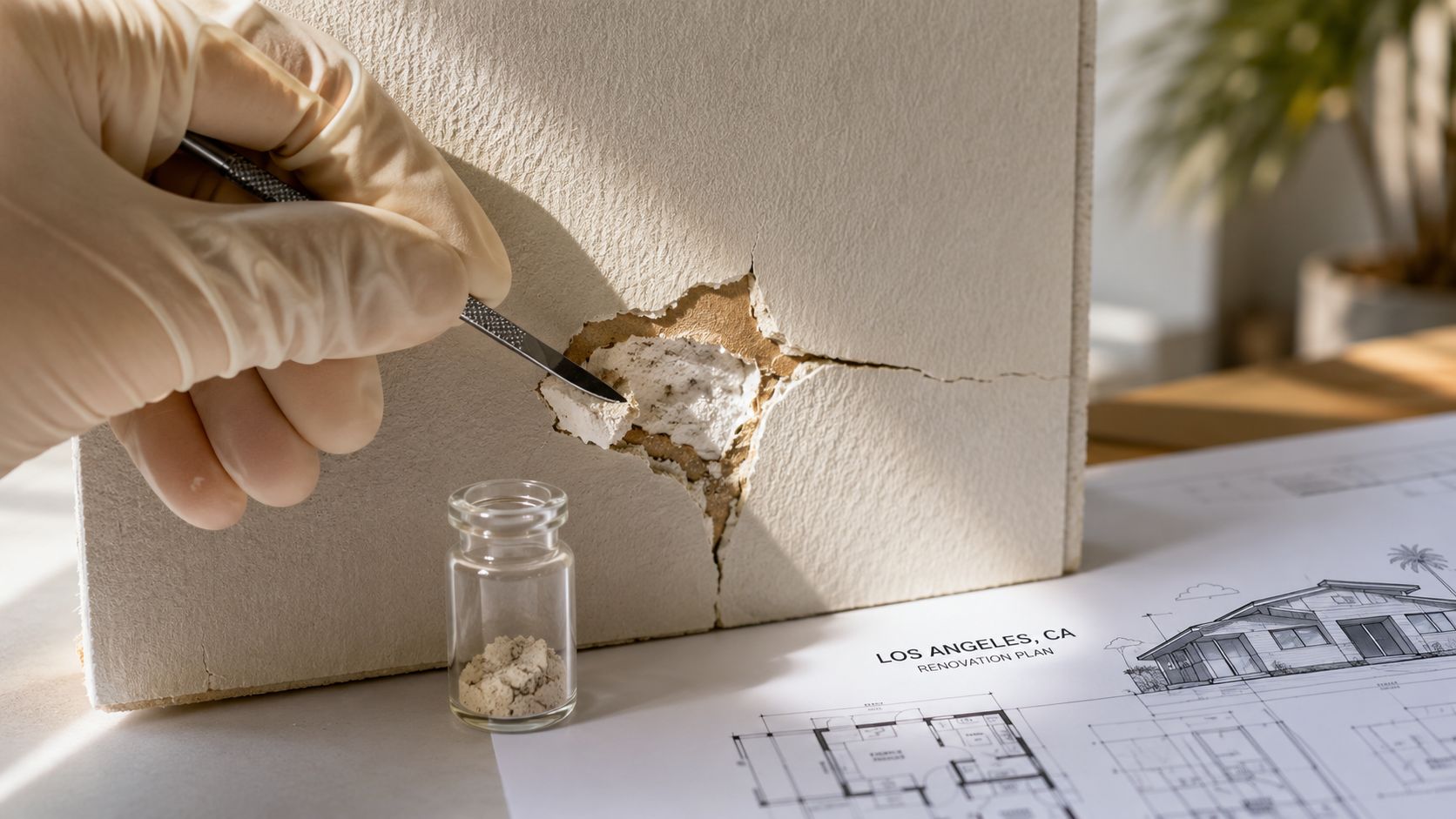
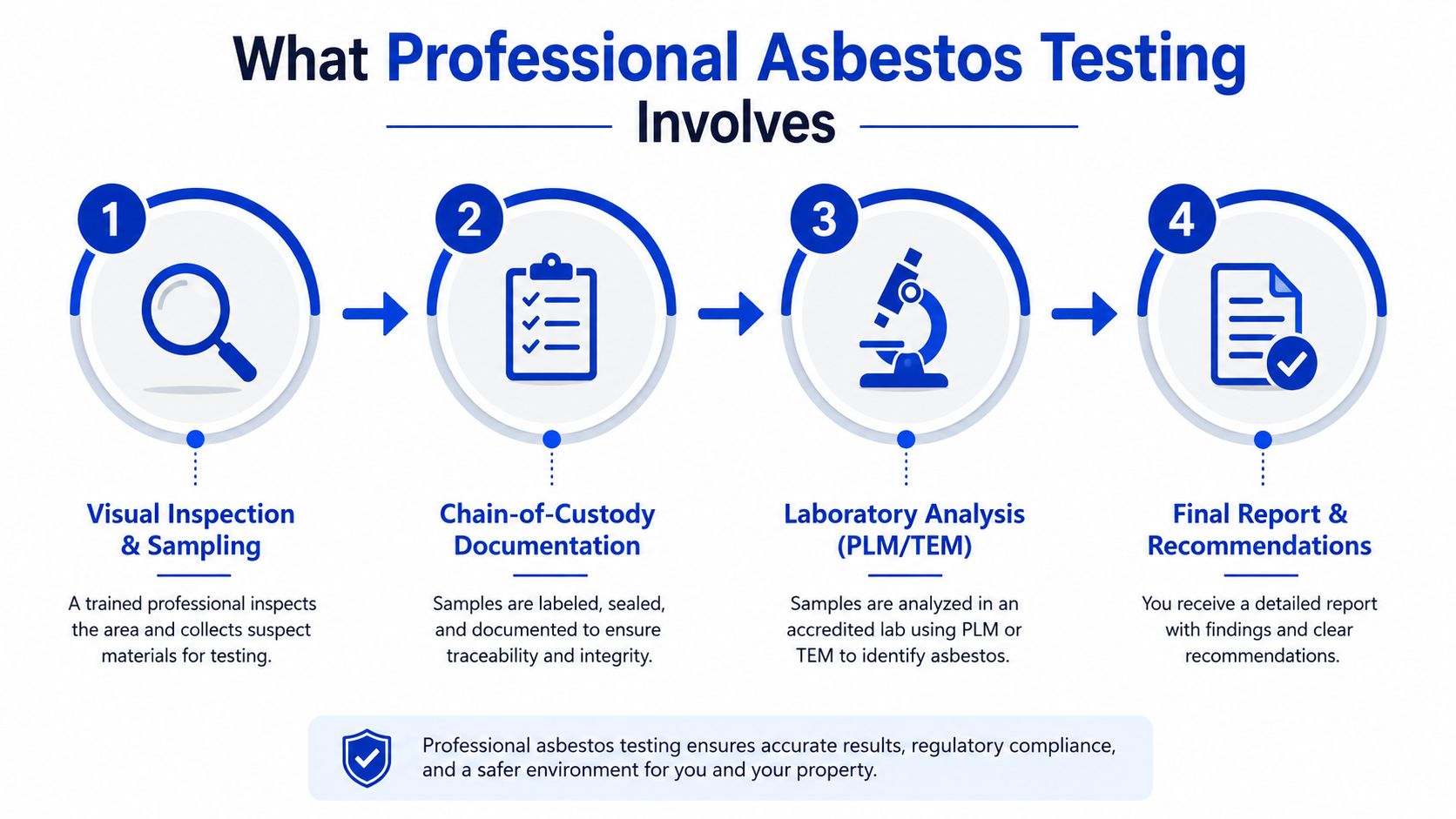
Sampling is intentionally limited and controlled. The inspector may remove a small chip or collect a small core that includes the relevant layers. The area can then be covered, leaving the project with a documented sample location rather than an open defect.
Why documentation matters
Each sample should be identified by location and material description. The chain of custody records who collected, transferred, and received the sample. An accredited laboratory then analyzes the material, commonly using polarized light microscopy for asbestos identification, with the laboratory report tied back to the sample labels and site locations.
Sensitive Environmental provides asbestos testing in Los Angeles for residential and commercial projects requiring inspections, targeted sampling, laboratory analysis, and reporting. The appropriate scope depends on the property, materials, and planned disturbance, so one sample shouldn't be presented as a universal answer for an entire building.
Professional sampling versus a kit
DIY kits may offer access to a laboratory, but they don't replace an inspection. The person collecting the sample still has to select the correct material, include all relevant layers, avoid cross-contamination, and document the location accurately. A poor sample can produce false reassurance, while an uncontrolled scrape can spread dust.
The same principle applies when mold or indoor air quality concerns appear alongside drywall work. For separate water-damage concerns involving HVAC systems, a practical guide to mold in AC vents can help readers understand why visual checks alone may not resolve an environmental question. Mold testing, lead testing, VOC testing, and airborne contaminant assessments each require their own sampling logic and laboratory methods.
The final report should state what was sampled, where it was collected, what the laboratory found, and what limitations apply. It supports project planning and compliance. It doesn't promise that every material outside the sampled scope has the same composition.
Los Angeles Area Rules That Trigger Testing
For Los Angeles-area renovation and demolition work, asbestos surveying is often a formal compliance step. SCAQMD Rule 1403 requires the affected facility or facility components to be thoroughly surveyed before demolition or renovation begins, including inspection, identification, quantification of friable and Class I and Class II non-friable asbestos-containing material, and physical sampling where required (SCAQMD Rule 1403).
That requirement changes the contractor's sequence. The team shouldn't start demolition and ask questions after materials are exposed. The survey and laboratory documentation belong in the planning stage, before the activity that could disturb suspect materials.
Procedure 5 and the documentation package
SCAQMD Procedure 5 guidance identifies several components of a submission:
- Completed notification: The agency receives the required project information.
- Site survey report: The report documents suspect material sampling and laboratory analysis.
- Procedure 5 cleanup plan: The planned response work is described.
- Chain of custody and laboratory report: The analytical record supports the findings.
This documentation demonstrates why a verbal statement such as “the drywall looks new” isn't enough for a regulated project. The report connects field observations, sample locations, laboratory results, and project scope. SCAQMD's Procedure 5 guidance explains the supporting materials expected in the formal process.
Common LA triggers for asbestos drywall testing
| Trigger | Why It Matters | Relevant Rule or Context |
|---|---|---|
| Planned renovation | Seams, patches, texture, and board may be disturbed | SCAQMD Rule 1403 |
| Planned demolition | The affected facility must be surveyed before work begins | SCAQMD Rule 1403 |
| Procedure 5 project | The submittal depends on survey and laboratory records | SCAQMD Procedure 5 |
| Notice to Comply | The agency notice can create a defined documentation timeline | Local compliance response |
| Real estate transaction | Known environmental conditions may require organized disclosure and due diligence | Property documentation and transaction review |
A Notice to Comply doesn't identify asbestos by itself. It can, however, prompt the owner or manager to obtain a defensible assessment quickly. Commercial owners, HOAs, developers, architects, and general contractors can also review California asbestos real estate disclosure guidance when asbestos information becomes part of a property transaction.
A Practical Decision Framework for Property Owners
Use the building's history, the planned disturbance, and the documentation requirement together. No single factor proves asbestos is present, but several factors can make professional testing the responsible next step.
Call for an assessment when
- The building predates 1980: Original compound or texture may remain in place (older home asbestos guidance).
- The work affects finished surfaces: Cutting, sanding, scraping, drilling, patching, or removing walls can disturb more than the gypsum panel.
- The project falls under Rule 1403: A pre-renovation or pre-demolition survey may be a compliance requirement.
- Records are incomplete: Unknown construction dates, undocumented repairs, and layered finishes increase uncertainty.
- Fire or water damage changes the scope: Gutting damaged walls can disturb multiple materials, so asbestos testing may belong alongside mold, lead, indoor air quality, or combustion byproduct assessments.
- A Notice to Comply has been issued: The owner needs an organized inspection and report rather than an informal opinion.
An experienced inspector may determine that sampling isn't necessary for a specific material when reliable documentation demonstrates that the material is newer and outside the suspect scope. That decision should be tied to evidence and the planned work, not just a visual impression.
What the result can and can't establish
Testing identifies asbestos in the materials sampled and helps qualified professionals plan appropriate next steps. It can support SCAQMD documentation, contractor coordination, real estate due diligence, and project scheduling. It doesn't certify an entire property when only a limited area was sampled, and a positive result doesn't automatically mean that one response applies to every room.
A test result is a decision tool. It identifies the material and supports the next professional judgment.
For help interpreting a finding in the context of a transaction or inspection report, property owners can review what to do when asbestos is found on a real estate inspection. The next step may involve scope revision, additional sampling, regulatory documentation, or coordination with qualified parties. Testing itself isn't removal, abatement, cleanup, or a guarantee that every condition in a building has been evaluated.
Frequently Asked Questions and Next Steps
Can a small patch be tested? Yes. An inspector can target the patch, adjacent compound, texture, or underlying layers when the planned work makes them relevant.
Does one positive sample mean the whole house is affected? Not automatically. The result applies to the material represented by that sample and must be interpreted alongside material homogeneity, locations, and project scope.
What if renovation has already started? Pause disturbance and arrange professional assessment before continuing. The inspector can determine whether additional sampling or documentation is needed.
How long do results take? The schedule depends on the laboratory and project requirements, so confirm turnaround before work is scheduled.
If you're planning renovation, demolition, a Los Angeles real estate transaction, or responding to a Notice to Comply, contact Sensitive Environmental to discuss a professional asbestos survey or targeted drywall sampling. Ask for reporting that supports the documentation needs of SCAQMD Rule 1403 and Procedure 5.
Sensitive Environmental provides asbestos inspections, surveys, targeted sampling, laboratory analysis, and clear reporting for homeowners, contractors, property managers, and commercial clients throughout Los Angeles and Southern California. Visit Sensitive Environmental to schedule pre-renovation asbestos testing or discuss the right drywall sampling scope for your project.