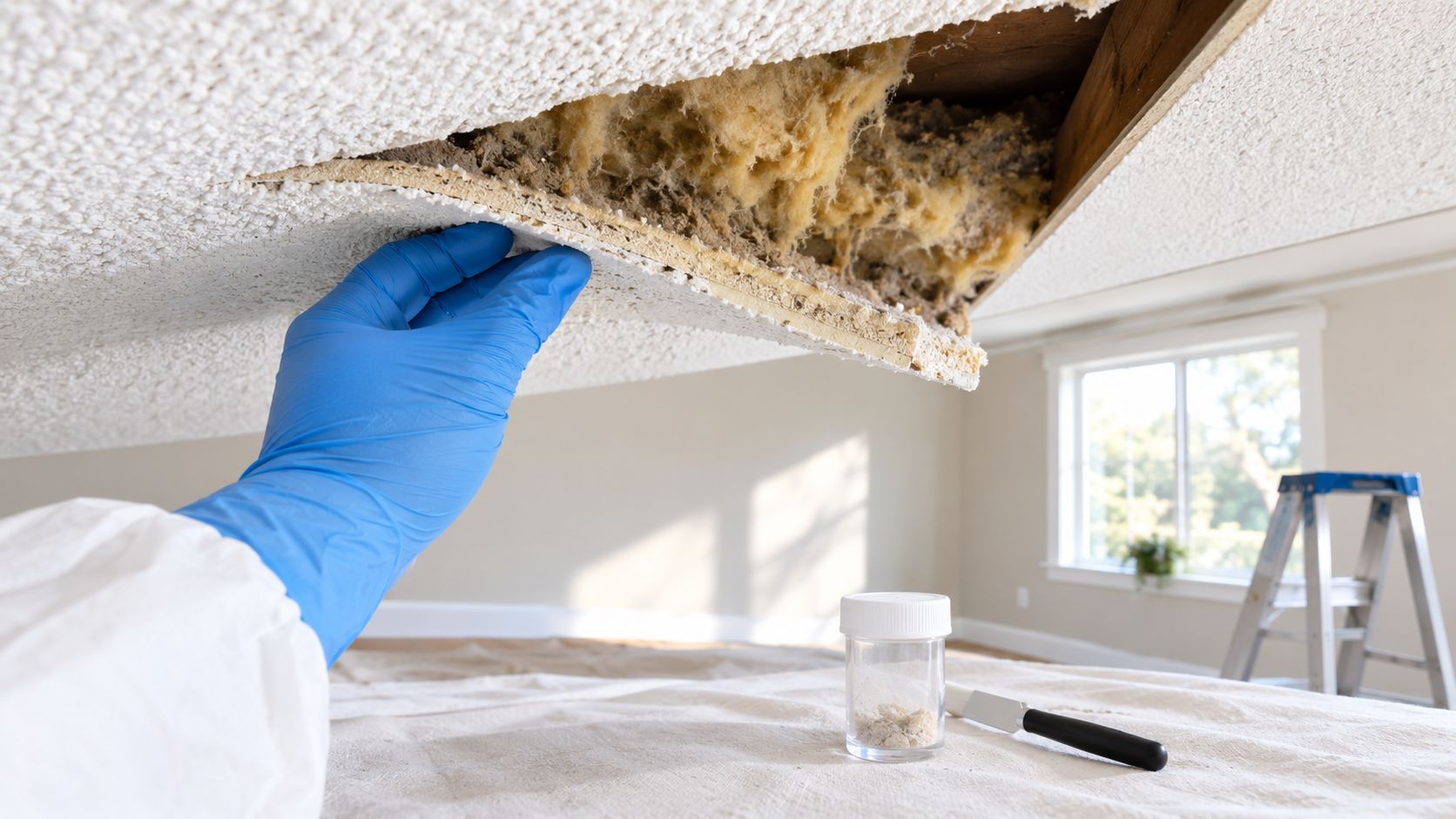
A Los Angeles homeowner is ready to renovate a kitchen. During preparation, a contractor lifts a brittle tan ceiling tile and notices settled dust in the cavity above it. The immediate question isn't whether the ceiling looks old. It's whether the material can be disturbed, what needs to be sampled, and which documentation the project requires before work continues.
That decision matters in homes, offices, schools, retail buildings, and other older properties throughout Southern California. Asbestos in ceilings may be present in ceiling tiles, textured coatings, joint compounds, or other layered materials, and appearance alone can't confirm its presence. The practical answer comes from a properly planned inspection, controlled sampling, accredited laboratory analysis, and a report that matches the project's regulatory needs.
Table of Contents
- Why Ceiling Asbestos Still Matters Today
- Common Asbestos-Containing Ceiling Materials
- How Ceiling Asbestos Becomes a Health Risk
- How Professional Ceiling Asbestos Testing Works
- SCAQMD Rule 1403 and Compliance in Los Angeles
- Professional Testing Versus DIY Approaches
- When Ceiling Asbestos Testing Becomes Necessary
- Next Steps After Your Ceiling Survey Results
Why Ceiling Asbestos Still Matters Today
Asbestos was widely used in ceiling tiles and acoustic ceiling materials from roughly the late 1940s through the late 1980s, with especially heavy production from the late 1940s through the late 1970s. One industry estimate places the remaining asbestos content in 5% to 10% of U.S. ceiling tiles, while some materials installed before the 1980s may contain 1% to 3% asbestos, often amosite, according to this overview of asbestos in ceiling tiles.
That doesn't mean every older ceiling contains asbestos. It means a property owner can't make a dependable renovation decision from color, texture, or age alone. Many older materials remain in place, including materials above suspended ceilings and behind later finishes.

The disturbance is the decision point
An intact ceiling may not create the same exposure concern as one that's being drilled, scraped, sanded, cut, broken, or removed. A renovation can change the situation quickly. Installing recessed lighting, moving ductwork, opening a ceiling for plumbing, or removing acoustic panels can disturb materials that had remained undisturbed for years.
Federal regulatory history helps explain why older buildings still require careful evaluation. The EPA banned spray-applied asbestos surfacing materials in 1973, and later surfacing applications were prohibited under 1978 rules, but existing inventories could still be used. As a result, popcorn ceilings and similar products continued appearing into the early 1980s, as described in the EPA's asbestos protection actions.
Practical rule: Don't treat an old ceiling as confirmed asbestos, and don't treat it as asbestos-free. Treat it as an unverified material until qualified sampling and laboratory analysis provide an answer.
For a Los Angeles property owner, the first questions are straightforward:
- What material will the work disturb?
- Does the survey need to cover only the renovation area or the whole structure?
- Who will collect the sample and prepare the report?
- Will the results support contractor planning and SCAQMD compliance?
Those questions are more useful than trying to identify asbestos from a photograph.
Common Asbestos-Containing Ceiling Materials
Several ceiling products deserve attention during an environmental inspection. Their appearance can guide sampling, but it can't replace laboratory confirmation.
Textured and popcorn coatings
Spray-applied popcorn, stippled, and textured finishes were used extensively in older construction. A white, tan, gray, or painted surface may look similar to a product that contains no asbestos. Paint can also conceal the original texture, while later repairs may create multiple layers with different compositions.
Acoustic ceiling tiles
Suspended acoustic tiles may contain asbestos in the tile body, backing, adhesive, or related materials. A tile that looks intact from the occupied room may have deteriorated edges, water damage, or dust in the plenum above it. Removing a panel to reach wiring or mechanical equipment can expose material that had previously been contained by the ceiling system.
Joint compounds and patching materials
Asbestos may be present in more than the visible ceiling texture. Joint compounds, patching compounds, and repair materials can occur around seams, penetrations, light fixtures, and old patches. Sampling only the most obvious texture may miss a separate homogeneous material that the project will also disturb.
Plaster and layered ceiling assemblies
Older plaster ceilings, skim coats, and repaired areas may contain different materials installed during different construction or renovation phases. A building's construction date provides context, but a later remodel can introduce new materials, and an earlier layer may remain underneath.
| Material Type | Typical Era | Visual Cues | Friability |
|---|---|---|---|
| Textured or popcorn coating | Older buildings, especially materials installed before the early 1980s | Bumpy, stippled, sprayed, painted, or layered surface | Varies with binder, age, damage, and moisture |
| Acoustic ceiling tile | Older suspended-ceiling systems | Mineral-like panel, perforated surface, backing, or brittle edge | Varies by tile construction and condition |
| Joint compound or patching material | Older drywall and repair work | Seams, fasteners, patches, penetrations, and altered areas | May become more friable when scraped, sanded, or deteriorated |
| Plaster or layered ceiling material | Older structures and remodeled interiors | Smooth or textured finish with multiple layers | Depends on the material matrix and condition |
The only reliable way to determine whether a ceiling material contains asbestos is qualified sampling followed by laboratory analysis. The guide to testing asbestos in a popcorn ceiling also reflects the central point for property owners: visual inspection can identify suspect areas, but it can't confirm composition.
How Ceiling Asbestos Becomes a Health Risk
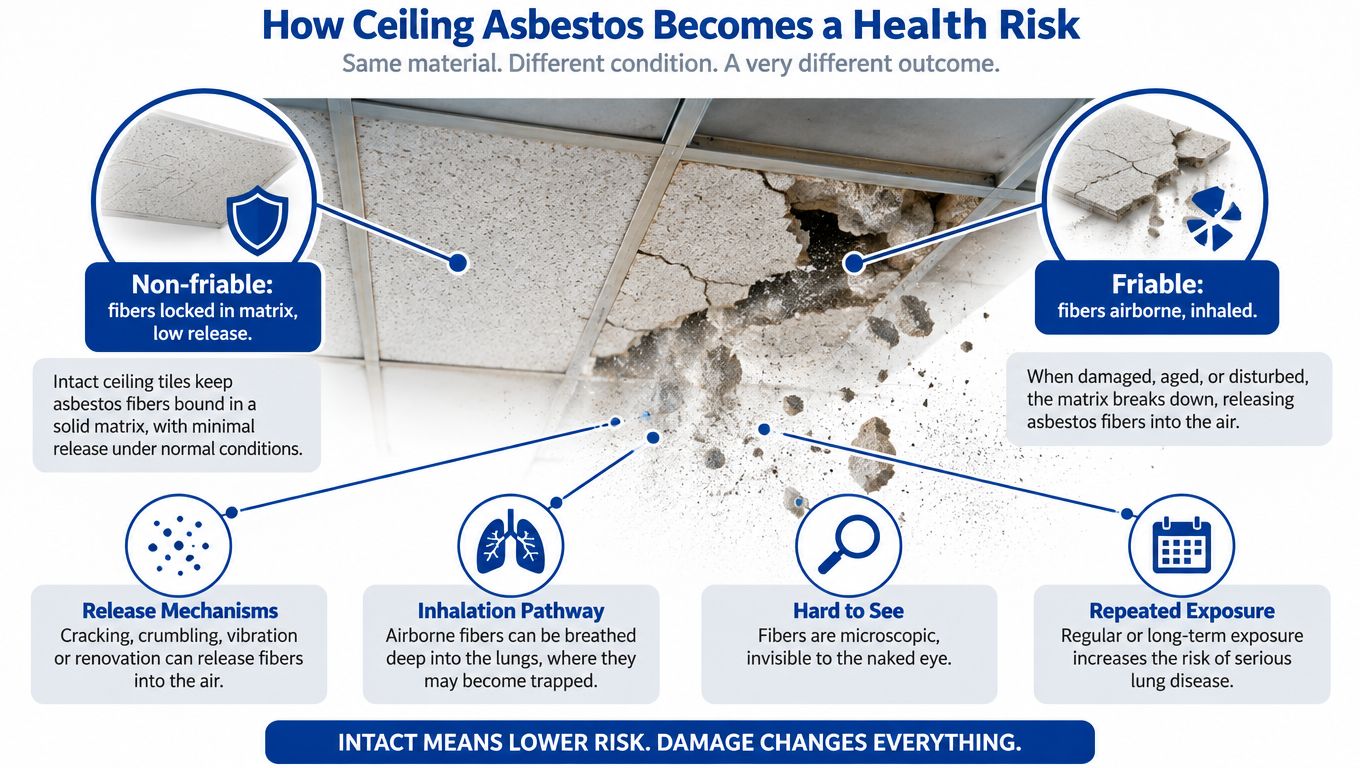
The important distinction isn't just “asbestos present” versus “asbestos absent.” Condition and disturbance determine whether a material is more likely to release airborne fibers.
A relatively stable, non-friable material holds fibers within a solid matrix. A friable material can crumble, be reduced to powder, or release fibers more readily when handled. Ceiling coatings, tiles, and troweled materials may become more friable when they're scraped, sanded, drilled, broken, or weakened by water damage.
What changes during renovation
A ceiling can remain relatively undisturbed for years, then become a source of airborne dust when a project begins. Saw blades, sanding tools, drills, pry bars, and hand pressure can fracture the material. Even removing suspended panels for access may disturb material above the ceiling plane.
Water damage adds another concern. Staining, sagging, delamination, peeling, and crumbling can indicate that a ceiling assembly has lost stability. The presence of a stain doesn't prove asbestos, but it does justify stopping unplanned disturbance and evaluating the affected materials.
The occupational safety guidance on asbestos materials describes the practical relationship between friability and disturbance. Intact material may present a different exposure condition from material that's damaged or actively being handled.
Why visual concern isn't enough
A property owner may see dust and assume asbestos, or see a smooth painted surface and assume there's no concern. Neither conclusion is reliable. Dust may come from ordinary construction materials, while asbestos-containing material may be hidden beneath paint or a later finish.
Testing helps separate three questions:
- Composition: Does the sampled material contain asbestos?
- Condition: Is it intact, deteriorated, or damaged?
- Project impact: Will the planned work disturb it?
The result doesn't automatically dictate removal or another particular response. It gives the owner, contractor, consultant, and applicable agency the information needed to choose appropriate next steps.
How Professional Ceiling Asbestos Testing Works
A professional ceiling asbestos assessment starts before anyone collects a piece of material. The inspector reviews the building's age, renovation history, available plans, and the work scope. A kitchen remodel requires a different sampling plan from a whole-building demolition or a commercial tenant improvement.
The inspection and sampling plan
The inspector identifies homogeneous areas, meaning materials that appear sufficiently consistent in composition and installation history to be evaluated as a group. A ceiling may require more than one sample if the visible texture, underlying joint compound, patching, adhesive, or tile type changes across the work area.
Sampling should be controlled and deliberate. A qualified professional uses appropriate protective equipment, minimizes dust, selects representative locations, and seals each bulk sample in a labeled container. The sample location, material description, and project context should be recorded so the laboratory result can be connected to a specific ceiling area.
Laboratory analysis and reporting
The sample goes to an accredited laboratory for analysis. Polarized light microscopy, or PLM, is a recognized method for identifying asbestos in bulk building materials. For compliance work in the South Coast AQMD jurisdiction, analyses must follow specified methods, including SCAQMD Method 300-91 or the PLM method identified in 40 CFR Part 763 Appendix A, Subpart F, Section 1, as stated in the SCAQMD Rule 1403 text.
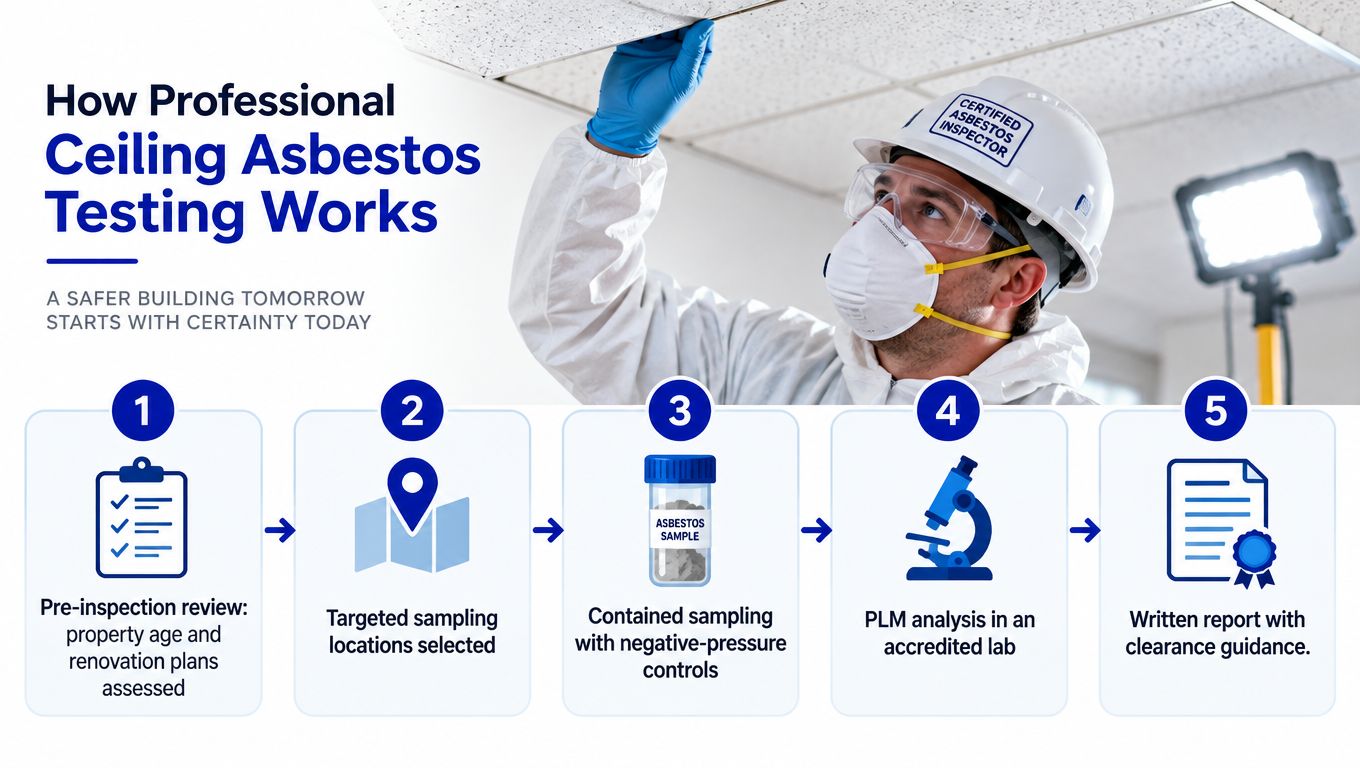
The laboratory report is only one part of a useful assessment. The consultant's written report should connect the analytical result to the sampled location, material condition, project scope, and applicable compliance requirements.
A defensible file may include:
- Property and project information, including the areas scheduled for renovation or demolition.
- Sampling records, with locations and material descriptions.
- Laboratory reports, issued by an accredited laboratory.
- Chain-of-custody documentation, showing how samples were handled.
- Condition observations, including visible damage or deterioration.
- Clear recommendations, focused on testing findings and project planning.
For property owners seeking asbestos testing in Los Angeles, the useful deliverable isn't a vague visual opinion. It's documentation that a contractor, property manager, lender, or regulatory agency can evaluate in context.
SCAQMD Rule 1403 and Compliance in Los Angeles
The South Coast Air Quality Management District, commonly called SCAQMD, regulates asbestos emissions from renovation and demolition activities in its jurisdiction, which includes Los Angeles, Orange, Riverside, and San Bernardino counties.
The compliance question is whether the planned activity may disturb suspect material. SCAQMD states that a prior asbestos survey is required before demolition or renovation under Rule 1403. The survey must be performed by a Cal/OSHA Certified Asbestos Consultant. For demolition, the survey is thorough and includes construction materials, foundations, underground utilities, and hidden or inaccessible materials. For renovation, the survey is limited to materials affected by the planned work, as explained in the SCAQMD asbestos survey requirements.
Survey scope depends on the project
A full demolition survey asks a broader question: what asbestos-containing materials exist throughout the structure and associated areas? A renovation survey asks a narrower but still important question: which materials could the specific work disturb?
That distinction matters for a commercial property manager planning a tenant improvement. Sampling the visible ceiling in one room may not address a different ceiling system, wall joint compound, pipe insulation, or hidden material affected by the same project. The survey should follow the actual scope rather than a generic checklist.
| Trigger | Threshold | Required Action |
|---|---|---|
| Demolition | The structure and associated materials are subject to the project scope | Obtain a comprehensive prior asbestos survey |
| Renovation | Materials that may be disturbed by the planned work | Obtain a renovation survey covering affected materials |
| Suspended ceiling access | Materials above the ceiling may be exposed when the interstitial space functions as an air plenum | Evaluate the ceiling system and above-ceiling materials before access |
| Damaged or disturbed asbestos-containing material | Material has been damaged or disturbed | Follow applicable SCAQMD procedures and obtain appropriate documentation |
EPA guidance treats material above a suspended ceiling as exposed when the interstitial space functions as an air plenum. It also recognizes that removing ceiling panels for access can change the exposure condition. The EPA guidance for asbestos management in buildings supports limiting unnecessary access and addressing deteriorated material through properly planned controls.
When damaged or disturbed asbestos-containing material is involved under Rule 1403, SCAQMD requires a Procedure 5 cleanup plan, and abatement may not begin until SCAQMD staff approve the plan in writing. The plan is submitted through the Rule 1403 Asbestos Notifications Web Application with the survey report and notification documents, according to the SCAQMD Procedure 5 guideline.
Professional Testing Versus DIY Approaches
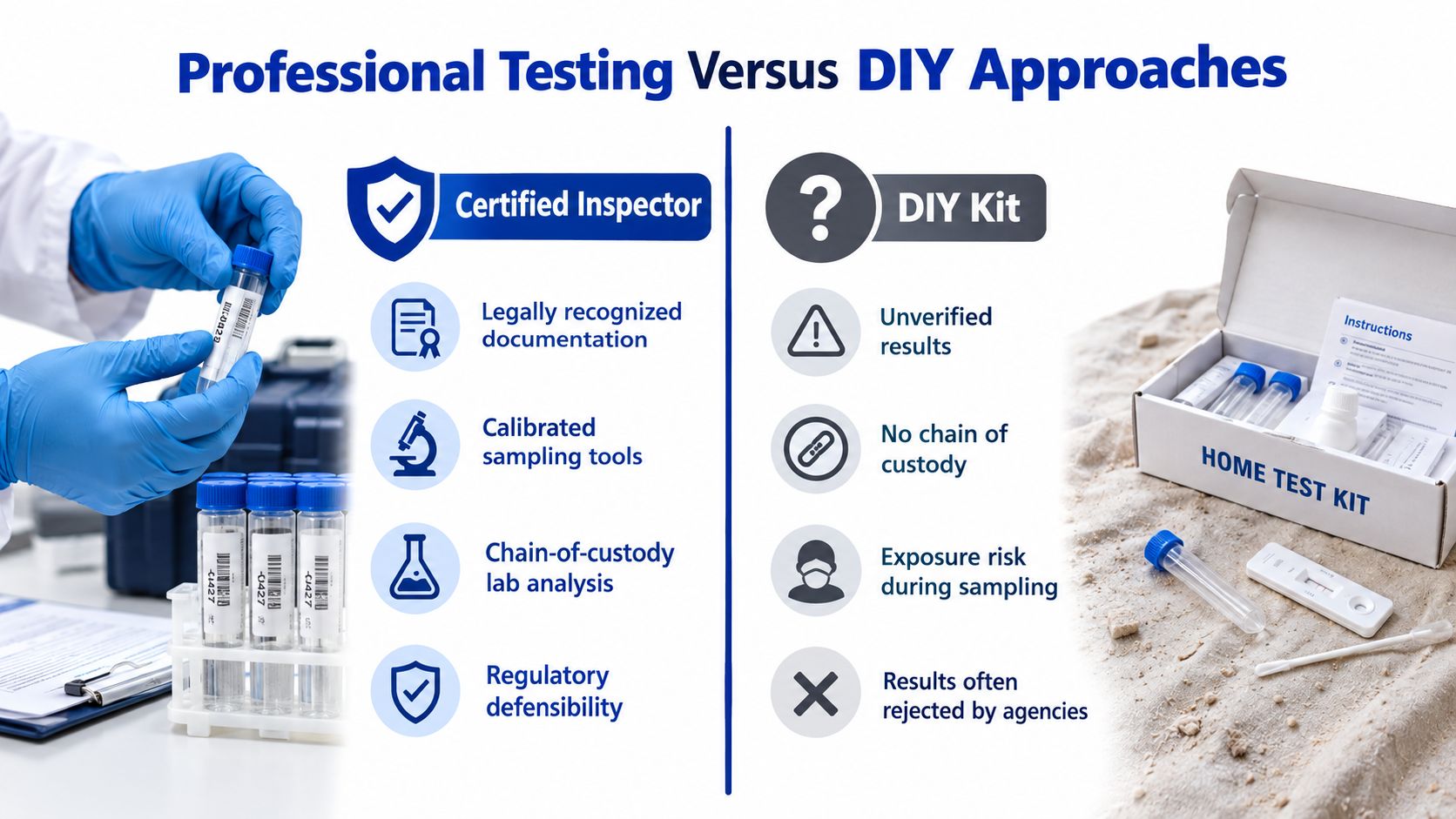
A home test kit may appear simple. The challenge is that asbestos testing isn't only about placing a material in a bag and receiving a result. Sampling location, material layers, contamination control, laboratory accreditation, documentation, and regulatory context all affect whether the report answers the project's real question.
What a professional assessment adds
A qualified inspector can evaluate the ceiling as part of the building and planned work. That includes identifying different materials, documenting condition, selecting representative samples, and explaining where the result applies.
Professional documentation may be important when:
- A contractor needs a work decision: The report identifies which surfaces can or can't be disturbed based on the sampled materials.
- A commercial project requires compliance records: The survey and laboratory analysis can be assembled into a project file.
- A property changes ownership: Buyers, lenders, and property managers may need clear due-diligence documentation.
- A regulator reviews the work: Accredited laboratory analysis and documented sampling provide a more defensible record than an informal kit result.
Where DIY testing falls short
DIY sampling can create an avoidable problem if a homeowner scrapes, drills, or breaks the ceiling without suitable controls. A poorly selected sample may also represent only one layer, while the renovation will disturb several materials.
A laboratory result can identify what was found in the submitted sample. It may not establish that every similar-looking area is equivalent, that hidden materials are free of asbestos, or that the survey meets a local project requirement.
A test result answers a material question. A professional survey answers the larger project question.
The EPA guidance on identifying asbestos in ceiling tile and other home materials states that the only way to be sure is to have suspect material tested by a qualified laboratory, with sampling performed by a properly trained and accredited asbestos professional when appropriate.
When Ceiling Asbestos Testing Becomes Necessary
The strongest reason to arrange a ceiling survey is planned disturbance. A property owner doesn't need to prove that asbestos is present before asking for an evaluation. The owner needs to determine whether the proposed work could disturb a suspect material.
Renovation and building maintenance
Arrange professional evaluation before:
- Scraping or sanding popcorn texture: Cosmetic removal can disturb the entire ceiling surface.
- Installing lighting or fans: Drilling and cutting can affect texture, drywall, joint compound, and backing materials.
- Rerouting HVAC or utilities: Access above a suspended ceiling may expose materials in the plenum.
- Repairing water-damaged areas: Peeling, crumbling, or sagging materials require condition-focused assessment before repair.
- Completing tenant improvements: A commercial survey should match the areas affected by partitions, fixtures, mechanical systems, and finishes.
A property manager should also consider testing when maintenance staff repeatedly remove ceiling panels. A material that seems contained during normal occupancy may become exposed through repeated access, especially if the surrounding materials are deteriorated.
Demolition and property transactions
Full or partial demolition requires a survey that reflects the broader structure and project scope. Renovation surveys are more targeted, but they still need to account for every material the planned work may disturb, not just the most visible ceiling finish.
Real estate transactions can create a separate reason for testing. A buyer, lender, insurer, or commercial tenant may request documentation for an older building, especially when renovation plans are already under consideration. Testing at that stage can help the parties understand what the project may involve before contracts, schedules, and construction pricing depend on unverified assumptions.
A practical decision checklist
Before authorizing ceiling work, ask:
- What will be opened, cut, drilled, scraped, sanded, or removed?
- Are there multiple ceiling finishes or visible repair areas?
- Could workers access materials above a suspended ceiling?
- Has water damage changed the material's condition?
- Does the project fall under SCAQMD renovation or demolition requirements?
- Will the report need to support a permit, contractor file, transaction, or agency review?
Voluntary testing can support due diligence and planning. Regulatory testing may be required before disturbance. Either way, the most useful time to arrange sampling is before the ceiling becomes part of the construction work.
Next Steps After Your Ceiling Survey Results
A negative laboratory result applies to the sampled material and documented scope. Keep the laboratory report, sampling records, chain-of-custody paperwork, site photographs, and consultant report with the project file. Share the documentation with the general contractor so the planned work matches the areas that were evaluated.
A positive result doesn't automatically mean that one particular response is required. If the material is intact and non-friable, the owner and qualified professionals may consider managing it in place, monitoring its condition, and documenting controls. If material is damaged or friable, the project may require coordination with appropriately licensed asbestos professionals and applicable SCAQMD procedures before disturbance.
Request a clear record of:
- Sample locations and material descriptions
- Laboratory analysis and accreditation information
- Chain-of-custody documentation
- Condition observations
- Applicable survey limitations
- Written recommendations for project planning
If a project involves damaged or disturbed material in the South Coast AQMD jurisdiction, review the Procedure 5 requirements before scheduling related work. For broader context on how post-construction environments are handled after permitted work, property teams can consult the Gmaids construction cleaning process, while keeping asbestos compliance decisions with qualified environmental and regulatory professionals. Owners should also understand how asbestos disposal documentation is handled before coordinating any regulated work.
A ceiling survey is most useful when it happens early enough to influence the scope, schedule, contractor coordination, and project records. Contact Sensitive Environmental to arrange professional asbestos sampling, a pre-renovation or pre-demolition survey, laboratory analysis, and clear reporting for a property in Los Angeles or Southern California.
Sensitive Environmental provides asbestos testing, ceiling inspections, sampling, laboratory analysis, and compliance documentation for residential and commercial properties before renovation, demolition, or maintenance disturbance. Visit Sensitive Environmental to discuss the ceiling materials, project scope, and testing records you need.