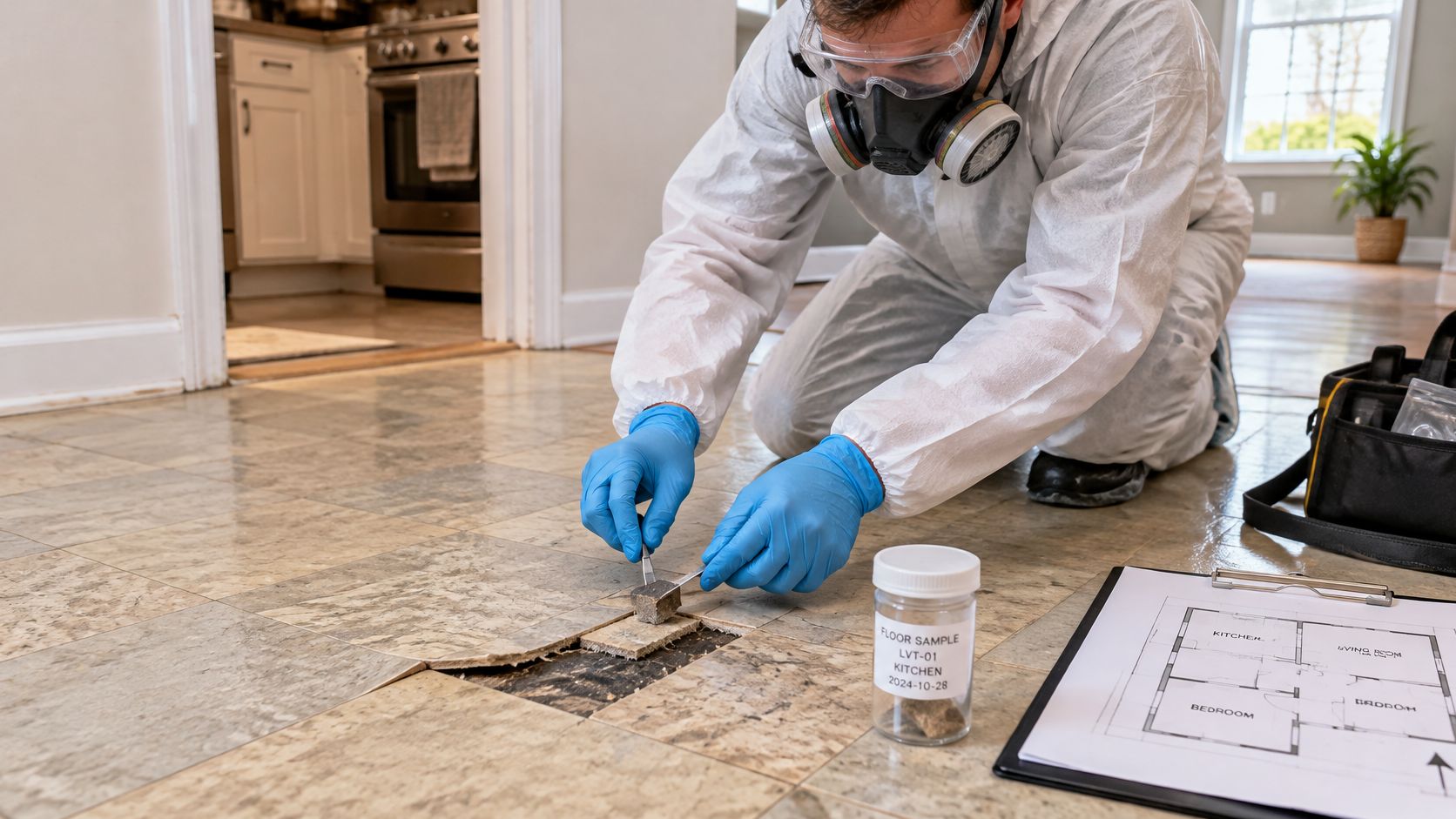
Your flooring contractor is ready to start, but a lifted edge reveals old vinyl and black adhesive beneath the surface. Before anyone brings in a scraper or grinder, you need to know what the project will disturb, not just what the top tile contains.
Asbestos floor testing starts with that work scope. For Los Angeles property owners and contractors, the important distinction is between identifying a product and documenting an entire affected assembly. A single tile chip can answer a narrow laboratory question. It doesn't automatically provide the survey needed to plan renovation or demolition.
Table of Contents
- When Asbestos Floor Testing Is Required
- How Inspectors Sample Every Floor Layer
- How Laboratories Identify Asbestos in Flooring
- What a Rule 1403 Survey Must Include
- How to Read a Floor Sample Report
- DIY Floor Sampling Versus a Professional Survey
- Floor Testing Questions Property Owners Ask
- Book Asbestos Floor Testing Before Disturbance
When Asbestos Floor Testing Is Required
Say a contractor plans to grind vinyl tile and black cutback adhesive in an older Los Angeles duplex before installing new flooring. The first step is an asbestos survey, not a trial pass with the grinder. Both the tile and the adhesive need assessment, along with any other materials the preparation work will reach.
South Coast AQMD requires asbestos testing before renovations regardless of building age. A recent-looking finish isn't an exemption, and an installation date doesn't establish what's beneath it.
When to test flooring and what the survey must cover
| Situation | Test now? | What the survey covers | Why it matters |
|---|---|---|---|
| Renovation that sands, cuts, scrapes, or lifts flooring | Yes, before disturbance | Wear layer, backing, leveling compound, and mastic toward the substrate | The affected layers need assessment, not a surface-only result |
| Demolition of a building or a portion | Yes, before notification and work | Affected floors and materials in cavities the demolition will open | A written survey is required even when some notification exemptions apply |
| Sale where the buyer will remodel | Yes, for materials the remodel will affect | Assemblies within the planned work, layer by layer | This supports project due diligence, not a whole-building safety certificate |
| Intact floor and no work planned | Usually no; document and leave it | Condition notes and photographs rather than curiosity samples | Sampling damages material; postponing testing doesn't authorize later disturbance |
| Damaged, wet, burned, or previously scraped flooring | Yes, promptly | Damaged tile or sheet flooring, backing, and exposed adhesive | Changed conditions and possible debris warrant professional assessment |
| Asphalt or vinyl in a building subject to OSHA's older-building presumption | Yes, if it will be disturbed | Flooring and associated mastic and backing | Qualified analysis is needed to rebut the presumption |
Under the OSHA inspection directive, asphalt and vinyl flooring in buildings constructed no later than 1980, including associated mastic and backing, is presumed asbestos-containing unless qualified analysis establishes otherwise. That directive also cites an EPA survey finding asbestos-containing flooring in 42% of U.S. public and commercial buildings in 1988, a historical benchmark, not a current estimate for homes.
For commercial owners, our explanation of asbestos testing before a Los Angeles commercial renovation helps connect inspection planning to the construction scope.
Keep asbestos identification separate from installation-readiness testing. Once the environmental assessment establishes how substrate access can proceed, Flacks Flooring's guide to test concrete moisture before flooring explains another question the flooring team may need to resolve. Moisture testing doesn't identify asbestos, and neither test replaces the other.
How Inspectors Sample Every Floor Layer
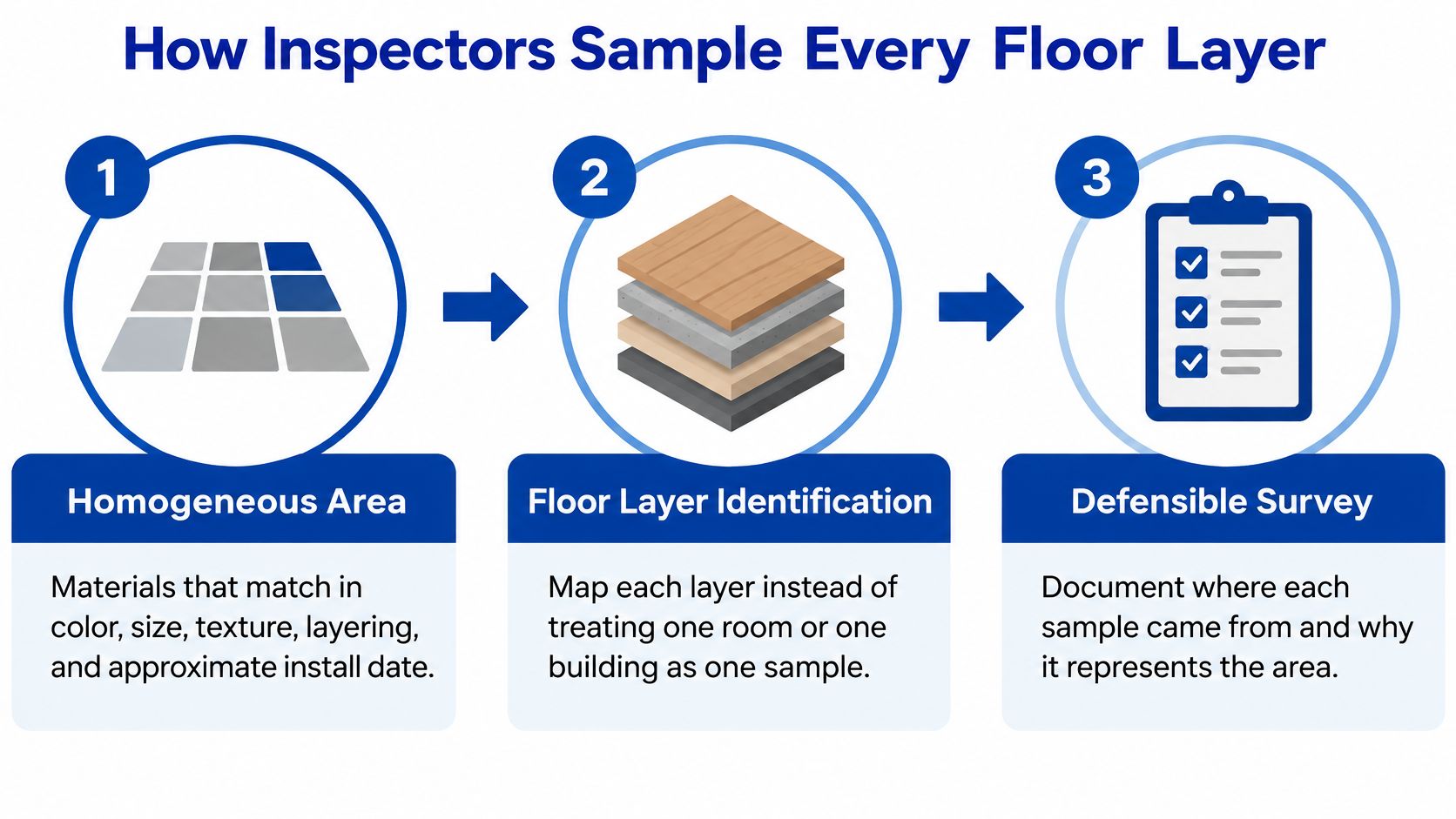
One tile chip answers one question: what does this product contain? A floor survey answers a bigger one. Which materials sit in the work area, where they lie, and in what condition.
Inspectors begin by defining homogeneous areas, materials that look consistent in color, size, texture, layering, and approximate installation history. Homogeneous areas work like paint batches: two cans labeled with the same color from different production runs still count as different material. A room boundary does not separate materials, and matching rooms do not guarantee matching flooring systems.
The field routine
- Walk the affected spaces. Check kitchens, halls, closets, and accessible covered edges. A replacement product tucked behind a doorway is easy to miss from the main room.
- Identify the separate materials. Record tile or sheet goods, paper or felt backing, leveling compound, and adhesive individually. A later patch does not automatically join the original flooring area.
- Map condition and locations. Mark damage, repairs, visible transitions, and proposed sample points on a floor plan. Without that map, a laboratory result is hard to connect back to the construction scope.
- Distribute representative samples. South Coast AQMD's proposed Rule 1403 text sets a floor of at least three samples for each homogeneous material area measuring 1,000 square feet or less, calls for additional samples as the area grows, and points to 40 CFR 763.86 for collection. The consultant confirms which requirements govern the project, since proposed language differs from an adopted rule.
- Capture the relevant assembly. Where feasible, collect material that lets the laboratory evaluate each component, not just a clean surface fragment. The NIOSH bulk-analysis procedure describes a representative laboratory portion typically weighing 1–10 grams, adjusted to the parent material.
- Control disturbance and contamination. Use appropriate dust controls, clean tools between materials, sealed labeled containers, and chain-of-custody records. Residue carried on a tool can undermine interpretation.
- Check coverage before leaving. Reconcile samples against the floor plan and work scope. An inaccessible layer is written up as a limitation on the report.
Minimum bulk samples by homogeneous floor area
Separation comes first. The minimums below apply per material once the inspector has identified each one, and under the proposed text the required count scales upward as the homogeneous area grows.
| Homogeneous area | Minimum samples | Do not combine with |
|---|---|---|
| Uniform material at or below the smaller-area threshold | At least three samples, collected from separated points | Different colors, sizes, textures, or installation eras |
| Larger homogeneous area | More than three, scaling upward with the area | Other rooms unless the material and its layers genuinely match |
| Each distinct layer in the stack | Its own homogeneous material, carrying the same per-area minimum as the tile above it | Wear layer above or mastic below |
| Black or brown mastic and paper backing | Its own samples, counted separately from the flooring they sit under | A chip containing only the clean top surface |
| Replacement patch or different tile size | A separate homogeneous area with the applicable minimum | Original field tile without supporting evidence |
A Long Beach bungalow with successive remodel layers over old mastic shows why the stack matters. A corner chip off the upper finish characterizes that finish alone, and a clean result on vinyl says nothing about the leveling compound or adhesive beneath it. The inspector leaves with labeled samples, a location sketch, photographs, and documented limitations, not a verbal all-clear.
How Laboratories Identify Asbestos in Flooring
A laboratory analyst cannot identify asbestos by eye alone. With polarized light microscopy, or PLM, the analyst first examines the bulk sample under a stereomicroscope to identify layers, assess uniformity, and locate fibrous material.
The analyst then prepares subsamples in refractive-index liquids and examines their optical properties. Polarized light, crossed polars, a compensator, and dispersion staining help distinguish fibers by shape and their interaction with light.
According to EPA supplementary analytical guidance, this approach generally classifies material as asbestos-containing above 1%, and as non-asbestos-containing when none is detected or the concentration is 1% or less. That classification isn't a guarantee of zero asbestos or permission to ignore other applicable requirements.
PLM, TEM, and air monitoring for floors
| Method | Used on | What a result means | Limit to remember |
|---|---|---|---|
| Polarized light microscopy, PLM | Bulk tile, sheet flooring, backing, and mastic | Identifies asbestos fibers and estimates concentration | Dense or organically bound matrices can obscure very thin fibers |
| Transmission electron microscopy, TEM | Often vinyl tile and other nonfriable organically bound materials after a PLM nondetect | Investigates fibers that PLM may not resolve | Appropriate preparation and interpretation still matter |
| Phase-contrast microscopy, PCM | Air samples associated with exposure monitoring | Counts airborne fibers for comparison with occupational limits | Cannot distinguish asbestos fibers from other fibers or identify an intact flooring product |
Vinyl floor tile and mastic are examples of nonfriable organically bound materials. Their binder can make fiber identification difficult, so the testing plan should address whether supplemental TEM analysis is appropriate rather than promising that every PLM nondetect settles the question.
For air monitoring, OSHA's asbestos construction requirements specify 0.1 fiber per cubic centimeter as an 8-hour time-weighted average and 1.0 fiber per cubic centimeter over a 30-minute excursion period. OSHA also distinguishes bulk identification from airborne exposure assessment and requires demonstrated analytical proficiency through recognized programs such as NVLAP or equivalent programs.
Practical distinction: A bulk sample asks what's in the material. An air sample asks about airborne fibers under the conditions sampled.
A useful laboratory report names the exact material, method, asbestos type when detected, estimated concentration, and analytical limitations. The consultant then connects those findings to the represented material and project scope.
What a Rule 1403 Survey Must Include
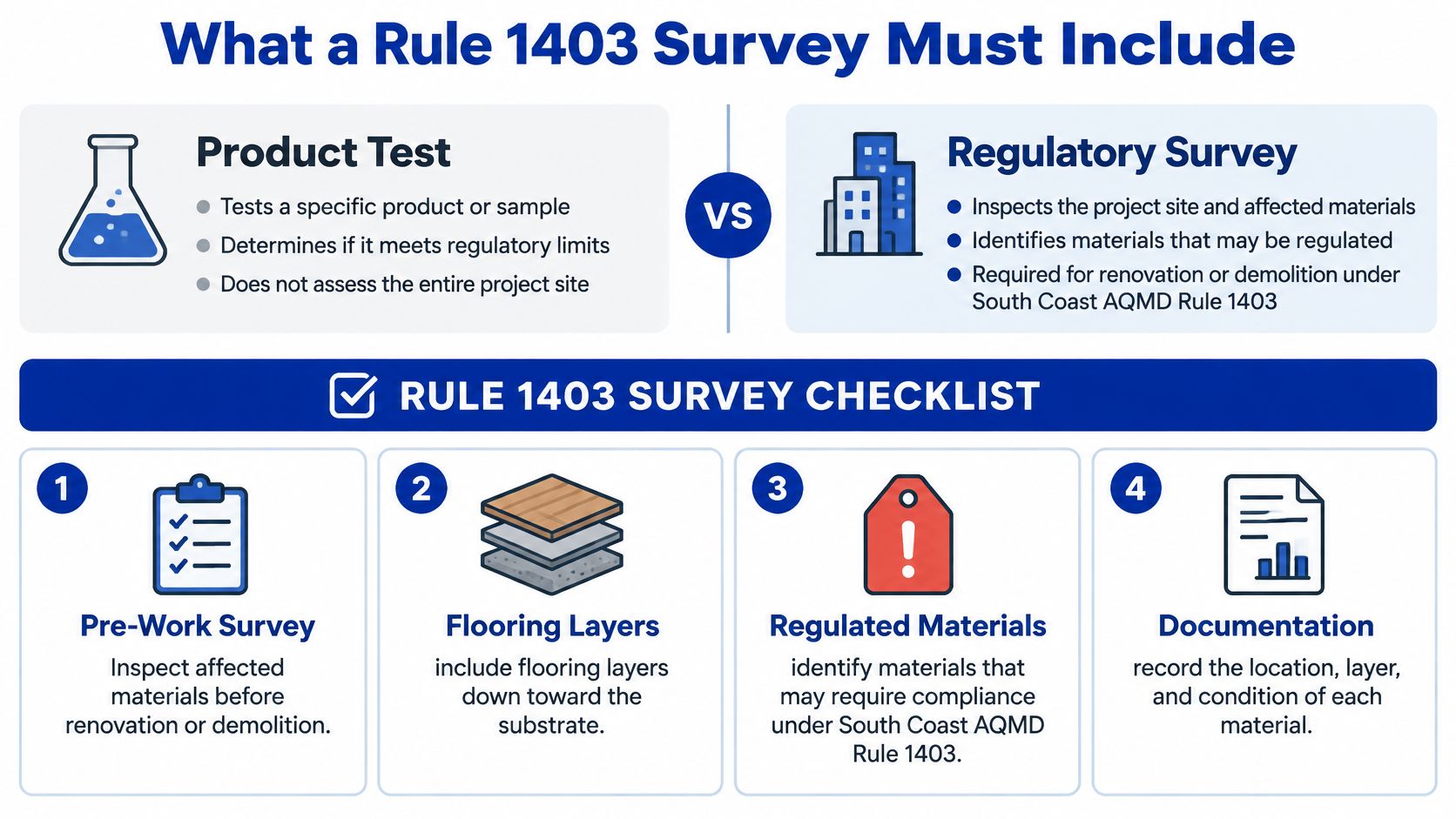
A product test identifies the submitted material. A regulatory survey documents affected building materials and their relationship to the work. That distinction matters when an owner receives a laboratory certificate and assumes the contractor can start.
Under South Coast AQMD Rule 1403, the pre-work survey must address affected materials before renovation or demolition, including flooring layers down to the joist level and materials in wall or ceiling cavities when necessary. The written survey requires a Cal/OSHA-certified asbestos consultant, specified analytical methods, and an NVLAP-accredited laboratory.
Check the written survey package
- Scope and affected assemblies. Identify the planned work and the materials it will reach, including concealed components where necessary.
- Material inventory. Identify, quantify, and assess friable and nonfriable asbestos-containing materials. Friability concerns how readily material can crumble and release fibers.
- Locations and condition. Show where materials occur, their quantities, and their observed condition.
- Sampling documentation. Include sample locations, photographs, and chain-of-custody records connecting field collection to laboratory analysis.
- Complete results. Record negative findings as well as positive findings, with methods and limitations.
- Unresolved access. Identify uninspected or inaccessible materials so contractors don't mistake an unknown area for a cleared area.
Our inspection reporting includes the amount and location of asbestos in the building. Those details help owners and contractors understand whether the documented survey covers their planned disturbance.
Procedure 5 and agency documentation
If a Certified Asbestos Consultant finds asbestos-containing material damaged or significantly damaged, it may be classed as a Procedure 5, requiring a Procedure 5 cleanup plan written by the consultant. The classification and plan are compliance steps; sampling itself doesn't remove flooring or resolve damaged-material conditions.
A Notice to Comply also needs careful attention to the agency's specific request. Survey procedures, laboratory methods, results, and affected locations must be organized into a response that addresses the cited issue, rather than assuming any existing laboratory certificate will suffice.
Say an Orange County property manager commissions a surface-only test, then discovers older adhesive during construction. The missing assessment can interrupt scheduling and require additional investigation. Testing less at the outset isn't necessarily less work overall.
Positive results inform the next decision. They don't, by themselves, prescribe a removal method or mean every intact material must immediately be removed.
How to Read a Floor Sample Report
Start with a sample entry, not the report's summary sentence. An entry identifying hallway vinyl tile is useful only if you can locate that hallway material on the survey plan and connect it to the contractor's work.
A laboratory result and a survey report serve related but different purposes. The laboratory describes what it found in submitted material; the consultant explains where that material came from and what it represents.
Read from identity to coverage
- Match material and location. Find the room, sample identifier, and precise component. A generic flooring label isn't enough to distinguish tile from backing or adhesive.
- Read the detected constituent and concentration. Note the asbestos type when reported and the estimated amount. Don't substitute a summary classification for the actual analytical finding.
- Check the layer. A negative tile result doesn't cancel a positive adhesive result beneath it. The adhesive matters if the planned preparation reaches it.
- Identify the method. Look for PLM, supplemental TEM, and any preparation or matrix limitations. A method abbreviation is part of the meaning of the result, not administrative fine print.
- Check represented areas. Confirm which mapped materials the consultant associates with the sample group. An unsampled replacement patch remains unresolved.
- Review the supporting file. Sample locations, chain of custody, photographs, quantities, condition observations, and negative findings should support the project assessment.
EPA analytical guidance on organically bound materials recommends further TEM analysis for appropriate floor-tile and other organically bound samples reported negative by PLM. When the report stops at a PLM nondetect, the practical question is whether the consultant and laboratory have adequately addressed that material's analytical limitations.
A result applies to an identified material and represented area. It isn't a building-wide certificate.
Turn the findings into a project decision
Qualified professionals can use the report to evaluate leaving intact material undisturbed, restricting access to damaged areas, planning appropriate repair, or preparing for necessary disturbance. The decision should account for condition and scope, not just a positive or negative label.
Before accepting the file as complete, make these checks: the survey matches the work, every affected layer is named, and the analytical method fits the material. If any check fails, resolve the gap before construction starts.
DIY Floor Sampling Versus a Professional Survey
A mail-in kit can produce a laboratory result for a submitted chip. A professional survey adds material mapping, representative sampling, condition assessment, scope evaluation, and documentation. Those aren't interchangeable purchases.
The EPA's guidance on suspected asbestos in homes recommends trained, accredited professional sampling when testing is warranted, particularly before disturbance or when material is damaged. It also explains why an intact material doesn't always need immediate sampling.
Common mistakes and the corrective action
- Sending only a surface chip. Have the affected floor assembly mapped so backing, adhesive, and underlying materials aren't omitted.
- Breaking material to inspect it. Leave collection to a trained inspector using appropriate disturbance controls. Don't sand, grind, or snap tile to look for fibers.
- Ordering air testing instead of material identification. Match the test to the question before authorizing sampling.
- Assuming a newer finish clears older layers. Name each component the work will encounter.
- Using another material as visual proof. Asbestos-insulated ducting and white asbestos tape may be recognizable on air-handling systems, but they can't identify what's in adjacent vinyl flooring.
- Treating postponed testing as permission to scrape. Schedule the assessment before the project changes from observation to disturbance.
Our explanation of whether you can test for asbestos at home helps distinguish sample submission from a properly scoped inspection.
Dust reduction isn't asbestos identification
Savera Wood Floor Refinishing's resource on hardwood refinishing without the dusty mess addresses dust-conscious flooring work. That's a separate issue from determining whether concealed flooring or adhesive contains asbestos; dust-reduction equipment doesn't replace an asbestos survey.
Before scheduling tools: Establish what the crew will touch, then confirm the inspection covers those materials.
The useful comparison isn't just DIY cost versus professional cost. It's whether the resulting information answers the project's actual environmental and compliance questions.
Floor Testing Questions Property Owners Ask
Can I test a floor myself?
A DIY kit can provide analysis of submitted material, but it doesn't create the regulatory survey needed for renovation or demolition. For that work, the consultant's credentials, sampling coverage, laboratory qualifications, and written documentation matter together.
Does a negative vinyl result settle the question?
Not automatically. Confirm the represented material, the layer tested, and whether the analytical approach adequately addressed organically bound flooring. A negative result from the upper finish doesn't resolve an untested component beneath it.
Does a positive result mean the floor must be removed?
No. The finding helps owners and qualified professionals assess condition, planned disturbance, and applicable requirements. Leaving intact material undisturbed may be appropriate when the project and regulatory circumstances allow it.
Is a newer home free of asbestos flooring?
Construction age alone doesn't establish material composition. Renovation planning should address the actual affected assemblies, including patches and concealed materials, rather than treating the building's apparent age as a laboratory result.
Do I need testing before selling?
A sale alone isn't the same situation as a planned renovation. When a buyer intends to remodel, we recommend having a Certified Asbestos Consultant assess all materials that work will impact. Keep the agreed investigation scope clear so neither party mistakes project-specific testing for a whole-property certification.
When should the survey be scheduled?
Schedule it before disturbance, ideally early enough to inform contractor bids and the project sequence. Waiting until the crew encounters unexpected mastic leaves less room to investigate concealed materials and address documentation gaps.
What if the floor was damaged by water or fire?
Arrange a professional assessment of the changed conditions before further handling. An asbestos investigation addresses suspect building materials; it doesn't automatically answer separate questions about mold, combustion residue, or other contaminants that may require their own sampling plans.
Book Asbestos Floor Testing Before Disturbance
If your project involves scraping, cutting, grinding, lifting flooring, or opening the assembly beneath it, start with a written survey matched to that work. Send the testing team the building's known history, photographs, visible layer information, and the contractor's proposed preparation method.
Include details that are easy to overlook:
- Work boundaries. Identify rooms, closets, transitions, and adjoining finishes the crew may affect.
- Depth of disturbance. Explain whether preparation stops at the finish or reaches adhesive, leveling compound, or subfloor.
- Existing documents. Provide prior surveys, laboratory reports, agency correspondence, and any Notice to Comply.
Sensitive Environmental provides testing and documentation for SCAQMD Rule 1403 compliance, AQMD requirements, Notices to Comply, and Procedure 5 asbestos testing protocols. Our role here is environmental inspection, sampling, analysis, and reporting, not directing a demolition crew.
If the findings require planning for subsequent work, our guide to understanding asbestos removal precautions offers additional context. Keep the survey as the project's factual starting point, not a promise that an entire property is safe.
Sensitive Environmental offers professional asbestos floor testing, pre-renovation surveys, laboratory analysis, and clear reporting for properties throughout Los Angeles and Southern California. Visit Sensitive Environmental to request a free, no-obligation consultation and schedule a survey covering the flooring layers your project will disturb.