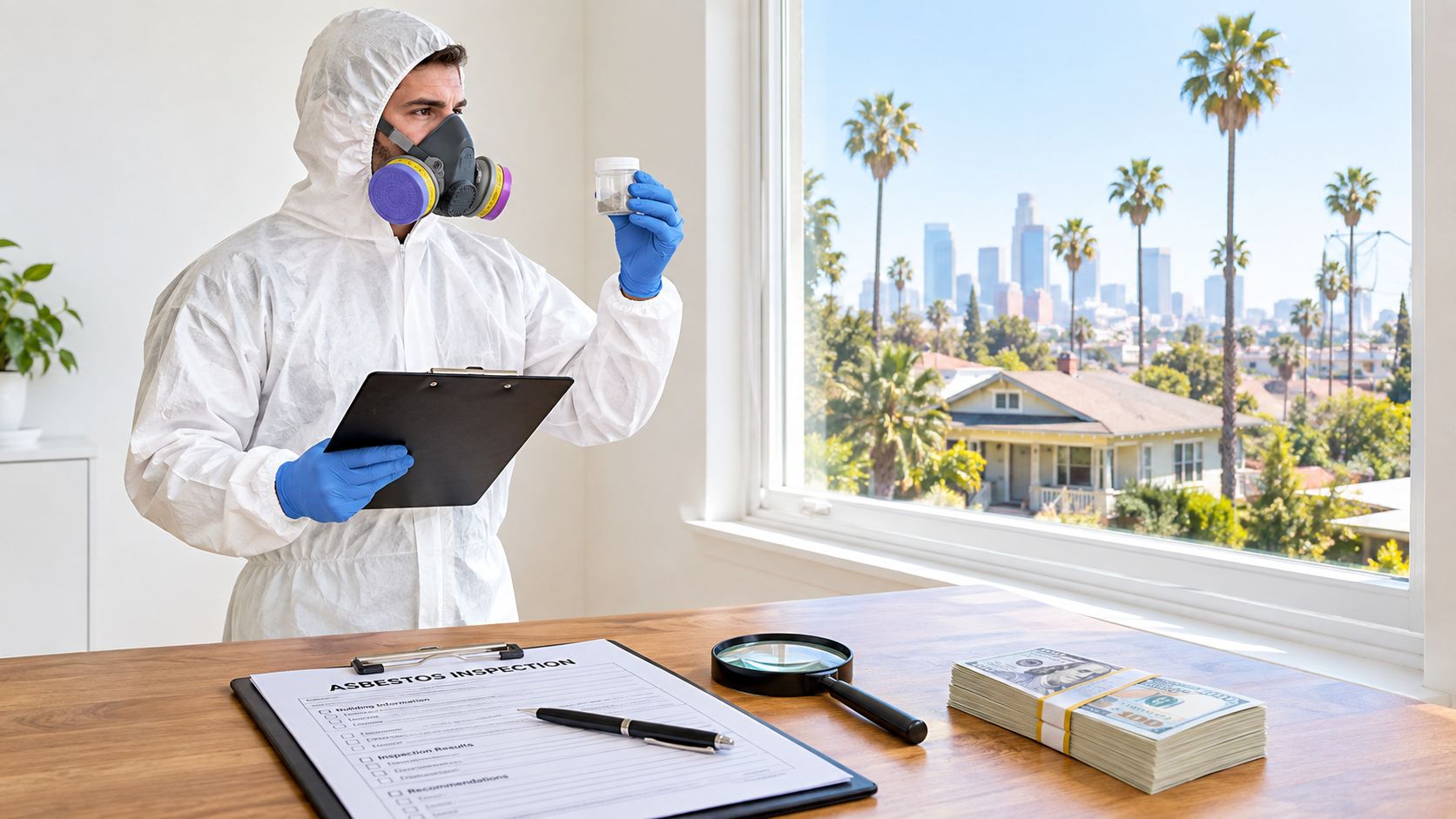
Most residential and small commercial asbestos surveys in Los Angeles fall between roughly $400 and $1,500, while pre-demolition or large commercial surveys typically run $1,500 to $5,000 or more. The final asbestos survey cost is driven by sample count, property size, access difficulty, reporting requirements, and whether the work must satisfy South Coast AQMD Rule 1403.
You may be looking at an older house in Echo Park, a duplex renovation in Silver Lake, or a commercial tenant improvement with demolition already scheduled. Three consultants may give you three dramatically different prices, and the cheapest quote can look attractive until you discover it doesn't include the sampling, laboratory analysis, or compliance documentation your project needs.
In Los Angeles, the price isn't just a market number. It reflects the scope of environmental testing, the building's construction, the materials that may be disturbed, and the regulatory paperwork required before work begins. A survey for property records isn't the same service as a destructive pre-demolition survey under Rule 1403.
Table of Contents
- Why Three Quotes for the Same Building Can Differ by Thousands
- The Three Survey Types and Why They Cost Different Amounts
- What Actually Drives Asbestos Survey Cost in Los Angeles
- Typical Price Ranges for Homes and Commercial Properties
- What a Compliant Los Angeles Report Should Include
- How to Compare Quotes Side by Side Without Guesswork
- Where Cheap Quotes Cut Corners in Pre-Demolition Work
- Next Steps for Scheduling a Los Angeles Asbestos Survey
Why Three Quotes for the Same Building Can Differ by Thousands
A property owner recently requested bids for a 1920s Echo Park bungalow and received proposals for $475, $1,150, and $2,400. The natural reaction was simple. One consultant must be overcharging, or another must be cutting corners.
Usually, the explanation is less dramatic and more important. The three bidders may be pricing three different jobs.
The $475 proposal may cover a limited presurvey of visible suspect materials. The $1,150 proposal may include a fuller management survey, several bulk samples, laboratory analysis, and a written report. The $2,400 proposal may include destructive access, a larger sample package, a signed Rule 1403 report, and expedited turnaround for demolition scheduling.
Practical rule: Never compare the headline price until you compare the scope line by line.
Read the footprint behind the number
Start by asking what areas the consultant will inspect. Does the quote cover only occupied rooms, or does it include crawlspaces, attics, ceiling voids, garages, mechanical spaces, exterior materials, and shared areas? A small building can still require substantial field time if it has many rooms, multiple construction assemblies, or difficult access.
Next, look at sampling. A visual walk-through that flags suspect materials is not equivalent to collecting samples from each homogeneous area and sending them for laboratory analysis. If your renovation will disturb walls, floors, ceilings, pipe insulation, roofing, or adhesive layers, the survey needs to address those materials rather than merely document what can be seen from standing height.
The third question is regulatory purpose. For a renovation or demolition project in the South Coast Air Basin, the consultant needs to understand whether the report must support SCAQMD Rule 1403, Procedure 5 sampling, notification, or a Notice to Comply response. EPA guidance also says a facility must be inspected or thoroughly surveyed before demolition or renovation, with the federal requirement broadly applying to structures and buildings subject to the asbestos NESHAP rules. EPA guidance for building owners and managers explains that the survey comes before the work, not after demolition has exposed hidden materials.
The spread between bids often reflects scope variance, not honesty variance. Your job is to identify what each consultant included, what each excluded, and whether the report will serve the actual project.
The Three Survey Types and Why They Cost Different Amounts
Think of asbestos services like a medical visit. A presurvey is the initial look. A full or management survey is the detailed examination. Bulk sampling is the laboratory confirmation that tells you whether a physical material contains asbestos.
That analogy matters because these services often get blended together in casual conversations about price.
A presurvey generally involves a visual review of accessible suspect materials. It can help identify areas that deserve further investigation, but it may not include enough sampling or documentation for renovation and demolition compliance. A full or management survey examines accessible building areas, records homogeneous materials, identifies locations, assesses condition, and documents sample points.
Bulk sampling is not a separate substitute for inspection. It is the physical collection and laboratory analysis component of a broader survey. A technician may collect a small piece of flooring, adhesive, wall texture, insulation, roofing, or another suspect material. A qualified laboratory then analyzes the sample, commonly using polarized light microscopy, to determine whether asbestos is present.
How the services stack together
A full survey typically includes inspection, sampling, laboratory analysis, interpretation, and reporting. A presurvey may include only visual observations or a limited number of samples. A refurbishment or demolition survey goes further because the consultant must investigate materials that ordinary occupancy or maintenance may not expose.
For Los Angeles projects, the difference becomes especially important when work will disturb building components. South Coast AQMD Rule 1403 requires an asbestos survey report signed by an asbestos consultant before covered renovation or demolition work begins, and the survey must address materials that may be disturbed. The rule also requires surveys for abatement projects regardless of size, subject to the specific residential single-unit exception described in the agency's FAQ. South Coast AQMD Rule 1403 FAQ provides the applicable regulatory context.
| Survey Type | What's Inspected | Lab Analysis | Typical Use | Relative Cost |
|---|---|---|---|---|
| Presurvey | Visible and accessible suspect materials | Limited or may not be included | Early planning and screening | Lower |
| Full or management survey | Accessible areas and documented homogeneous materials | Included when samples are collected | Property management, due diligence, maintenance planning | Moderate |
| Refurbishment or demolition survey | Accessible and concealed materials likely to be disturbed | Extensive sampling as required by scope | Renovation, demolition, Rule 1403 documentation | Higher |
Asbestos isn't the only legacy building hazard investors should evaluate. If a purchase involves older painted surfaces, a separate resource on lead paint testing for investors can help explain why lead inspection and asbestos assessment should be scoped as different environmental services.
What Actually Drives Asbestos Survey Cost in Los Angeles
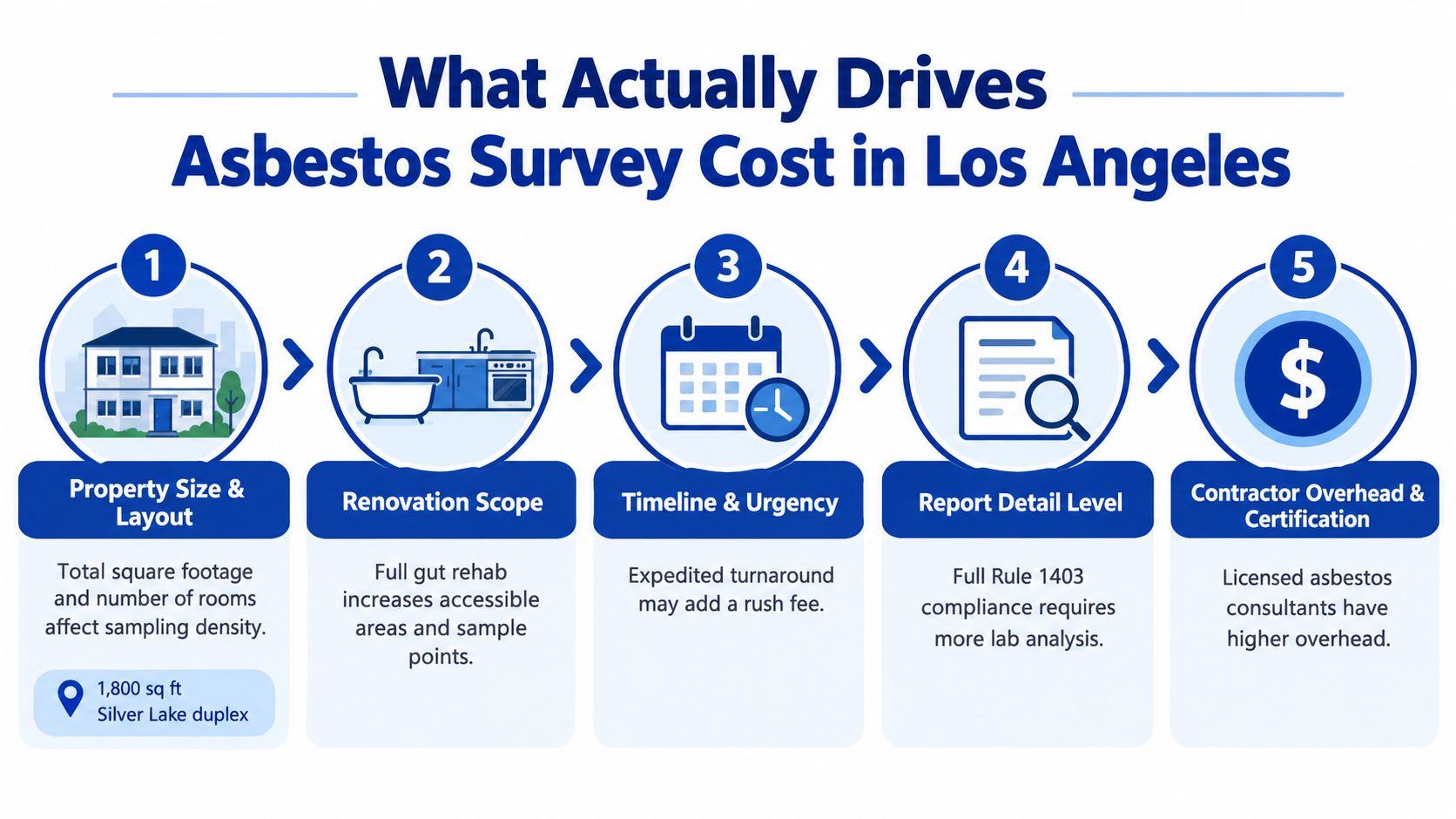
Consider an 1,800-square-foot Silver Lake duplex being prepared for a kitchen and bathroom gut renovation. The square footage matters, but it doesn't determine the price by itself. A two-unit property has more rooms, more repeated materials, more shared systems, and more opportunities for hidden construction than a simple open-plan space.
Five pricing levers
Property size and layout establish the baseline. The consultant must account for rooms, floors, exterior areas, mechanical spaces, crawlspaces, and other locations where suspect materials may exist. A compact building with many separate areas can require more documentation than a larger, open industrial space.
Renovation scope changes the survey footprint. A cosmetic kitchen update may disturb fewer materials than a gut renovation involving cabinets, flooring, walls, ceilings, plumbing chases, and electrical pathways. If the contractor plans demolition behind finished surfaces, the consultant must evaluate whether destructive access is necessary.
Sample count creates one of the clearest cost swings. Each sample requires field collection, labeling, chain-of-custody documentation, laboratory analysis, and result interpretation. One independent UK pricing guide reports targeted asbestos sampling and laboratory analysis at about £30 to £60 per sample, while full-property surveys commonly range from £150 to £800 or more, depending on building type and size. ACMS UK asbestos survey cost guidance illustrates how sample quantity and access affect the final fee.
Accessibility adds technician time. Vaulted ceilings, tight crawlspaces, occupied units, shared mechanical systems, locked rooms, and fragile finishes can turn a straightforward inspection into a more involved field assignment.
Report detail and urgency affect the deliverable. A Rule 1403 report requires more than a brief letter. It may need sample location drawings, photographs, laboratory results, findings, recommendations, and consultant certification. Expedited scheduling also costs more because the consultant and laboratory must rearrange their workload. A quote should identify any rush charge rather than hiding it inside an unexplained total.
For a Silver Lake duplex, ask bidders to show the expected inspection areas, sampling assumptions, laboratory fees, report format, turnaround, and any exclusions. Expert insights from Richard Maize can also provide useful real-estate context when environmental findings affect transaction and renovation planning.
For Los Angeles property owners, the practical starting point is asbestos testing in Los Angeles, with the project scope defined before anyone quotes a number.
Typical Price Ranges for Homes and Commercial Properties
Use price bands, not a single universal figure. The market data shows that asbestos survey cost changes with building type, survey purpose, sample quantity, and the level of regulatory documentation.
For Los Angeles homes and small multifamily properties, a practical planning range is $400 to $1,000 for many standard surveys. Older houses in communities such as the San Fernando Valley, South Los Angeles, and central Los Angeles can land toward the upper end when the consultant encounters numerous suspect materials, additions, crawlspaces, or renovation plans that require broader access.
Small commercial spaces, including tenant improvements, often fall around $800 to $1,800 when the scope includes multiple rooms, commercial finishes, sampling, and a formal report. Larger commercial and pre-demolition assignments commonly reach $1,500 to $5,000 or more, while complex schools, healthcare facilities, warehouses, industrial properties, and multi-story buildings can exceed that range because the survey involves more areas and more documentation.
The broader US market supports the same conclusion. One national pricing guide reports an average asbestos test cost of $482, with a typical inspection range of $230 to $782. It also places residential surveys at $600 to $1,500 and commercial surveys at $2,000 to $5,000. Angi's asbestos testing cost guide provides those national benchmarks. An Australian government fact sheet cited in that same verified market data notes that when at least five samples are collected, the report may average around $1,000 after analysis.
A useful international comparison
UK pricing guides commonly place a small residential management survey around £200 to £260, with full residential management surveys reaching £150 to £500, residential refurbishment and demolition surveys at £300 to £500 or more, and commercial management surveys at £495 to £2,000 or more. Another UK source places small commercial units around £290 to £650 plus VAT, while larger commercial, school, healthcare, and industrial properties may be priced by survey day at £340 to £995 or more. The Asbestos Register pricing guide details those UK market bands.
| Property Type | Los Angeles Range | UK Range |
|---|---|---|
| Residential home or small multifamily | $400 to $1,000 | £150 to £500 |
| Small commercial property | $800 to $1,800 | £290 to £950 |
| Large commercial or pre-demolition property | $1,500 to $5,000 or more | £2,000 or more for large demolition scopes |
The currencies and regulatory systems aren't interchangeable. US pricing reflects local insurance, laboratory requirements, consultant qualifications, and South Coast AQMD Procedure 5 expectations. A quote below $300 deserves scrutiny because it may represent limited sampling, a visual-only visit, laboratory analysis billed separately, or no complete report.
What a Compliant Los Angeles Report Should Include
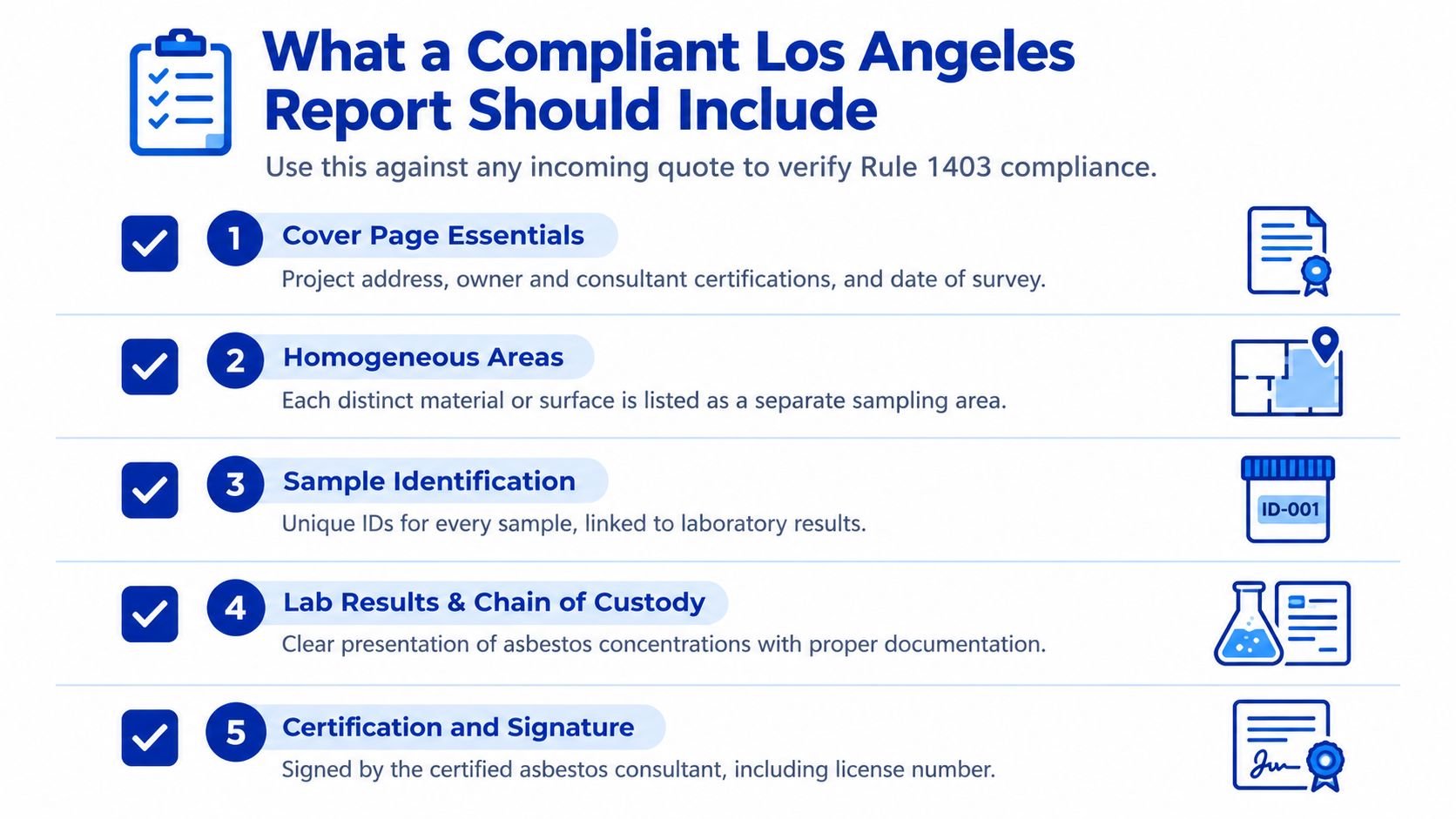
A credible Los Angeles asbestos report should let a property owner, contractor, regulator, or project manager understand exactly what was inspected, what was sampled, where the samples came from, and what the results mean.
Use this checklist before approving a quote.
Cover page and credentials
The first page should identify the project address, property owner, consultant, inspection date, and intended project scope. For a Rule 1403 assignment, verify the consultant's Cal/OSHA-Certified Asbestos Consultant license number and relevant AHERA inspector credentials.
The report should identify who performed the fieldwork and who reviewed or signed the final document. A technician's name alone may not satisfy the needs of a pre-demolition project requiring consultant certification.
Field methods and sample control
The methodology should state the areas inspected, limitations on access, materials grouped into homogeneous areas, and the number of bulk samples collected. Every sample needs a unique identification number that connects the field location to the laboratory result.
The laboratory should be appropriately accredited for the analysis, and the report should preserve chain-of-custody records. A laboratory certificate without sample locations, field notes, or a site map gives the project team incomplete information.
Findings and recommendations
Positive materials should be listed by location, material description, condition, friability, and estimated quantity in square feet or linear feet when applicable. The report should include photographs, a floor plan or site map showing sample locations, laboratory reports, and a recommendations section that distinguishes the relevant response categories.
A positive result doesn't automatically dictate one identical action for every property. It gives the owner and qualified project professionals information for determining management, further assessment, work controls, or other appropriate next steps.
The importance of asbestos management in Los Angeles commercial buildings becomes clear when documentation must support ongoing facility decisions, contractor coordination, or agency review. A quote that omits core report elements isn't a bargain. It's an incomplete deliverable.
How to Compare Quotes Side by Side Without Guesswork
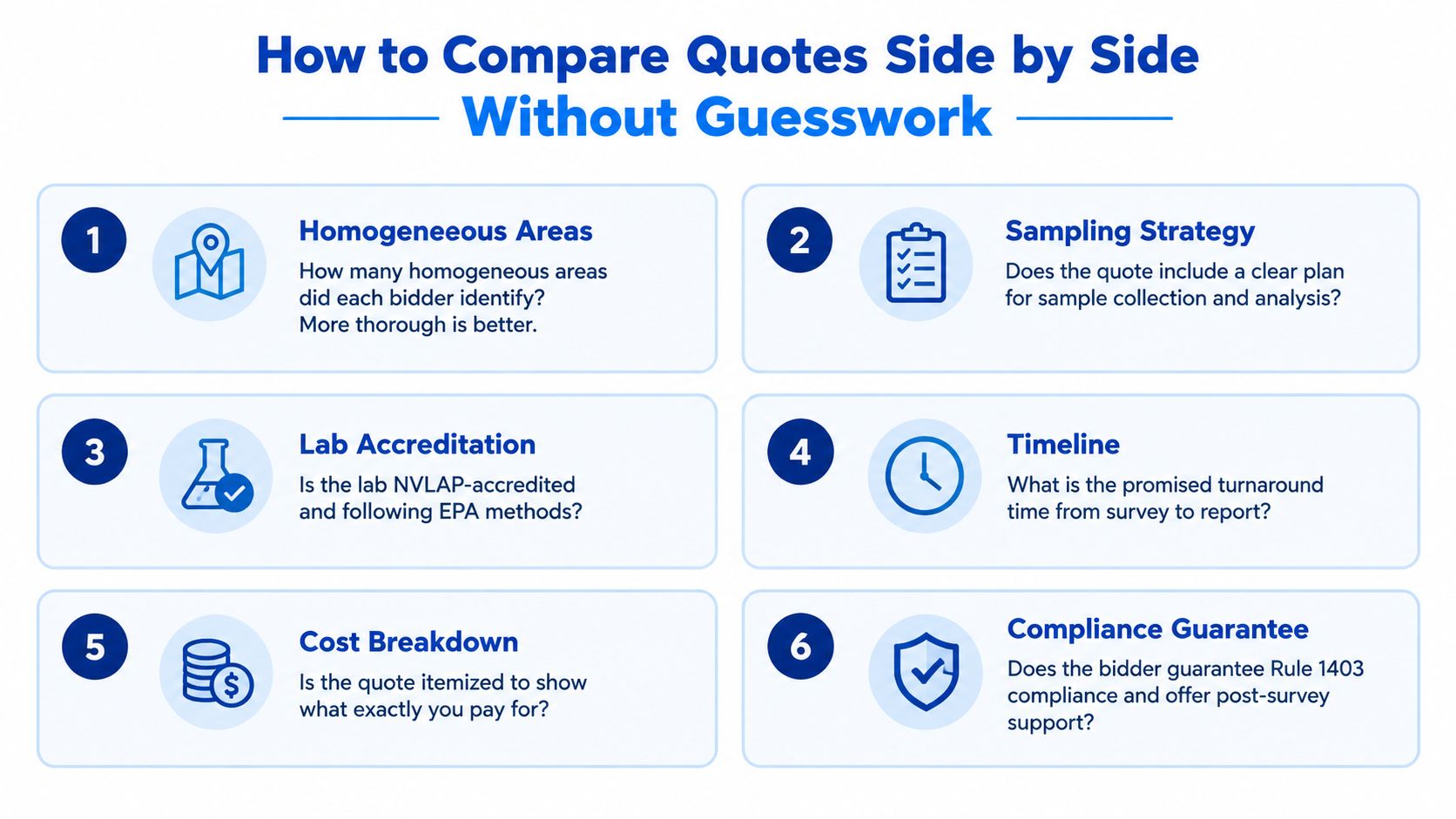
Put the proposals in separate columns and ask the same questions of every bidder. Don't let a polished one-page estimate hide missing fieldwork or laboratory services.
Six questions for every bidder
How many homogeneous areas did you identify? Ask each consultant to explain the materials and locations included in the inspection. An unusually low sample count may signal that the bidder has priced a narrow visual review.
What is the sampling strategy? The proposal should explain where samples will be collected, how materials will be grouped, and how the consultant will handle inaccessible or concealed areas. The strategy should match the renovation or demolition plans.
Is the laboratory independent and properly accredited? Ask whether the lab is NVLAP-accredited and whether the consultant will provide laboratory reports with the final deliverable. Independent laboratory controls can matter when results are questioned.
Who signs the report? Confirm whether a Cal/OSHA-Certified Asbestos Consultant will review and sign a pre-demolition report, rather than receiving only a technician's field summary.
What is the turnaround time? Get the standard delivery time and any expedited option in writing. A low base fee can become expensive when the project suddenly needs priority laboratory analysis.
What's included in the final package? Look for a site map, photo log, sample inventory, chain of custody, laboratory reports, findings, limitations, recommendations, and required compliance forms. Also ask whether the consultant carries asbestos-specific liability insurance and can provide a certificate before the site visit.
Score each proposal against the same criteria, then separate genuine scope differences from administrative differences. A higher quote may be justified if it includes more sampling, deeper access, accredited laboratory analysis, signed certification, and a report your contractor can use without ordering another inspection.
The Oracle Asbestos cost guide shows why larger UK commercial and industrial scopes can move from thousands to much higher fees as floor area, complexity, and sampling density increase. The same principle applies in Southern California. A quote should explain the step change instead of just presenting a larger total.
Where Cheap Quotes Cut Corners in Pre-Demolition Work
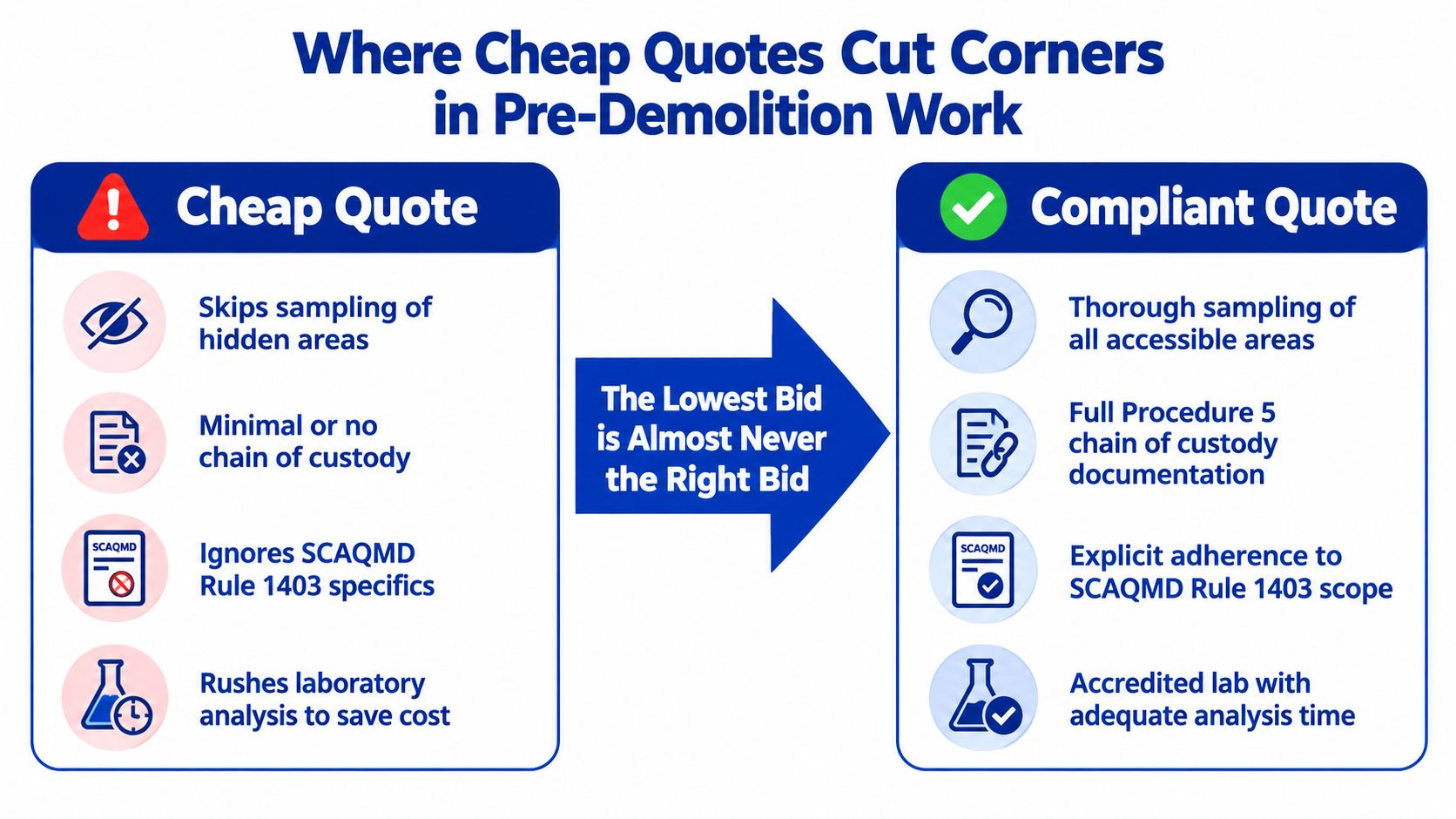
The lowest bid is almost never the right bid for Los Angeles demolition work. Rule 1403 isn't satisfied by a technician walking through the rooms, photographing a few visible materials, and attaching a laboratory certificate to a short letter.
Cheap quotes commonly reduce the field scope first. The consultant may skip hidden areas, avoid destructive inspection behind walls or above ceilings, collect too few samples, or assume that similar-looking materials are identical without documenting the basis for that conclusion.
The shortcuts that create project exposure
A weak proposal may also send samples to a laboratory that doesn't provide the accreditation or documentation your project needs. It may omit photographs of sample locations, floor plans, chain-of-custody records, or the forms required for South Coast AQMD notification and compliance responses.
Those omissions don't disappear when demolition begins. They can lead to questions from South Coast AQMD inspectors, work interruptions, site hold tags, schedule disruption, and additional sampling after the contractor has mobilized. The property owner may carry the practical liability even if a consultant prepared the original report.
The Los Angeles County notification instructions state that fees are charged per notification, are non-refundable, and vary by project size, with the schedule tied to square footage ranges beginning at 1,000 square feet or less and continuing upward. Los Angeles County AQMD demolition forms show why notification planning belongs in the project budget rather than appearing as a surprise administrative charge.
A compliant survey is closer to project insurance than overhead. It helps you identify the materials and documentation requirements before crews disturb the building.
Testing isn't remediation, removal, or abatement. A survey identifies suspect materials and provides laboratory-backed information so the owner and qualified professionals can determine the appropriate next step. If you need to understand the separate role of asbestos abatement in Los Angeles, keep that service decision separate from the inspection and testing scope.
Next Steps for Scheduling a Los Angeles Asbestos Survey
Before contacting a consultant, gather the property address, approximate construction year, square footage, renovation or demolition plans, known suspect materials, previous reports, access limitations, and the date you need the final report.
Tell the consultant whether the project involves ordinary renovation, major refurbishment, full demolition, a real-estate transaction, maintenance planning, or a Notice to Comply response. The purpose determines whether you need a limited assessment, a management survey, or a more intrusive Procedure 5 scope.
A credible engagement normally follows a straightforward sequence:
- Initial scope call: Discuss the building, project plans, access, and deadline.
- Site walk: Inspect accessible areas and identify homogeneous materials and sampling locations.
- Written proposal: Review fieldwork, sample assumptions, laboratory analysis, report format, exclusions, and turnaround.
- Sampling and analysis: The consultant collects properly identified samples and submits them with documented chain of custody.
- Report delivery: Standard laboratory turnaround is commonly discussed in the range of 24 to 72 hours for expedited project workflows, but confirm the actual timing and whether rush service is included in the quote.
- Compliance coordination: For applicable work, confirm whether the final report supports Rule 1403, Procedure 5 documentation, Notice to Comply responses, and related notification needs.
Sensitive Environmental provides asbestos inspections, sampling, laboratory analysis, and reporting for residential and commercial properties in Los Angeles and Southern California. Contact the team with your existing bids and project plans, then request a side-by-side scope comparison before choosing the lowest number.
Schedule a Los Angeles asbestos survey with Sensitive Environmental for professional inspection, sampling, laboratory analysis, and clear documentation suited to renovation, demolition, or Rule 1403 requirements. Send your competing proposals and project details so the team can identify missing scope items before they create delays.