The report comes back with one line of text. Maybe it says 2% chrysotile, maybe it says no asbestos detected, and either way someone who isn't a microscopist has to decide what that line means for a 1950s stucco house in Highland Park or a shuttered retail suite in Torrance before demolition starts Monday.
Polarized light microscopy asbestos testing is the method behind most of those lines. It's the standard laboratory technique for identifying asbestos in bulk building materials, and what it produces is evidence, not a verdict. That evidence depends on the sample, the fiber size, and the decision the result has to support.
Here's how the lab reaches an answer, what each line of the report is telling you, and which questions are worth asking before anyone swings a hammer.
Table of Contents
- How Polarized Light Microscopy Works on Building Materials
- Optical Properties That Separate Asbestos From Look-Alikes
- How the Lab Process Moves From Sample to Report
- SCAQMD Rule 1403 Requirements for Bulk Asbestos Testing
- Where PLM Results Fall Short and Why Context Matters
- When to Confirm PLM Results With Higher-Resolution Methods
- Confirm Your Bulk Sample Testing Before Work Begins
How Polarized Light Microscopy Works on Building Materials
A remodeling crew has already pulled a fist-sized chunk of ceiling texture from a 1955 ranch house in Van Nuys and set it on a folding table. The contractor wants to know whether it contains asbestos before the rest of the ceiling comes down.
In most cases asbestos cannot be identified by looking at it. The fibers are too fine, and they sit inside a matrix of gypsum, cellulose, mica, and paint that hides them. There's a narrow exception: you can sometimes see it on air handling systems, such as asbestos-insulated ducting and white asbestos tape wrapped around joints, where the material was applied as a visible wrap or paste. Everywhere else, a visual look gives you a guess.
Here's where the sample goes next, into a laboratory read rather than a visual inspection.
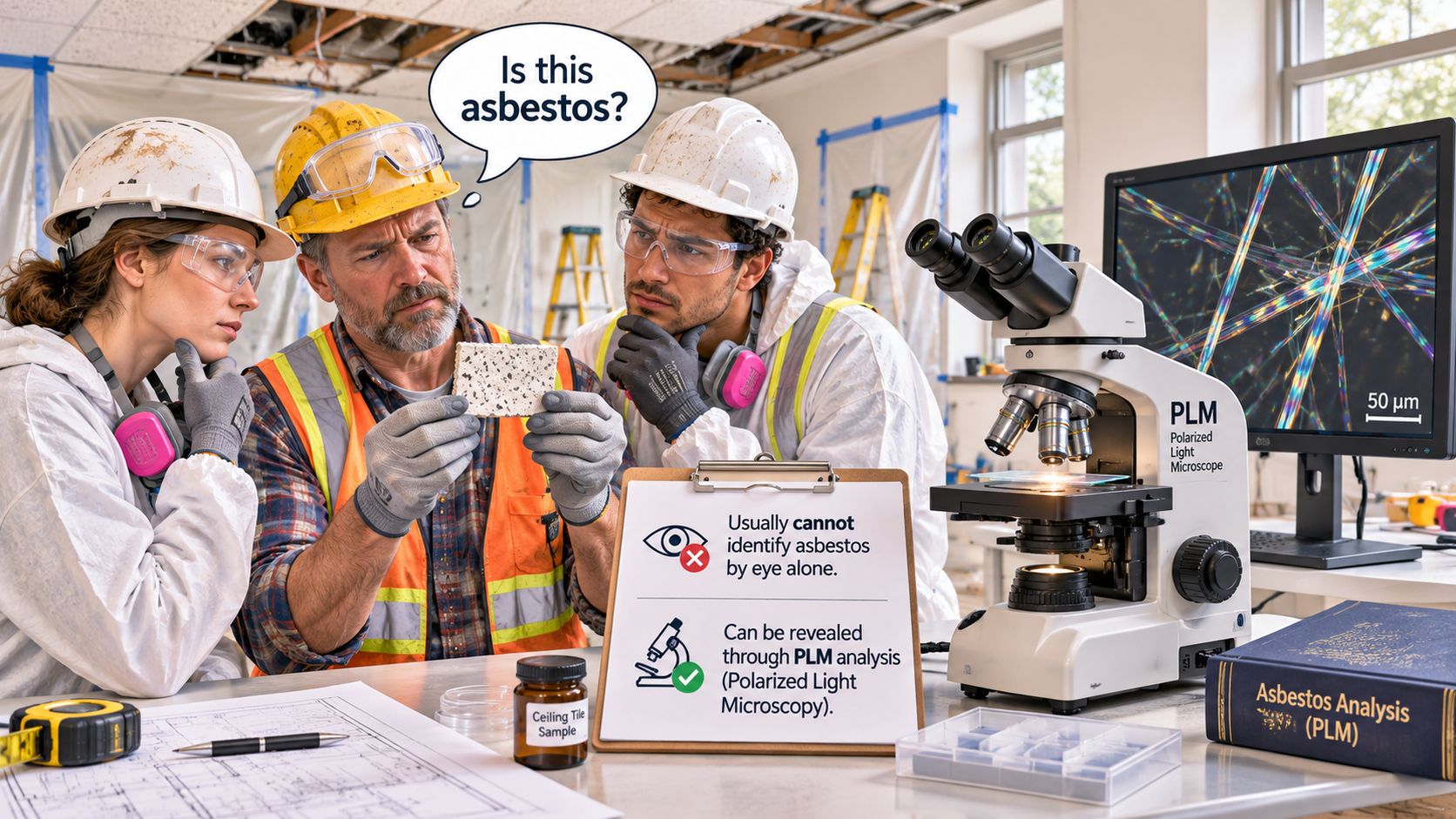
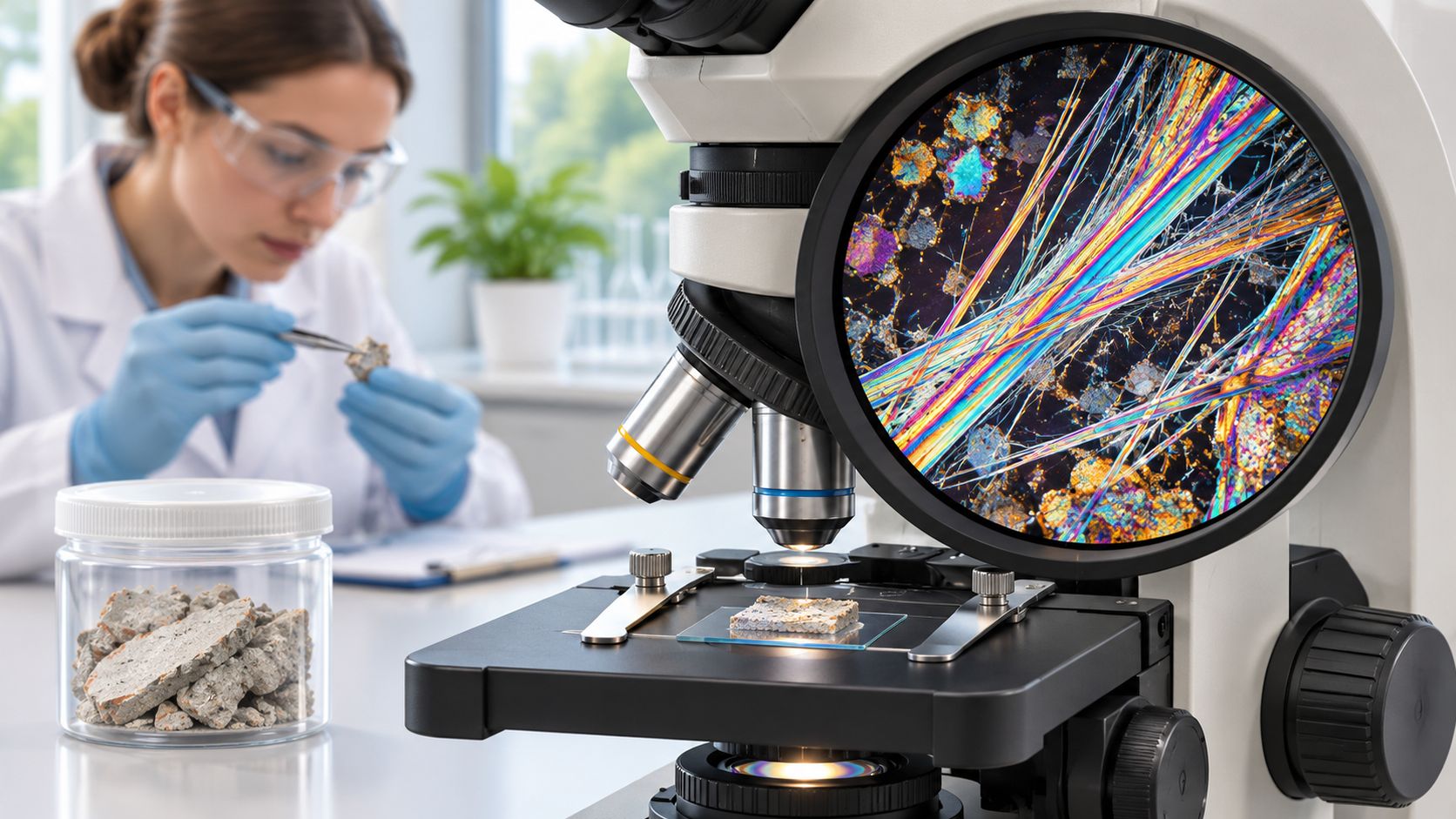
Polarized light microscopy, or PLM, is a microscope fitted with two polarizing filters. Light passing through the lower filter is aligned into one plane, then travels through the sample and up through the upper filter. As the analyst rotates the stage and slides accessories into the light path, each fiber brightens, dims, and shifts color in ways that depend on its crystal structure. Those behaviors repeat identically for a given mineral, which is what makes them usable as an identification.
Think about how a birder identifies a songbird. Shape alone gets you to "small brown bird" and no further. The plumage pattern, the call, and the habitat together narrow it to one species, and no single one of those features would be enough on its own. A microscopist works the same way: shape first, then a series of optical tests, then a conclusion that only holds if the tests agree.
Where PLM Fits in a Renovation or Real Estate Decision
PLM handles the physical materials, not the air. It's the bulk-sample method, and it's separate from air monitoring, which answers a different question about what's floating around a room. The materials that most often go to a PLM bench in Southern California buildings include:
- Joint compound and texture on drywall from the 1960s and 1970s
- Vinyl floor tile, sheet flooring, and the black mastic underneath
- Plaster and stucco, including the scratch and brown coats
- Pipe insulation and boiler wrap on mechanical systems
- Roofing cement, flashing, and some siding panels
Testing becomes worth considering in three situations: a planned renovation or demolition that will disturb materials, a building whose finishes are deteriorating or will be worked on, and real-estate due diligence on an older property where a buyer needs to know what's in the walls before closing.
Four things decide how much weight an answer carries. The optical properties the analyst recorded, the sampling that produced the material, the resolution limits of the method at that fiber size, and the rules that apply where the building sits.
Optical Properties That Separate Asbestos From Look-Alikes
An analyst sitting at the microscope isn't looking for a picture of asbestos. No single feature answers the question. The identification comes from a set of properties read together, each one narrowing the possibilities until only one mineral fits.
The NIOSH method for asbestos by polarized light microscopy lists what has to be combined: morphology, refractive indices, birefringence, extinction behavior, pleochroism, and sign of elongation. Federal analytical requirements in Appendix E to 40 CFR Part 763 call for the same list, including the use of a retardation plate under orthoscopic illumination to determine elongation sign. That's why a compliant report reads like a set of measurements rather than a description.
| Property | What the analyst observes | What it tells the identification |
|---|---|---|
| Morphology and color | Fiber shape, bundles, splitting and color under the microscope | Narrows the list of candidate fibers before optical tests |
| Refractive indices | Index values measured in calibrated immersion liquids | Separates asbestos minerals from most non-asbestos fibers |
| Birefringence | Brightness of the fiber between crossed polars | Confirms the fiber is optically anisotropic |
| Extinction | Whether the fiber goes dark parallel to its length or at an angle | Most regulated types are parallel; tremolite-actinolite is oblique, about 10 to 20 degrees |
| Sign of elongation | Result with a first-order red compensator | Positive for major asbestos varieties; crocidolite is negative |
| Pleochroism | Color change as the stage is rotated | Supports the identification alongside the other properties |
Reading Each Property in Plain Terms
Morphology and color come first because they're fast and free. The analyst notes whether fibers are straight and needle-like, as amphibole bundles tend to be, or curly and bundled like chrysotile, and records color before any liquid touches the slide. This stage shortens the candidate list. It doesn't name the mineral.
Refractive index does most of the separating. It describes how much a mineral bends light, and each mineral species has its own value. The analyst mounts fibers in a series of calibrated immersion liquids of known index and watches which one makes the fiber nearly vanish against the background.
Birefringence is the brightness a fiber holds between crossed polars. With the filters at right angles the background goes dark while an anisotropic fiber stays lit, often with interference colors. A fiber that never brightens isn't asbestos.
Extinction is where the fiber goes dark as the stage turns. Most regulated asbestos types extinguish parallel to their length. Tremolite and actinolite commonly extinguish obliquely, at roughly 10 to 20 degrees off the fiber axis, which is one of the sharpest separations in the method.
Sign of elongation is read by sliding a first-order red compensator into the light path. The compensator adds or subtracts color depending on fiber orientation, and the result is recorded as positive or negative. Every major asbestos variety is generally positive except crocidolite, which is negative. Pleochroism, a color shift as the stage rotates, is supporting evidence rather than a deciding test.
Why One Property Is Never Enough
Non-asbestos amphiboles, fibrous talc, cellulose, and other minerals can each mimic one or two of these behaviors. That's why the method demands the whole set agree. A fiber with parallel extinction and a plausible refractive index but negative elongation is not chrysotile. A bright, straight fiber that turns out to be a non-fibrous amphibole fragment fails on morphology and pleochroism.
Practical rule: any single optical feature can be matched by a look-alike. The identification is the combination, documented property by property.
What a Defensible Report Lets You Check
A report that says only that fibers "appeared consistent with asbestos" gives you nothing to review. A defensible one records the observations and the refractive index liquid conditions, so a line like parallel extinction, positive elongation, low birefringence, refractive index matching the mounting liquid can be traced from observation to conclusion. That's the standard the NIOSH and EPA procedures set, and it's the difference between an opinion and a finding you can hand to a contractor or a regulator.
How the Lab Process Moves From Sample to Report
A sample that reaches the lab carries more than fibers. It carries where it came from, how it was handled, and whether the analyst saw enough of it to speak for the whole material. That last point matters because a polarized light microscopy, or PLM, result is evidence tied to the sample. The smaller or less representative the sample, the narrower the conclusion.
Collect from every distinct layer. A ceiling is rarely one uniform material. Texture, joint compound, paper tape, and the substrate each get sampled separately, because one layer can test positive while the one beside it tests clean. Skipping that step can hide asbestos in a thin layer that gets averaged into the wrong story.
Seal, label, and document each piece. Each sample goes into a leak-tight container labeled with location, material type, and date. Collected asbestos is wet before being packed in plastic bags of 5mm thickness and sealed in leak-tight plastic containers, which keeps fibers from going airborne during transport. Think of the container as both a safety barrier and a chain-of-custody tool. If the label or location record is weak, the lab may still identify a fiber, but the report loses its link to the building.
Examine it under a stereomicroscope. EPA bulk procedures start here, judging homogeneity and making a preliminary fiber identification on the whole piece before any slide is prepared. Homogeneity means the material looks consistent enough that a small portion can represent the rest. A sample with obvious layers, specks, or mixed textures needs closer separation.
Prepare representative subsamples on slides. Small portions are mounted in refractive index liquids, liquids selected to match or bracket the way fibers bend light. The analyst uses these liquids to measure optical behavior rather than estimate it. That measurement is what separates an asbestos finding from a guess based on appearance.
The full sequence, from collection through the final report, looks like this.
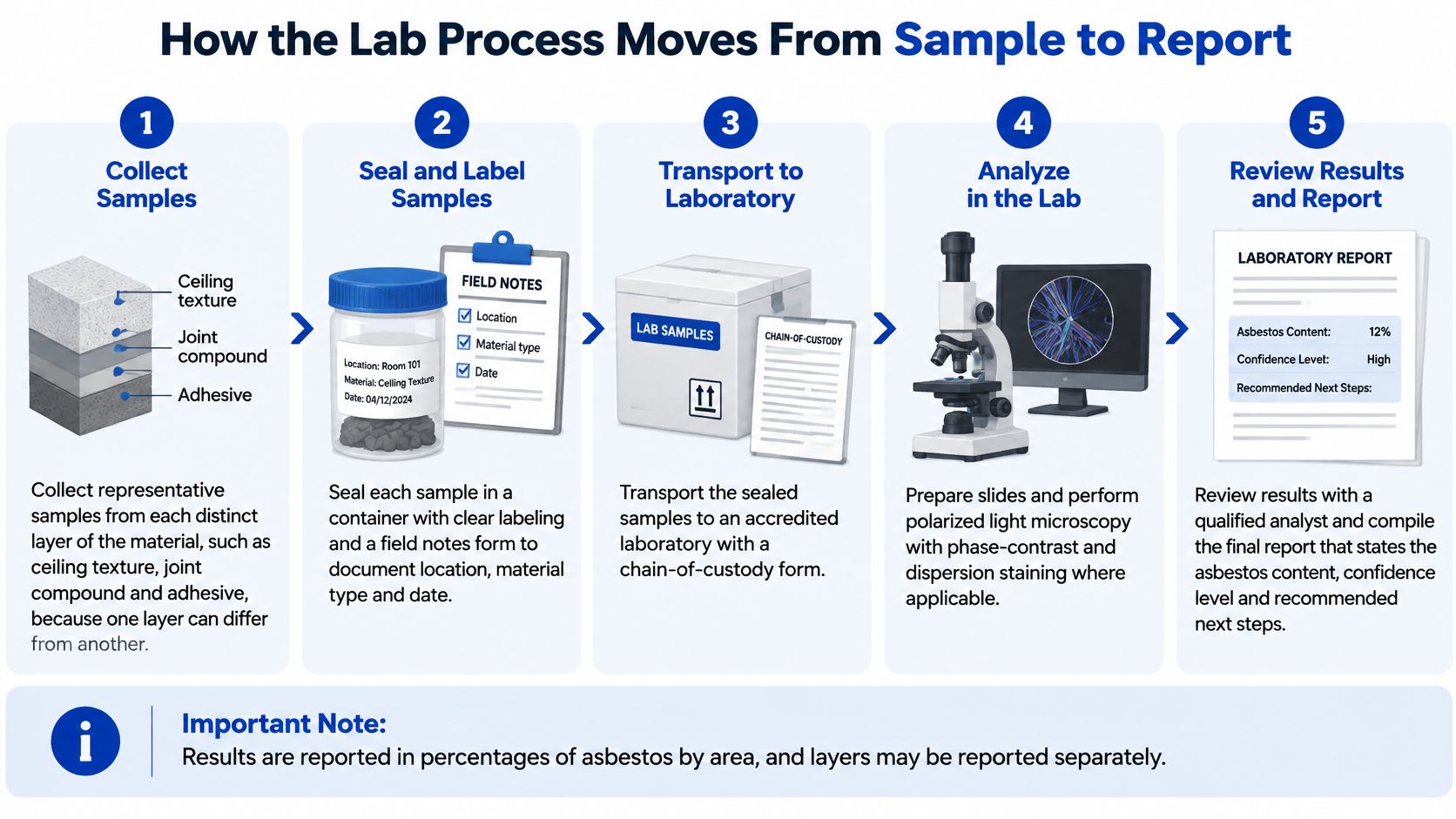
Read each suspect fiber under PLM. The optical properties get recorded, fiber by fiber, with the liquid conditions noted for each observation. Point counting, a method of recording what fraction of the mount consists of asbestos fibers, can then support a percentage estimate for that layer. The result depends on the portion selected, the size of the fibers present, and the question the report is meant to answer.
Mount and examine at least three slides when nothing is found. AQMD analysis practice treats this as a quality-control step. When no asbestos is detected by PLM, point counting is not required, but at least three slide mounts must be prepared and examined in their entirety. That matters most when the answer is "no," because a negative finding depends on showing that enough material was checked.
Issue a report that states type, amount, and location. The result should name the asbestos mineral found, the percentage by area for each layer analyzed, where in the building it sits, and the observations behind the conclusion. Sensitive Environmental provides clear reporting for contractors, property owners, and inspectors on asbestos projects, so the reader can connect the lab finding to the material that was sampled.
What a percentage means: "3% chrysotile in joint compound" describes that layer, not the ceiling as a whole. Layered materials usually get reported layer by layer for that reason.
A useful report also tells you what the result can and cannot prove. It can describe the fibers seen in the prepared sample under the recorded conditions. It cannot prove that every inch of a wall, ceiling, or duct system has the same content. That is why the location notes, layer descriptions, and sample count matter as much as the final percentage.
A do-it-yourself kit usually falls short. A kit typically relies on one small pinch from one spot, with no documented preparation steps, no layer separation, and no record of which liquid conditions produced the identification. Professional testing includes identification of asbestos-containing materials, certified sampling, and laboratory analysis. It also covers pre-renovation and pre-demolition inspections and compliance testing for regulatory requirements.
Before approving work, ask the lab or consultant a few direct questions. Which layers were sampled separately? Were all distinct materials in the affected area included? Were point counts used, and what did they measure? Can the report tie each result back to a location and material description? Those questions turn a PLM result from a simple yes or no into evidence you can use.
SCAQMD Rule 1403 Requirements for Bulk Asbestos Testing
A renovation can turn a sealed wall, ceiling, or flooring material into a dust-generating work area. South Coast AQMD Rule 1403 governs how asbestos is handled during renovation and demolition across the South Coast air basin, which includes much of Los Angeles County and Orange County. The rule turns polarized light microscopy, or PLM, from a useful laboratory service into a documented regulatory step. Asbestos testing is required before renovations regardless of building age, and the South Coast Air Quality Management District requires that testing.
The Rule 1403 regulation text sets the requirements in plain terms:
- Survey before work. The affected facility or component must be thoroughly surveyed before any renovation or demolition begins.
- Identify and quantify. The survey must inspect, identify, and quantify friable asbestos-containing material and Class I and Class II non-friable material, with physical sampling where appropriate.
- Collect under the federal rule. Bulk samples must be collected under 40 CFR Part 763.86.
- Analyze by an approved method. Compliant analysis uses SCAQMD Method 300-91 or the polarized-light-microscopy procedure in Appendix A, Subpart F, 40 CFR Part 763.
- Use an accredited lab. The laboratory must hold accreditation from the National Voluntary Laboratory Accreditation Program (NVLAP), a laboratory accreditation program that evaluates testing competence.
That last requirement is easy to overlook. NVLAP accreditation is what separates a documented regulatory result from an informal look through a microscope. It gives the property owner, contractor, and inspector a defensible basis for deciding how disturbed material must be managed.
What to Check on the Report You Receive
Read the report like a map. A result that looks precise on paper still depends on where samples came from, which layers were opened, and what method the laboratory used. Check four things:
- The method named on the report. It should match a Rule 1403 option, such as SCAQMD Method 300-91 or the PLM procedure in the federal appendix.
- The amount of asbestos found. The result should state the percentage by area for each layer analyzed, not just a building-wide estimate.
- The location of each material. The report should identify where the material sits in the building so the work crew knows what area the result applies to.
- The list of layers sampled. A report covering two of five layers on a wall tells you only about those two layers.
A useful report connects the lab result to a real location and a specific material. That connection matters because a percentage from one joint compound layer, floor tile, or insulation section does not describe every similar-looking material in the building. It answers the question asked by the sample that was collected.
Sensitive Environmental provides clear reporting for contractors, property owners, and inspectors on asbestos projects. The company's hired asbestos experts have training qualification documents approved and certified by both the federal and state governments, which is the baseline to confirm with any firm you hire.
A positive result does not automatically require removal. It tells you the material contains asbestos, and it gives you and a qualified professional the basis for deciding what happens next, whether that's planning and documentation for work that will disturb it, leaving it in place and managing it, or another approved approach. Rule 1403 work also intersects with Procedure 5 when a Certified Asbestos Consultant, or CAC, finds asbestos-containing material damaged or significantly damaged. In that case, the CAC writes a Procedure 5 clean-up plan.
Where PLM Results Fall Short and Why Context Matters
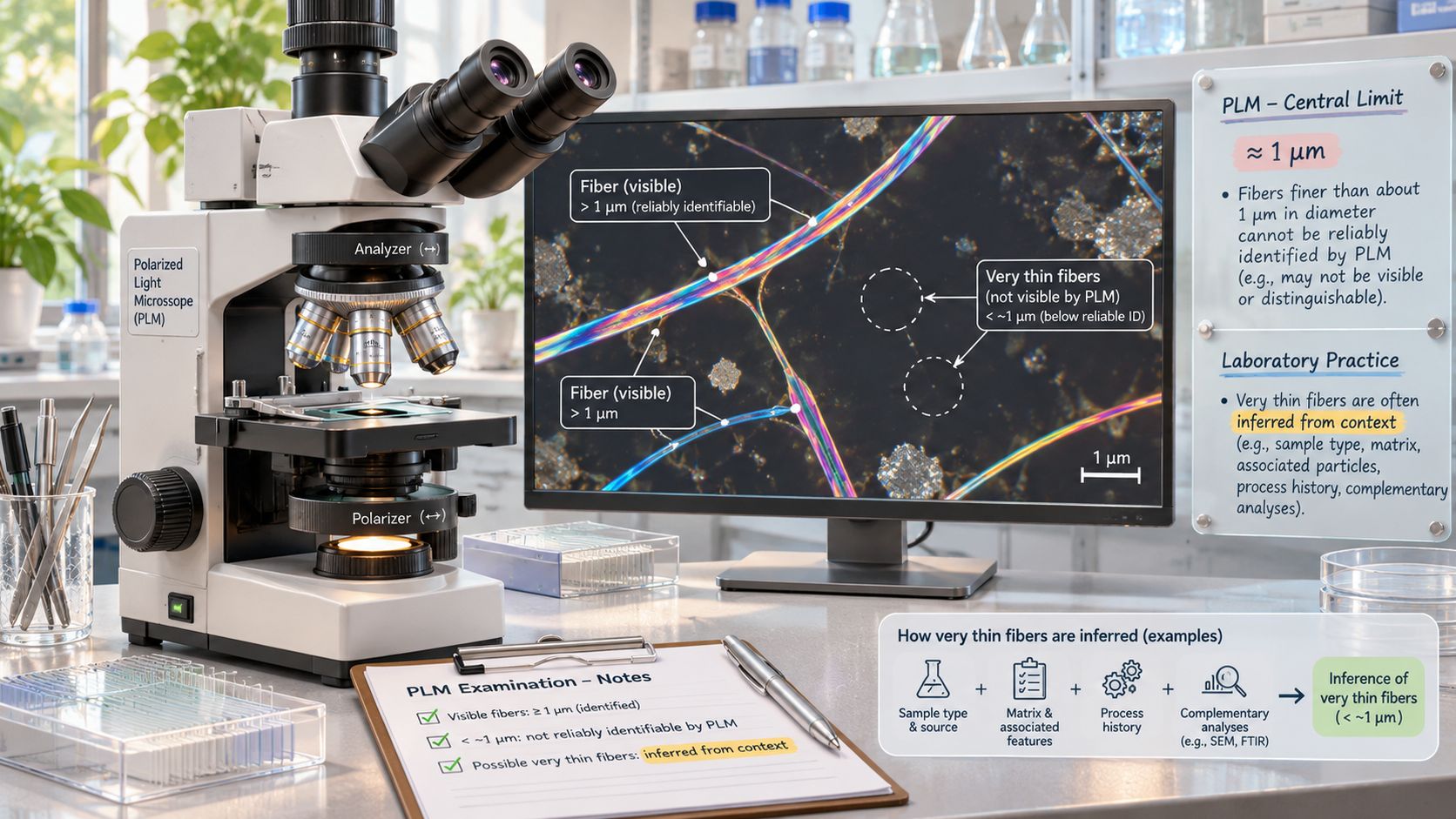
PLM has a hard floor, and it's measured in fiber width. The OSHA appendix on bulk sample analysis notes that polarized-light methods generally cannot reliably identify fibers finer than approximately 1 micrometer in diameter, even when those fibers are visible. Laboratories work around this by inferring very fine fibrils from larger, identifiable bundles in the same material.
That inference is reasonable most of the time. It becomes shaky in materials that are heavily bound, finely milled, weathered, or unusually homogeneous.
Sampling bias matters just as much. The OSHA ID-191 method document notes that PLM uses only a small amount of material, so an inhomogeneous sample can produce either a high or a low result depending on where the analyst's portion happened to come from. EPA guidance cited in that document warns specifically that thin asbestos fibers in some floor tiles could go undetected, which means an older negative result on flooring may not be definitive.
A Worked Example on One Wall
Say three bulk samples come back from a single wall in a commercial suite. One is positive for chrysotile in the joint compound. The other two are negative, and both negatives came from a textured patch that didn't include the joint compound layer sitting behind it.
What those negatives prove: the material examined didn't contain detectable asbestos. They say nothing about whether the wall is clear for demolition.
The samples were valid. The sampling plan wasn't. Whoever reads the report has to notice that the negatives describe a different layer than the positive, and that the layer which tested positive is the one the crew is about to cut through.
A negative result also says nothing about exposure risk if fibers are already airborne, which is a separate question from why asbestos is dangerous once material is disturbed.
Three Questions to Ask the Lab
Before a negative result becomes a project decision, ask:
- How was the sample split, and was every layer in the bag examined and reported separately?
- How many layers were tested, and does the report name them or only give one overall result?
- How does the report treat fibers below the method's resolution, and would additional preparation change the conclusion for this material?
None of those questions require a technical background. They're the difference between reading a result and relying on one.
When to Confirm PLM Results With Higher-Resolution Methods
Three microscopy methods come up in asbestos work, and they don't do the same job.
| Method | What it resolves | Typical use |
|---|---|---|
| Polarized light microscopy (PLM) | Optical properties of fibers at and above the optical resolution limit | Routine identification in bulk building materials |
| Phase-contrast microscopy (PCM) | Fiber counts only; cannot separate asbestos from non-asbestos fibers | Air exposure monitoring, not bulk identification |
| Transmission electron microscopy (TEM) | Very fine fibers and structure, with elemental information | Confirmation when PLM is inconclusive or the decision carries high consequences |
PLM's limitation isn't only about seeing small fibers. It also struggles to separate asbestos from visually similar non-asbestos fibers and to interpret low concentrations, because it relies on morphology, color, and optical properties and cannot directly establish elemental composition or crystal structure. CDC-supported research summarized in EPA's asbestos analysis guidance notes that matrix materials can mask identifying characteristics and that PLM may produce false positives or false negatives in certain materials. It also notes PLM cannot reliably detect asbestos at concentrations below approximately 1% in some contexts, and that routine fiber-counting conventions may exclude structures shorter than 5 micrometers or with a length-to-width ratio below 3:1, which can underestimate smaller structures.
The Criteria That Decide It
Five factors shift the answer. The material type (heterogeneous, layered, textured, or heavily bound products). The fiber type suspected. Matrix interference from binders and coatings. The regulatory threshold that applies to the project. And what happens if the result is wrong.
Two examples show how that plays out. Routine bulk identification of clearly visible fibers in a plaster sample usually stays with PLM, and that's the right call. Thin fibers suspected in layered flooring before a demolition, or a negative result that will support a high-consequence decision such as disturbance during demolition or an exposure investigation, may justify TEM confirmation. Standards activity has moved toward more explicit integration of PLM with SEM or TEM and improved sample pretreatment for difficult organic and mineral matrices.
A Verdict by Situation
- Routine residential renovation with clearly identified fibers: PLM is the method, and it answers the question.
- Layered, textured, or heavily bound products before demolition: ask whether the material warrants electron microscopy before you accept a clean result.
- Any negative that will carry a major decision: request the extra step, and get the reasoning in writing.
The decision framework belongs with a qualified professional, not a menu of acronyms. Choosing TEM for every sample adds cost without improving a project that properly calls for PLM, and choosing basic PLM where another method applies creates the opposite problem. If you're weighing whether you can test for asbestos at home with a kit, remember that the method question is settled by the material and the decision, not by convenience.
Confirm Your Bulk Sample Testing Before Work Begins
Five steps get a project from "we think there's asbestos" to documentation a contractor and a regulator can both use.
- List every material the work will disturb, including layers hidden under finishes. Texture over drywall, mastic under tile, and backing under sheet flooring all count.
- Ask for a sampling plan that covers each distinct layer and each building area the project will affect.
- Confirm the lab's NVLAP accreditation and the method named on the report before work is scheduled.
- Check that the report lists amount and location, not a simple yes or no. Our inspection reports include the amount and location of asbestos in a building for exactly this reason.
- Decide with a qualified professional whether a higher-resolution method is needed for thin fibers or for a result that will carry a high-consequence decision.
If a wall is coming out to open up a kitchen, the structural questions come first, and open-concept layout choices for split-level homes covers how those decisions play out. The environmental question runs alongside it, because a wall that comes down releases joint compound, texture, and adhesive that nobody sampled. Commercial projects carry heavier documentation expectations, which is part of why asbestos testing is essential before any commercial renovation project in Los Angeles.
We recommend that home buyers planning renovations have a Certified Asbestos Consultant test all materials that will be impacted during the work, before the first fixture comes off the wall.
Sensitive Environmental provides asbestos testing, surveys, and sampling throughout Los Angeles and Southern California, with laboratory analysis and reporting that names the method, the amount found, and where each material sits in the building. If a renovation, demolition, or property purchase is coming up, we can review the materials involved and lay out a sampling plan before work is scheduled. Call for a free, no-obligation consultation and visit Sensitive Environmental to start the conversation.