A Phase II Environmental Site Assessment is an intrusive, sampling-based investigation that follows a Phase I ESA to confirm, quantify, and delineate suspected contamination in soil, groundwater, soil vapor, or other relevant media. It gives property owners information they can use to make informed decisions about transactions, redevelopment, regulatory compliance, and remediation planning.
You may be looking at a commercial property in Los Angeles, preparing a renovation, or reviewing a development site where the Phase I report identified a recognized environmental condition. The natural question is, “What does that finding mean, and what should happen next?” A Phase II ESA helps replace assumptions with field data and laboratory analysis, but it isn't just a pass-or-fail inspection.
Table of Contents
- When a Phase I Report Leads to More Questions
- Defining a Phase 2 Environmental Site Assessment
- How Phase I and Phase II Environmental Assessments Differ
- Investigation Methods Used in Phase II Environmental Testing
- Understanding Phase II Results and Remediation Decision Pathways
- Common Misconceptions About Phase II Environmental Assessments
- When to Schedule Phase II Environmental Testing in Southern California
When a Phase I Report Leads to More Questions
You've just received a Phase I Environmental Site Assessment for a property your company wants to purchase. The report notes a former underground storage tank, historical industrial use, or a nearby source that could have affected the site. Nothing in the report proves contamination exists, but the finding is serious enough that a lender, attorney, investor, or environmental professional may recommend additional investigation.
That recommendation doesn't automatically mean the property is contaminated. A Phase I ESA is designed to identify potential environmental concerns through historical research, records review, site observations, and other due diligence activities. It can identify a recognized environmental condition, commonly called a REC, but it generally can't determine the concentration, location, or extent of contaminants without collecting physical samples.
The questions a Phase I cannot answer
A Phase I may raise practical questions such as:
- Is contamination present: Has a suspected release affected soil, groundwater, soil vapor, or another environmental medium?
- Where is it located: Is the concern limited to one area, or has it migrated across the property?
- How concentrated is it: Do laboratory results show concentrations that require additional evaluation?
- What does it mean for the project: Could the condition affect a purchase, planned construction, worker safety, or future property use?
A Phase II investigation is the logical next step when those questions matter to the transaction or project. EPA brownfield guidance describes Phase II as the stage where an environmental professional develops a sampling plan and collects samples from soil, groundwater, and other media to determine contaminant type and distribution. EPA's brownfield assessment guidance also identifies Phase II as appropriate when a Phase I reveals known or potential contamination.
Practical rule: A Phase I identifies a reason to investigate. A Phase II gathers the evidence needed to decide what that reason means.
For a developer, the information may shape site design, utility work, excavation planning, or project budgeting. For a buyer, it may support negotiations and environmental due diligence. For a general contractor, it may identify conditions that need to be understood before subsurface work begins. In each situation, the value of Phase II testing lies in improving the next decision, not in producing a dramatic label for the property.
Defining a Phase 2 Environmental Site Assessment
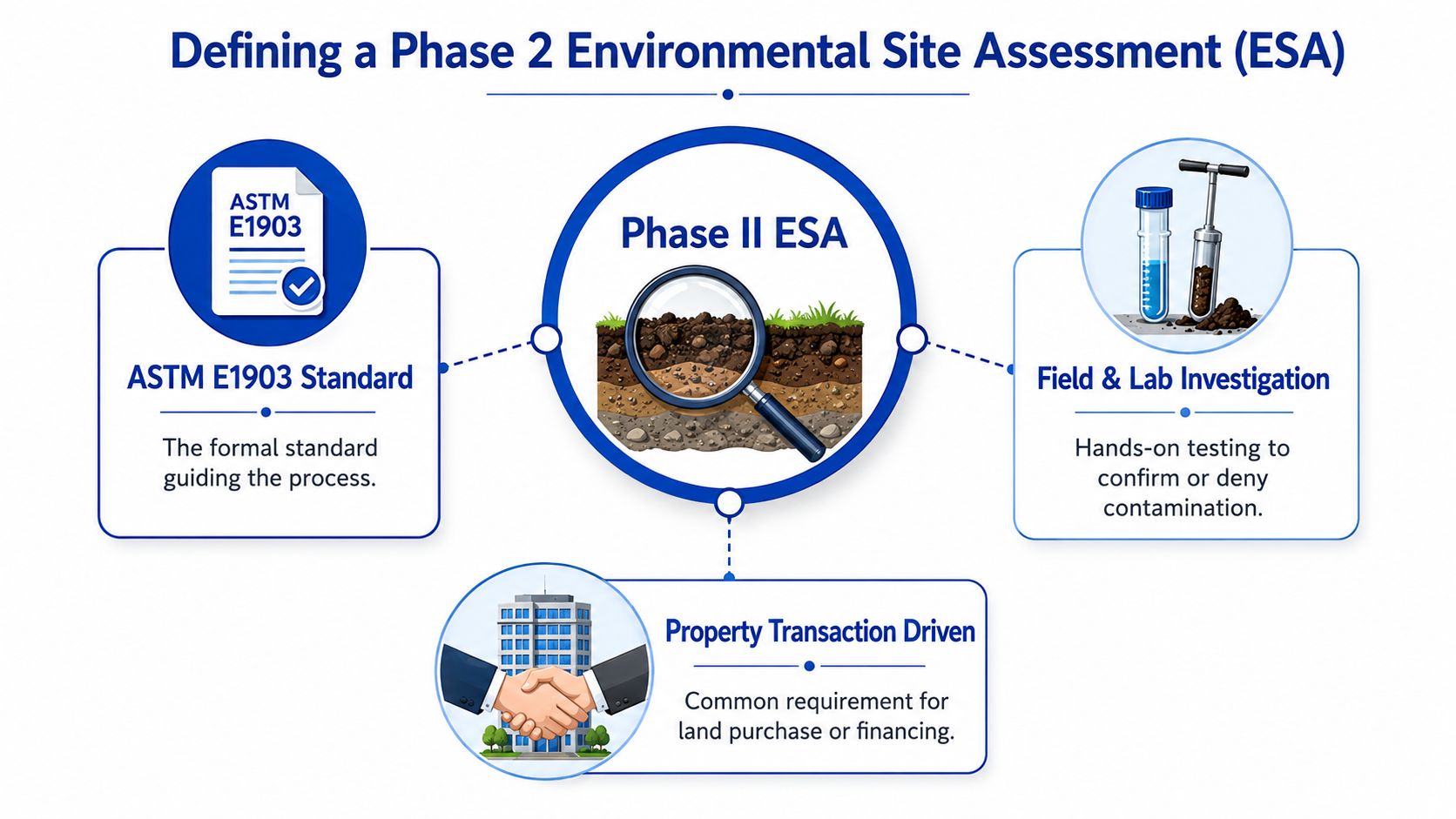
A Phase II Environmental Site Assessment is an intrusive follow-up investigation to a Phase I ESA. Under ASTM's framework, it evaluates the presence or likely presence of contaminants in commercial property, including hazardous substances, pollutants, contaminants, petroleum, petroleum products, and other substances within the scope of CERCLA. ASTM's Phase II environmental assessment standard describes the practice as one based on the scientific method and intended to be objective, representative, reproducible, and defensible.
The central purpose is to evaluate recognized environmental conditions identified in the Phase I ESA or a transaction screen. ASTM states that the investigation should gather enough information about the nature and extent of contamination to support informed business decisions and, where applicable, the innocent purchaser defense under CERCLA. The ASTM E1903 guidance provides that decision-making focus.
What the investigation is trying to establish
Phase II work moves from suspicion toward quantification and delineation. Alberta's environmental site assessment standard describes Phase II as a process for quantifying and delineating concentrations of contaminants of potential concern, or COPCs, so professionals can assess risk and evaluate management or remediation options when necessary. Its workflow includes reviewing earlier reports, developing a conceptual site model, planning sampling, conducting the investigation, interpreting data, and summarizing conclusions. Alberta's environmental site assessment standard explains that progression.
The consultant may investigate soil, groundwater, soil vapor, surface water, sediment, or other media, depending on the suspected source and exposure pathway. Sampling locations are selected to address the REC, not scattered randomly across the property. A former tank area, for example, may require a different plan from a concern involving vapor beneath a building.
What Phase II does not promise
A Phase II ESA isn't always a complete site characterization. HUD-related ASTM guidance explains that the investigation can stop short of fully characterizing every part of a property, provided it proceeds far enough to identify the location of greatest concentration and risk in relation to the recognized environmental conditions.
That boundary matters. A Phase II report may provide strong evidence for a transaction or development decision while still recommending additional delineation. It's better understood as a targeted, defensible decision-making investigation, not a universal certificate that a property is clean.
How Phase I and Phase II Environmental Assessments Differ
The easiest way to understand the relationship is to view Phase I and Phase II as different questions in the same due diligence process. Phase I asks whether available information suggests an environmental concern. Phase II asks what physical testing can establish about that concern.
Phase I is generally non-intrusive. The environmental professional reviews historical records, regulatory information, available property documents, and current site conditions. The process may identify former industrial operations, storage tanks, spills, staining, or other conditions that warrant closer attention, but it doesn't ordinarily include drilling or laboratory sampling.
Phase II is intrusive and data-driven. The consultant develops a sampling plan, collects samples from appropriate media, sends them for laboratory analysis, and interprets the results against relevant screening or action levels. The findings can help define whether contamination exists and whether additional investigation or management should be considered.
| Feature | Phase I ESA | Phase II ESA |
|---|---|---|
| Primary question | Could recognized environmental conditions be present? | Are contaminants present, and what are their nature, concentration, and distribution? |
| Typical approach | Records review, historical research, site reconnaissance, and interviews | Intrusive sampling, field observations, laboratory analysis, and data interpretation |
| Physical disturbance | Generally non-intrusive | May involve borings, test pits, monitoring wells, or vapor sampling points |
| Laboratory role | Usually no environmental sample analysis | Laboratory analysis is central to the investigation |
| Main output | Identification of potential environmental concerns | Data supporting transaction, redevelopment, risk, or regulatory decisions |
| Typical conclusion | Further investigation may be recommended | Results may support no additional testing, more delineation, consultation, or planning |
Why a Phase I recommendation isn't a verdict
A Phase I recommendation for Phase II testing doesn't establish that a release occurred. It means the available information doesn't resolve an environmental question that could affect the property.
That distinction helps keep the process practical. A buyer shouldn't treat the recommendation as proof of a failed deal, and a seller shouldn't treat it as an accusation. The Phase II gives both sides a clearer factual basis for deciding how to proceed.
For commercial real estate professionals, the timing matters as well. Environmental testing should be planned early enough for site access, utility considerations, laboratory analysis, and report review. Waiting until construction or closing is imminent can make a targeted investigation harder to coordinate.
Investigation Methods Used in Phase II Environmental Testing
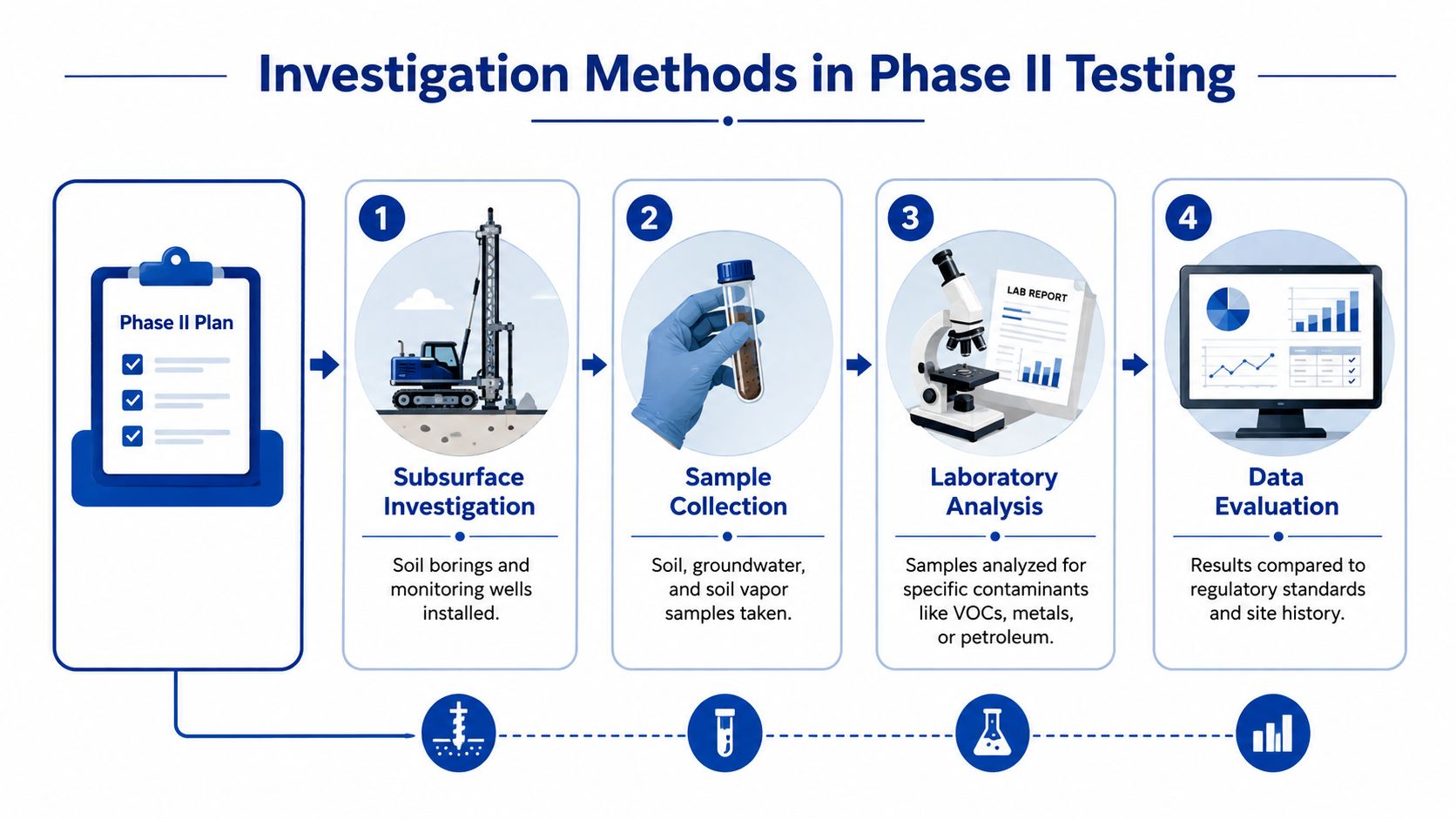
A good Phase II starts before anyone drills a boring. The environmental professional first reviews the Phase I findings, identifies areas of concern and contaminants of potential concern, develops a conceptual site model, and selects sampling locations and media that can answer the site-specific questions.
The sampling plan should connect the suspected source to a possible pathway. A former petroleum storage area may lead to soil and groundwater sampling. A volatile chemical concern beneath an occupied building may require soil vapor evaluation. A historical industrial use may call for analysis of metals, petroleum compounds, VOCs, or other substances selected because of documented or suspected site activities.
From subsurface access to laboratory results
Field work can include several techniques:
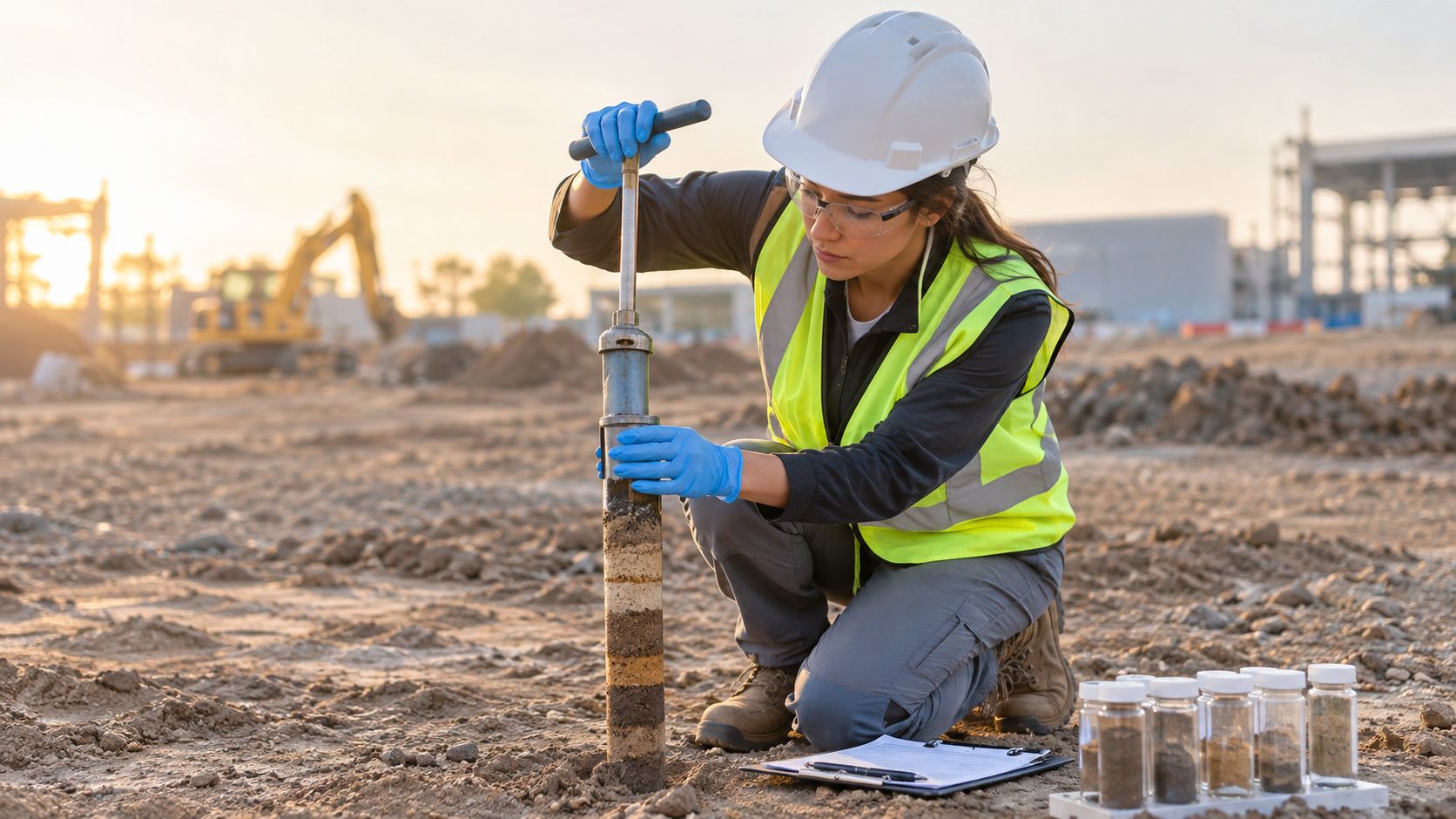
- Soil borings: A drilling rig advances through subsurface materials so the consultant can collect soil at selected depths and inspect changing conditions.
- Test pits: Excavations may help evaluate shallow soil, fill, buried materials, or a localized area where a boring isn't the most suitable approach.
- Groundwater sampling: Monitoring wells or other approved methods can provide samples when the suspected contaminant pathway may reach the water table.
- Soil vapor sampling: Vapor points can help evaluate volatile compounds in subsurface gas and potential vapor migration toward a structure.
- Other media: Depending on the property, the plan may include surface water, sediment, or building-related materials when those samples are relevant to the recognized environmental condition.
A technically strong investigation uses targeted subsurface sampling to identify localized hot spots and define the vertical and lateral extent of a contaminant plume. Soil is commonly collected from borings or test pits, while groundwater is sampled when the contaminant pathway is likely to reach the water table. An ASTM-based Phase II ESA example illustrates that connection between field methods and decision quality.
Why sample selection affects confidence
Sampling density and media selection influence how confidently a consultant can describe site conditions. A limited plan may be appropriate for a narrowly defined concern, while a complex property may require additional locations or depths to determine whether contamination extends beyond the suspected source.
Field personnel also document sample identification, handling, preservation, and transport. The laboratory then analyzes samples for the contaminants selected in the work plan. The final report typically brings together field observations, laboratory results, site history, maps, tables, and an interpretation of how the data relate to the recognized environmental condition.
Sensitive Environmental provides environmental testing services that include professional sampling, laboratory analysis, and reporting for environmental conditions affecting properties. For a Los Angeles commercial site, the scope may need to coordinate Phase II work with other testing, such as asbestos sampling before renovation, lead testing, mold sampling after water damage, indoor air quality testing, or fire residue testing after a wildfire.
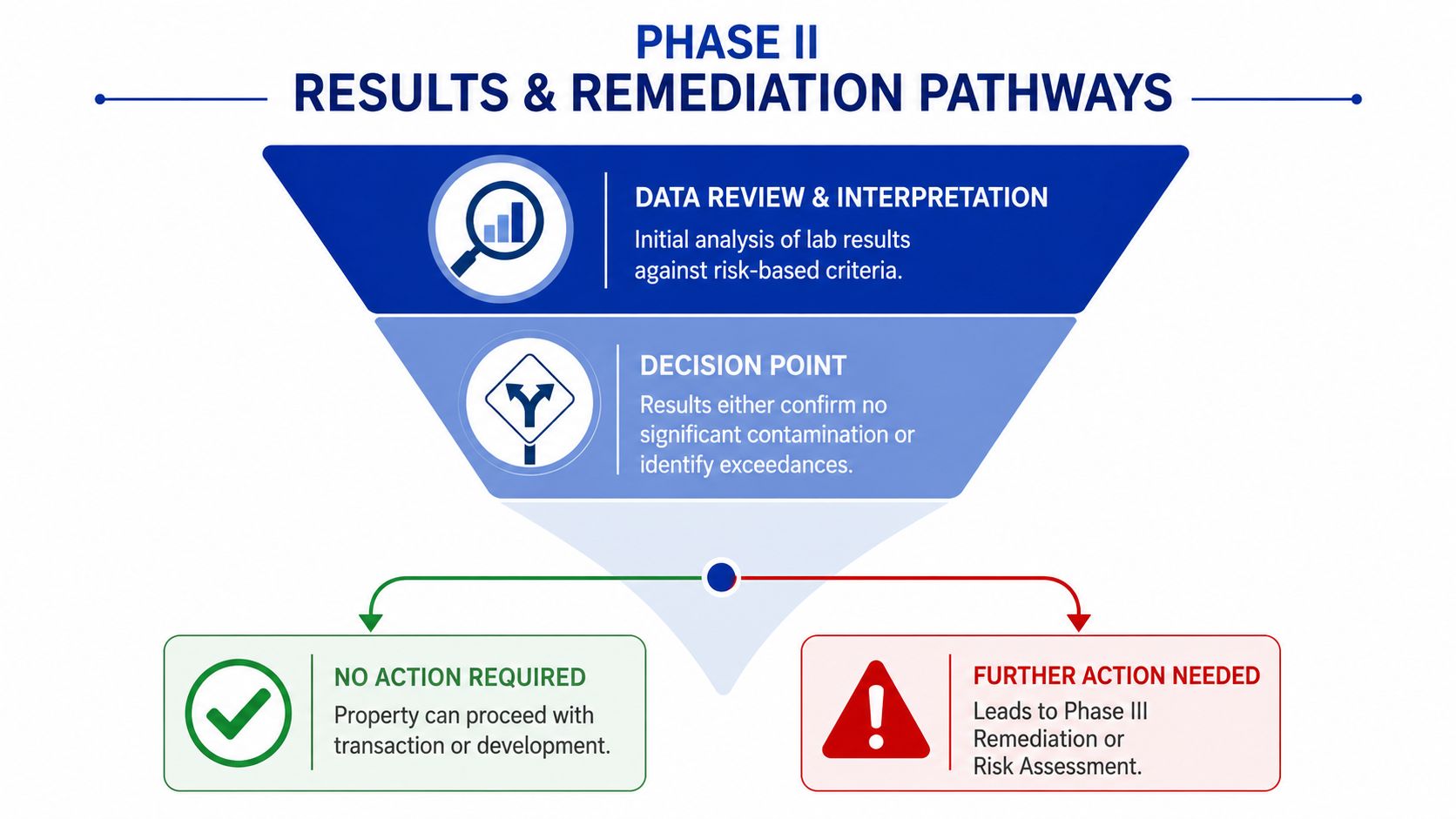
The consultant compares detected concentrations with applicable state or federal screening levels, action levels, or other criteria relevant to the intended reuse. If results exceed a relevant threshold, that doesn't by itself dictate one universal response. It identifies a condition that may require further delineation, risk evaluation, regulatory discussion, or planning by qualified professionals.
Understanding Phase II Results and Remediation Decision Pathways
Laboratory results are only the beginning of interpretation. The consultant considers the contaminant, concentration, sample depth, location, likely source, exposure pathway, property use, and applicable regulatory criteria together. A result that matters for one planned reuse may require a different evaluation for another, which is why raw laboratory tables shouldn't be read in isolation.
Phase II data can support several decision pathways. Results may indicate that the suspected concern wasn't identified in the sampled areas. They may show contamination that appears localized. They may also reveal concentrations or migration patterns that justify additional sampling, regulatory consultation, risk assessment, or remediation planning.
How owners and project teams use the findings
A property owner or developer may use the report to:
- Refine the project plan: Adjust excavation, grading, building placement, or utility work around known conditions.
- Support transaction discussions: Give buyers, sellers, lenders, and attorneys a documented basis for environmental risk discussions.
- Plan additional investigation: Target the next samples where the first round indicates uncertainty or a possible plume.
- Evaluate management options: Consider appropriate controls, monitoring, regulatory coordination, or other professional recommendations.
- Document due diligence: Preserve the investigation record for the transaction and future property decisions.
A positive result doesn't automatically mean full remediation or abatement is required. It means the data identified a condition that must be evaluated in context. The appropriate next step may be more delineation, a risk assessment, consultation with a regulatory agency, or a project-specific management plan.
A report is a snapshot, not a permanent guarantee
ASTM-based guidance emphasizes that investigation data represent site conditions only when the data were generated. Transportation and public-agency guidance on Phase II investigations also identifies worker safety, public health exposure, and disposal or reuse requirements as matters that Phase II scopes may need to address.
That's why a report shouldn't be described casually as a final “clean” or “not clean” verdict. It provides defensible information for a defined scope and time. If site use changes, new construction exposes previously inaccessible soil, or additional information emerges, the owner may need another evaluation.
Sensitive Environmental is not a remediation or removal contractor. Its role is environmental testing, inspection, sampling, laboratory coordination, and reporting, while property owners and their qualified project advisors determine what response is appropriate based on the findings. For broader project coordination, readers may review environmental remediation services information in Los Angeles, while keeping the Phase II report's testing purpose separate from any later response work.
Common Misconceptions About Phase II Environmental Assessments
A developer may receive a Phase I report, authorize a Phase II investigation, and expect a few soil samples to produce a simple yes-or-no answer. That expectation can lead to poor decisions. A Phase II ESA is designed around the recognized environmental condition, suspected contaminants, possible migration routes, and the property's intended use. Its value lies in clarifying what decision the available evidence can support.
Phase II is not only about soil
Authoritative EPA guidance notes that Phase II ESAs may sample soil, groundwater, soil vapor, and other media to determine whether hazardous substances or petroleum are present and how they are distributed. The appropriate medium depends on the question under examination.
Soil alone may not show whether a volatile compound has migrated beneath a building. Groundwater may matter when a release could reach the water table. Soil vapor may be relevant when subsurface gas could move toward indoor spaces. Sampling only soil, without considering the likely pathway, can leave a significant environmental question unresolved.
A detection does not dictate one automatic response
A laboratory detection is evidence to evaluate, not an automatic order to remediate. The consultant considers concentration, location, depth, exposure route, intended property use, and applicable criteria before advising the owner or project team.
The misconception is that any detection forces the same response. In practice, the report may close the original question within its defined scope, identify a need to establish contamination limits, or route the condition to a risk or regulatory review. The findings may also affect construction planning, including worker protections, soil handling, disposal, reuse, or other controls. The appropriate response depends on what the results show and how the property will be used.
Proper planning matters more than the number of borings
A few strategically placed borings may answer the question, while a larger but poorly designed program may miss localized contamination. A defensible Phase II uses a conceptual site model and a site-specific plan, documenting why sampling locations, depths, analytical methods, and laboratory procedures were selected.
DIY sampling creates a separate problem. Home test kits and informal samples may lack the chain of documentation, targeted design, laboratory analysis, and professional interpretation needed for a commercial transaction or regulatory decision. A contractor or owner relying on incomplete samples could misjudge conditions before renovation, financing, redevelopment, or a compliance review.
Professional environmental testing matters especially where the property has industrial operations, historical releases, potential worker exposure, or construction plans that may disturb subsurface materials. The report should help the owner choose the next defensible action, not just produce a collection of laboratory results.
When to Schedule Phase II Environmental Testing in Southern California
Schedule a Phase II ESA when a Phase I report identifies a recognized environmental condition or leaves a significant contamination question unresolved. It can also be appropriate before acquiring, financing, or redeveloping a commercial or industrial property with a history of petroleum storage, chemical use, manufacturing, waste handling, or other activities associated with potential releases.
Southern California projects often involve overlapping environmental concerns. A developer may need a Phase II ESA for subsurface contamination while also arranging pre-renovation or pre-demolition asbestos testing, SCAQMD Rule 1403 compliance sampling, lead-based paint inspections, mold testing after water intrusion, indoor air quality testing, or combustion byproduct testing after fire damage. Those services answer different questions and shouldn't be treated as interchangeable.
Choosing the right testing provider
Ask whether the provider can:
- Tie the scope to the Phase I findings: The work plan should address the actual recognized environmental conditions rather than apply a generic sampling package.
- Select appropriate media: Soil, groundwater, vapor, and other samples should reflect the suspected source and pathway.
- Coordinate laboratory analysis: The analytical program should match the contaminants of concern and the project's decision needs.
- Explain regulatory comparisons: The report should make clear how results relate to relevant screening or action levels.
- Produce usable documentation: Owners, contractors, lenders, and regulators need clear maps, tables, methods, results, and conclusions.
Sensitive Environmental serves properties throughout Los Angeles and Southern California with environmental assessments, commercial environmental testing, industrial hygiene testing, asbestos and lead testing, mold and indoor air quality sampling, and fire-related testing for ash, soot, char, smoke residue, and heavy metals. Contact the team before closing, excavation, renovation, or redevelopment so the appropriate testing scope can be discussed early.
Sensitive Environmental can evaluate whether a Phase II Environmental Site Assessment is appropriate, develop targeted sampling plans, coordinate laboratory analysis, and provide clear reporting for property transactions and redevelopment decisions. Visit Sensitive Environmental to discuss professional environmental testing in Los Angeles and Southern California.