Maria had barely unpacked the boxes in her 1963 ranch house in Echo Park when she noticed paint flaking beside her toddler's bedroom window. She wanted a simple answer: is there lead, and does her family face a risk? The right answer depends on what she plans to do next. A paint inspection, dust sampling, soil testing, and drinking-water analysis answer different questions, and ordering the wrong test can leave the most important exposure pathway unmeasured.
The same problem affects homeowners preparing renovations, landlords handling tenant concerns, buyers reviewing disclosures, and families responding to a blood lead result that has risen above the expected threshold. A professional lead testing home plan should begin with the scenario, not with a retail kit or a single generic inspection.
Table of Contents
- Why the Reason for Testing Changes the Whole Plan
- The Four Sample Types and What Each One Tells You
- DIY Lead Kits vs Professional Sampling
- What a Professional Lead Inspection Actually Looks Like
- Reading the Lab Report Without Misreading It
- Federal and California Rules Homeowners Run Into
- Smart Questions Homeowners Ask Before Booking a Test
Why the Reason for Testing Changes the Whole Plan
A homeowner buying a pre-1978 house, preparing a renovation, responding to a child's blood lead result, or worrying about tap water needs a different testing plan. Paint, dust, soil, and water answer separate questions. Choose the scenario first, then choose the samples.
Residential lead paint was banned in the United States in 1978, but older housing still creates exposure concerns. The CDC reports approximately 29 million U.S. housing units with lead-based paint hazards, including deteriorated paint and contaminated dust, and about 2.6 million of those homes are occupied by young children. HUD's American Healthy Homes Survey II found lead-based paint in 34.6 million homes, or 29.4% of U.S. housing units. CDC lead paint and housing guidance provides the underlying figures.
Four triggers, four different plans
Buying a pre-1978 home with a child under six calls for a professional lead-based paint inspection. Add a risk assessment if paint is deteriorating, renovation is planned, or children can reach windows, floors, bare soil, or other likely exposure points. HUD estimates that 3.3 million American households with children under six have lead exposure hazards from deteriorated paint, dust, or soil. CDC's lead prevention information explains the continuing housing burden.
Planning renovation or window replacement requires component-by-component review. The assessor should identify painted surfaces workers may disturb and determine whether dust, chips, or nearby surfaces need sampling. An inspection can locate lead-based paint, but it cannot show whether renovation has already spread contaminated dust. Schedule dust sampling when that question matters.
Responding to an unexplained high blood lead result requires an exposure-focused risk assessment. Paint may contribute, yet dust, soil, and water can also be involved. The CDC and HUD blood lead reference value is now 3.5 micrograms per deciliter, down from 5.0 micrograms per deciliter in 2012 and 10 micrograms per deciliter before that. The policy change makes source investigation more important, not less.
Handling a tenant, buyer, or disclosure concern requires defensible documentation. A visual inspection may address part of a transaction question, but it does not establish dust or soil conditions. In Los Angeles, review Sensitive Environmental's lead testing services and ask which inspection and sampling combination fits the property.
Practical rule: Decide what decision the result must support before choosing the sample.
The Four Sample Types and What Each One Tells You
Lead testing becomes easier to understand once you separate the material being tested. Paint, dust, soil, and water don't measure the same thing, use the same units, or answer the same risk question.
Paint, dust, soil, and water
Paint testing identifies lead in a coating. An XRF analyzer can evaluate painted components without removing material, while a paint-chip sample sends the coating to a laboratory. Paint results help with renovation planning, component mapping, and compliance decisions. They don't, by themselves, prove that occupants are being exposed.
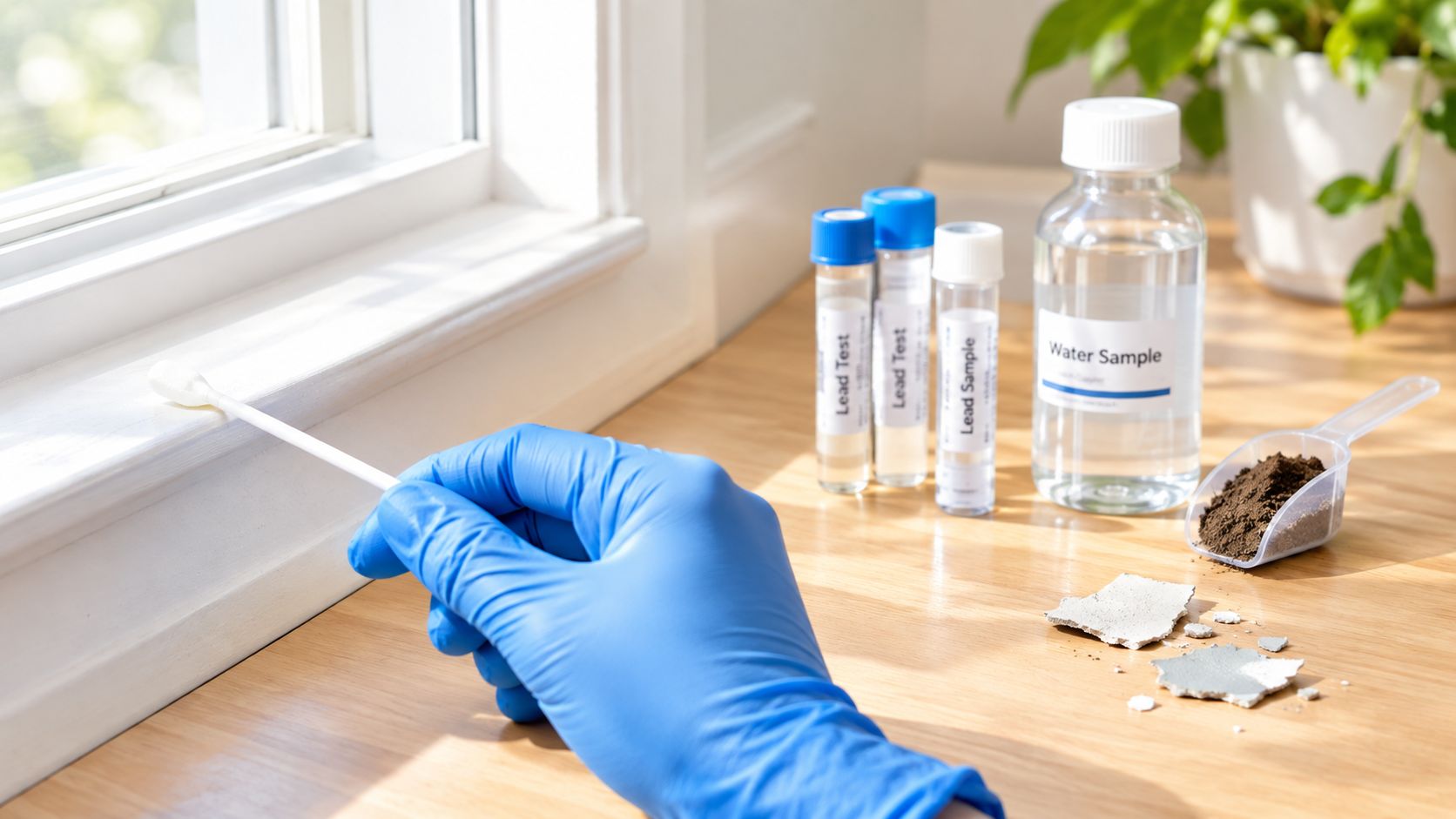
Dust-wipe sampling measures lead loading on a surface, commonly floors and windowsills. The result is reported in micrograms per square foot, or µg/ft². This is often the most useful environmental sample when a child has contact with floors, windows, or nearby household dust because it measures contamination available on a surface.
Soil sampling targets areas where exterior paint may have weathered, especially foundation driplines, bare soil, and play areas. It can also help evaluate soil brought onto a property or disturbed during landscaping. A soil result should be interpreted alongside the location, surface condition, and access pattern.
Water sampling addresses plumbing and service-line pathways. Samples may target first-draw water after stagnation or a flushed sample, depending on the question. EPA says certified-laboratory analysis is the way to confirm lead in drinking water and identifies typical testing costs of about $15 to $100 in its guidance on protecting tap water. For broader background on household plumbing and water-quality testing, water quality testing Australia 2026 offers useful context, although local sampling instructions and laboratory requirements control in Southern California.
| Sample Type | Media Tested | Units Reported | Best For |
|---|---|---|---|
| Paint or XRF | Painted components | mg/cm² or percentage by weight | Pre-renovation planning and identifying lead-based paint |
| Dust wipe | Floors, sills, troughs, and other surfaces | µg/ft² | Evaluating accessible household dust |
| Soil | Bare soil, driplines, and play areas | ppm or mg/kg | Exterior legacy paint and soil exposure pathways |
| Water | Tap water and household plumbing pathway | µg/L or ppb | Service lines, solder, fixtures, and drinking-water concerns |
The practical mistake is ordering every sample automatically. A pre-renovation project may need paint mapping and dust controls, while a family worried about a child's exposure may need dust, soil, and water considered together. If you're unsure whether a visible coating is suspect, what lead-based paint looks like can help you understand why appearance alone can't confirm its composition.
DIY Lead Kits vs Professional Sampling
Retail swabs look appealing because they're inexpensive, immediate, and easy to use. They're also a poor substitute for a professional inspection or laboratory sampling when the result will guide renovation, a transaction, a health investigation, or a dispute.
A field study found that LeadCheck Swabs didn't reliably detect dust lead above 40 µg/ft² under the published field conditions. Consumer Reports also found that these kits generally didn't reliably detect lead down to the Consumer Product Safety Commission benchmark of 100 ppm. The study is available through the National Library of Medicine.
What a kit can and can't do
A swab can serve as a rough triage tool before someone disturbs a painted surface. It may prompt a homeowner to stop sanding or drilling and call a qualified professional. That's its useful role.
It doesn't provide:
- Reliable low-level detection: A negative color change doesn't prove that paint or dust is free of lead.
- A defensible record: A retail kit generally lacks documented field blanks, controlled sample handling, laboratory chain of custody, and a formal report.
- Regulatory documentation: A kit result won't replace the professional documentation required for many renovation, disclosure, clearance, or health-department decisions.
- Exposure characterization: A swab doesn't tell you whether contaminated dust is present on floors, windowsills, or other accessible surfaces.
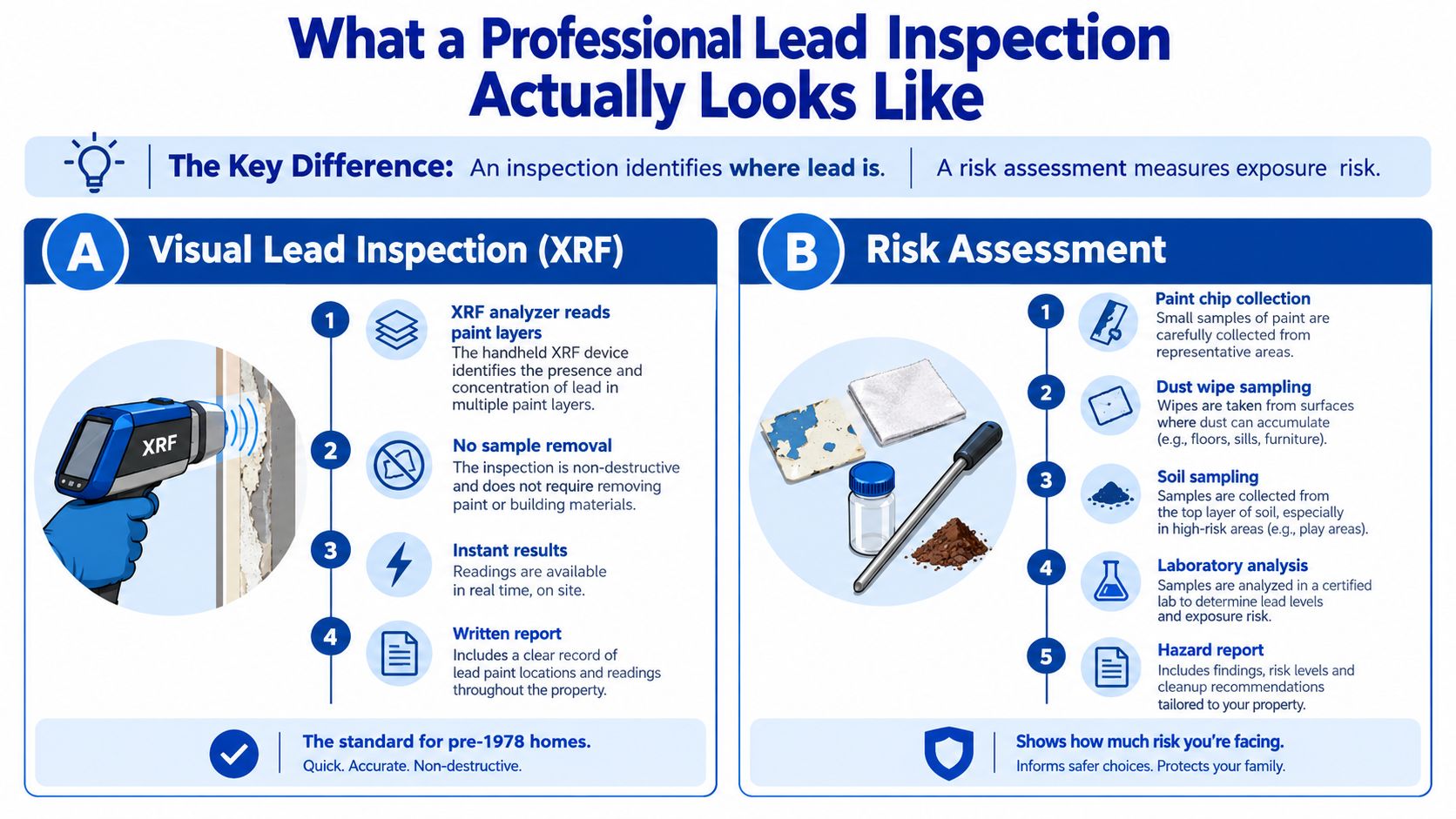
EPA guidance distinguishes an inspection from a risk assessment. An inspection identifies whether lead-based paint is present and where it's located. A risk assessment identifies current hazards and the actions that may be appropriate. The difference matters more than the word “test” on the product label.
A DIY negative is a reason to avoid disturbing the surface until it can be evaluated properly, not a clearance certificate.
What a Professional Lead Inspection Actually Looks Like
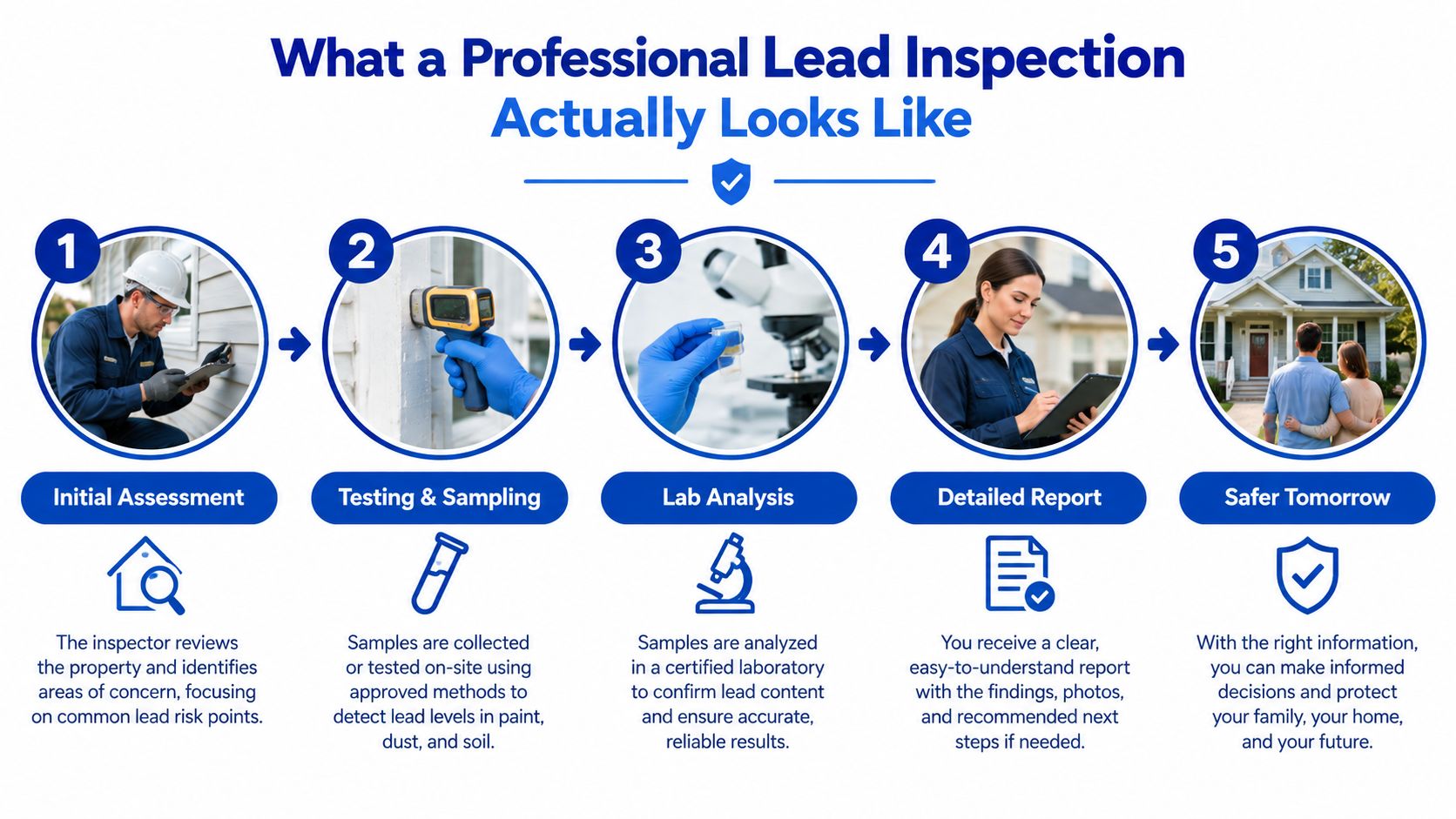
A professional visit usually follows one of two tracks. The first is a lead-based paint inspection, often using XRF equipment. The second is a risk assessment, which evaluates how lead may be moving from painted components, soil, or other materials into accessible dust or other exposure pathways.
Inspection and risk assessment are not interchangeable
During an XRF inspection, the assessor places the analyzer against each distinct painted component, such as a wall, door, window, trim element, or cabinet surface. The instrument reads the coating in place, so the assessor can map where lead-based paint is located without removing paint from every component. HUD identifies lead-based paint at 1.0 milligram per square centimeter or 0.5% by weight. HUD's inspection standard explains the threshold and surface-by-surface approach.
A risk assessment adds samples selected around actual exposure conditions. EPA's dust-wipe method typically uses about a 1-square-foot area on floors and wipes the surface several times in different directions before sealing the wipe for laboratory analysis. Recommended locations include a child's bedroom, the most frequently used living space, and the main entrance. EPA also strongly recommends analyzing the fraction passing a No. 60 sieve, or 250 µm, for indoor dust workups. EPA's dust sampling guidance describes the method.
Sampling, laboratory analysis, and reporting
For risk assessment work, the assessor may collect paint chips, dust wipes, soil, or water samples. Each container should be labeled, documented, and transferred under a chain-of-custody process. Samples collected for risk assessments, hazard screens, or post-work dust-lead testing must be analyzed by an EPA-recognized NLLAP laboratory in jurisdictions operating the applicable federal Lead-Based Paint Activity program. EPA's NLLAP laboratory requirements explain why laboratory recognition matters.
The final report should identify the inspected components, paint condition, sample locations, laboratory results, relevant hazard screens, and recommended next steps. A clear report doesn't declare a property “safe.” It gives the owner, contractor, property manager, or other qualified professional information for deciding what work, controls, monitoring, or additional assessment may be appropriate.
Reading the Lab Report Without Misreading It
A lead report can contain several units and thresholds, and the most alarming number isn't always the most useful one. Start by identifying the medium, the sampling location, the laboratory reporting limit, and the decision the result is meant to support.
Paint presence is not the same as exposure
For paint, a result above 1.0 mg/cm² by XRF or 0.5% by weight identifies lead-based paint under the HUD/EPA threshold. That finding tells you the coating contains lead. It doesn't automatically establish that the paint is creating a current exposure hazard. Condition, friction, impact, accessibility, renovation activity, and nearby dust all affect the interpretation.
Dust results answer a different question. EPA's cited framework treats reportable dust-lead results from an EPA-recognized laboratory as significant for hazard evaluation, rather than relying on a color-changing swab. The laboratory report should identify whether a result came from a floor, sill, trough, or another surface, because location changes how occupants encounter the dust.
| Sample Type | Threshold | Regulatory Source | What It Means |
|---|---|---|---|
| Paint | 1.0 mg/cm² or 0.5% by weight | HUD/EPA inspection standard | Lead-based paint is present |
| Floor dust | 10 µg/ft² | HUD/EPA clearance framework | Compare the result with the applicable clearance decision |
| Window-sill dust | 40 µg/ft² | HUD/EPA clearance framework | Compare the result with the applicable clearance decision |
| Window-trough dust | 100 µg/ft² | HUD/EPA clearance framework | Compare the result with the applicable clearance decision |
| Soil in play areas | 400 ppm | HUD framework | Evaluate the result in relation to accessible play areas |
| Other bare soil | 1,200 ppm | HUD framework | Evaluate the result in relation to accessible bare soil |
| Drinking water | 15 µg/L, or 15 ppb, in the cited EPA context | EPA water guidance | Compare the result with the applicable water action framework |
The table's thresholds aren't interchangeable. µg/ft² measures dust loading, while ppm and mg/kg describe soil or material concentration, and mg/cm² describes paint loading. A laboratory may also report a detection limit, method blank, or field blank. A blank result can identify contamination introduced during handling, which is why the assessor should review the full analytical package rather than focus on one line.
One elevated reading is a finding to investigate. It isn't an automatic order for abatement.
The next step may involve identifying a source, correcting a damaged component, controlling dust generation, collecting confirmation samples, or consulting the appropriate qualified professional. Testing informs that decision. It doesn't prescribe the same response for every property.
Federal and California Rules Homeowners Run Into
Lead regulations feel complicated because different rules activate at different points. A homeowner buying an older house, a contractor replacing windows, and a landlord signing a lease may all face different obligations.
The federal rules that matter most
For most housing built before 1978, federal disclosure law requires sellers, landlords, real estate agents, and property managers to disclose known information about lead-based paint and lead-based paint hazards before a sale or lease is signed. Buyers generally receive a 10-day period to conduct a paint inspection or risk assessment unless they waive it in writing. EPA's Section 1018 disclosure rule sets out those requirements.
The EPA Renovation, Repair, and Painting Rule applies when paid renovation work disturbs painted surfaces in pre-1978 housing or child-occupied facilities. It focuses on certified firms, trained renovators, work practices, and documentation. A homeowner arranging window replacement or remodeling shouldn't assume that a visual inspection alone addresses the project's compliance needs.
For drinking water, EPA's Lead and Copper Rule primarily governs public water systems, not every private household decision. A utility's compliance information can't substitute for a sample from an individual tap when the concern involves service lines, solder, or a fixture inside the home.
California adds its own triggers
California requirements may involve childhood lead poisoning prevention reporting, Cal/OSHA's lead-in-construction standard at 8 CCR 1532.1 when construction work can disturb lead, rental disclosures, and Proposition 65 warning duties in applicable circumstances. Contractors and owners should determine which rule applies to the work scope rather than treating every older building as identical.

A useful distinction is simple: disclosure rules concern known information, while renovation and worker-protection rules concern activities that may disturb painted materials. Testing can support both, but the report's scope must match the obligation. For Los Angeles property owners who need broader context about lead-related building work, lead abatement in Los Angeles and older buildings provides related information, while the testing decision should remain separate from any later work decision.
Smart Questions Homeowners Ask Before Booking a Test
Should I order first-draw or fifth-liter water samples?
Choose the sample that answers your plumbing question. A first-draw sample shows what has contacted household plumbing during stagnation. For homes with lead service lines, Michigan guidance discusses collecting both a first-liter and a new fifth-liter sample to better represent water held in the service line. One sample may miss part of the pathway, so tell the assessor whether your concern involves the faucet, interior plumbing, or service line.
If one dust wipe is positive, does the house require abatement?
A positive wipe does not automatically require abatement. The assessor should consider the location, dust loading, surface condition, likely occupant contact, sampling quality, and potential source. A positive floor wipe beside a child's play area calls for a different response than an isolated result in an inaccessible space. Both results need professional interpretation.
Does a child under six change the priority?
Yes. Young children spend time near floors, windows, and reachable painted components. A pre-1978 home with peeling paint or renovation activity deserves prompt planning. Current prevention policy uses a lower blood lead reference value than in prior years, so modest results can still require follow-up. The CDC's current lead prevention guidance explains how that reference value is used.
Can a renter demand testing?
Document the concern in writing and contact the landlord or property manager. Local housing, health, or code authorities may also be appropriate, particularly if deteriorated paint or renovation dust affects an occupied unit. Testing can identify conditions, but legal duties depend on the property and circumstances.
Can recent renovation invalidate dust results?
Renovation can make dust results harder to interpret. Sanding, window work, demolition, or cleaning may create short-term dust that does not represent longer-term conditions. Tell the assessor what work occurred, which rooms were affected, and how the area was cleaned before sampling.
What does disclosure require from a seller?
Section 1018 concerns known information about lead-based paint and lead hazards in most pre-1978 housing. It does not require every seller to order a full risk assessment. Buyers seeking evidence about current paint, dust, or soil conditions should arrange an inspection or risk assessment within the applicable transaction timeline.
Book a targeted service, not a generic package. Give the assessor the property's construction era, suspected pathway, recent work, occupants, and decision the report must support. A pre-1978 purchase, renovation, child exposure concern, tenant dispute, and drinking-water question each call for a different sampling plan.
Sensitive Environmental provides lead paint inspections, dust and surface sampling, exposure risk assessments, laboratory analysis, and reporting for homes and commercial properties in Los Angeles and Southern California. Visit Sensitive Environmental to discuss the appropriate plan.