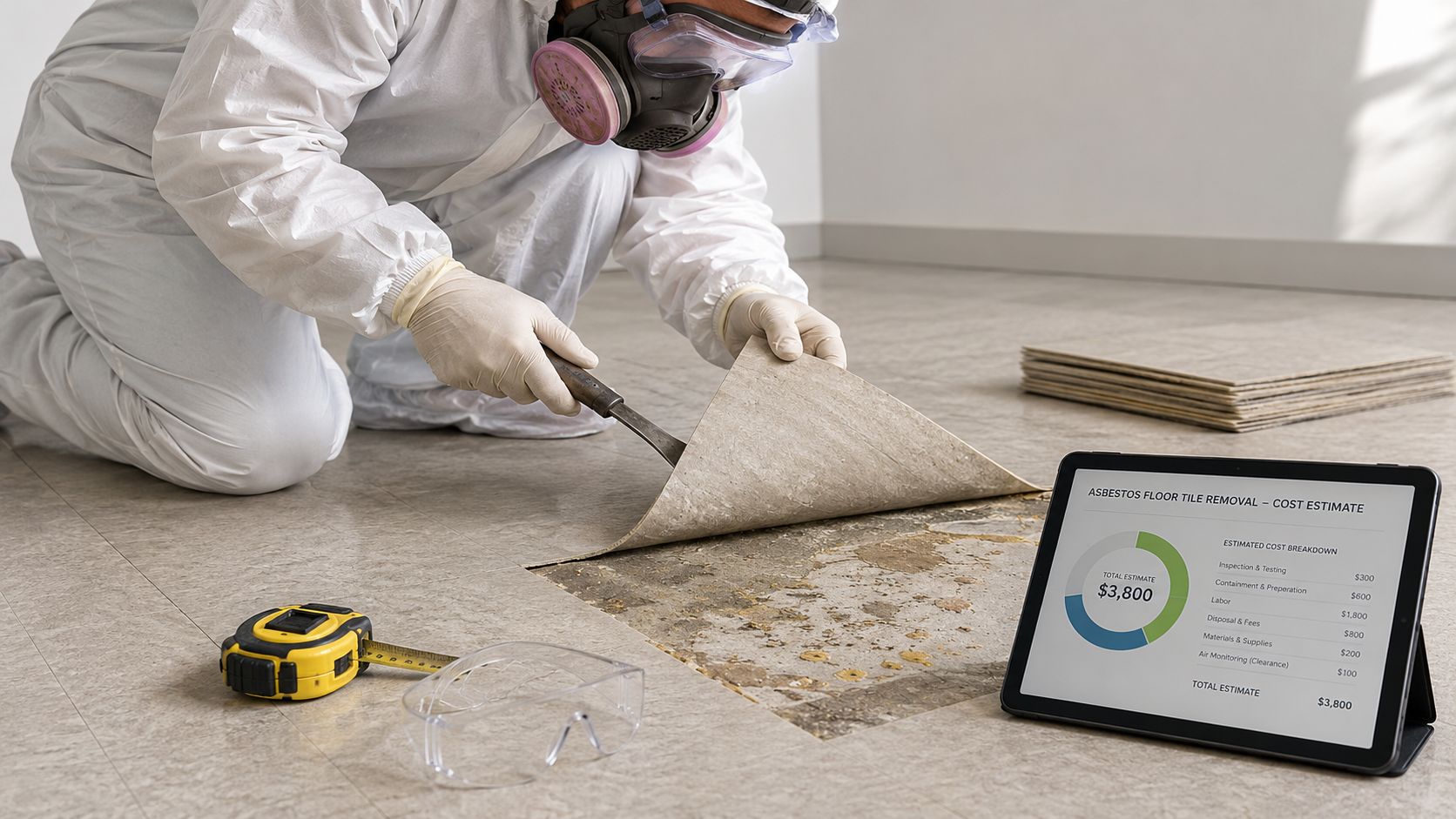
The cost of removing asbestos tile floor in 2026 usually lands around $5 to $15 per square foot, with an average project near $1,880. That headline number gets bigger fast once testing, containment, disposal, and clearance documentation enter the picture.
If you're staring at an old vinyl floor before a remodel, a sale, or a tenant turnover, don't start by asking for demolition quotes. Start by figuring out whether the floor needs removal, because in Los Angeles and the rest of Southern California, the testing and compliance step often decides the whole budget.
Table of Contents
- What Property Owners Should Know Before Pricing Asbestos Tile Removal
- Why Asbestos Testing Comes First Under SCAQMD and Federal Rules
- Key Cost Drivers That Shape the Final Removal Price
- Breaking Down Labor, Containment, and Disposal Expenses
- Removal Versus Encapsulation and Leaving the Tile in Place
- Prep Work and Restoration Costs That Often Get Overlooked
- Budgeting Tips and Next Steps for Los Angeles Property Owners
What Property Owners Should Know Before Pricing Asbestos Tile Removal
A lot of owners get the sequence backward. They see cracked 9-inch tile in a kitchen, assume removal is inevitable, and start collecting bids before anyone has sampled the floor. That's how people end up comparing bad estimates, because the job might be full removal, encapsulation, or leaving intact tile in place under new flooring.
The 2026 U.S. pricing picture is clear enough to set expectations. Professional asbestos floor tile removal is commonly priced at about $5 to $20 per square foot, with one guide putting the average project at $1,880 and a typical range of $1,270 to $2,440. Another source narrows flooring specifically to $5 to $15 per square foot, and a 300-square-foot room can run roughly $1,500 to $4,500 (Angi pricing guide).
That per-square-foot figure is only part of the bill. The cost usually reflects containment, licensed labor, disposal, and cleanup, which is why asbestos floor tile removal doesn't behave like standard flooring tear-out. In practical terms, intact tile in a vacant room is one kind of project, while broken tile in an occupied building with limited access is a different one.
Practical rule: if the tile is old, brittle, patched, or already lifting, treat it as a sampling issue before it becomes a removal bid.
The most common suspect material is older vinyl asbestos tile, especially 9-inch or 12-inch square tile and similar floor systems installed before 1980. If the tile is intact, pricing pressure is often lower than if the tile is broken, sanded, or water-damaged. Condition matters because the work changes from a simple floor project to a regulated disturbance problem.
If you're in Los Angeles and need a paper trail before renovation, a formal asbestos survey report is usually the right first move. It gives you the documentation needed to decide whether the floor should stay, be encapsulated, or be removed.
Why Asbestos Testing Comes First Under SCAQMD and Federal Rules
Testing isn't a sales add-on, it's the gatekeeper. In Southern California, SCAQMD Rule 1403 requires a facility to be thoroughly surveyed before demolition or renovation activity, and the survey has to include inspection, identification, quantification, and physical sampling of friable and Class I and Class II non-friable asbestos-containing material (Rule 1403).
That means a contractor shouldn't be pricing floor tile removal blindly. The job starts with a pre-renovation or pre-demolition asbestos survey, and in Los Angeles-area projects, that's where compliance and budgeting intersect. A Procedure 5 survey is especially important when the work is heading toward regulated renovation or demolition, because the survey determines what's present before anyone disturbs it.
A building inspector who isn't qualified for asbestos sampling is not the same thing as a certified asbestos consultant. The consultant collects the bulk samples, documents the homogeneous areas, and sends suspect tile and mastic for laboratory analysis. In regulated jurisdictions, bulk sampling has to happen before renovation or demolition, not after the floor is already torn up.
A sampling fee is small compared with the cost of a shutdown, a resubmission, or a project delay caused by missing documentation.
For compliance sampling under Rule 1403, the rule text states that a minimum of three samples must be collected from each homogeneous area that is 1,000 square feet or less, and suspected materials must be analyzed using SCAQMD Method 300-91 (proposed Rule 1403 language). That's not a loose guideline. It's the kind of threshold that decides whether a project is documented correctly before a single tile comes up.
For property owners who need asbestos testing in Los Angeles, a good survey costs far less than guessing wrong. It also tells you whether the floor is a removal case or a lower-disturbance case, which is exactly where the smarter spend usually begins. I'm intentionally not getting into abatement methods here, because the first question is always whether the material needs to move at all.
Key Cost Drivers That Shape the Final Removal Price
The floor itself doesn't set the price. Condition, access, and project scale do. Two tile jobs can look almost identical from the hallway and still land in completely different budget bands once a consultant tests the material and documents the substrate.
What pushes a quote up or down
Intact tile on a sound slab is the easy case. Broken tile, loose mastic, or tile that's been damaged by moisture is harder to handle and usually more expensive to assess and remove. The reason is simple, more disturbance means more containment, more labor, and more documentation.
Room size matters too. Small baths and closets carry a higher effective unit price because crews still have to mobilize, isolate the area, and manage waste. Whole-home or larger commercial floors can spread those fixed tasks across more square footage, which is why the per-foot number usually looks better on larger projects.
Substrate also matters. Concrete slab and wood subfloor are not interchangeable from an environmental testing and project-planning standpoint. Adhesive condition matters as well, because old black mastic can change the scope of sampling and the practical next step after the survey.
If the new finish is something like wool carpet, the project planning can change again, since floor coverings and underlayment decisions affect whether the existing tile stays in place or gets disturbed. That's why the lab result, not the sales pitch, should steer the next move.
| Cost Driver | Low-Impact Scenario | High-Impact Scenario | 2026 Price Effect |
|---|---|---|---|
| Tile condition | Intact tile, limited damage | Broken, water-damaged, or loose tile | Moves the project toward the higher end of the range |
| Project size | Small room with clear access | Whole-floor or multiple rooms | Small jobs carry a higher effective unit cost |
| Substrate | Clean, stable slab | Difficult wood subfloor or uneven base | Increases sampling and project-planning complexity |
| Adhesive condition | Adhesive remains stable | Mastic is degraded or heavily disturbed | Can change the compliance path and estimate |
| Access | Vacant, easy staging | Occupied building, tight corridors, elevator-only access | Adds labor and setup burden |
The right takeaway is blunt. Don't judge the cost of removing asbestos tile floor by footage alone. Judge it by how much control the consultant and contractor need to keep the area compliant and documented.
Breaking Down Labor, Containment, and Disposal Expenses
The headline price hides three places where owners get surprised, labor, containment, and disposal. Those line items are why small jobs can feel expensive even when the square footage is modest. If you want to audit a quote, these are the numbers that matter.
Labor and setup usually dominate
Industry cost breakdowns show labor often carries the heaviest weight. One benchmark attributes about $240 to $350 per hour to pre-clean and setup, $150 to $250 per hour to removal, and $10 to $50 per cubic yard to disposal (design transition studio cost breakdown). That's why a quote that looks low on paper can still climb once the crew starts itemizing the job.
Containment is the other big cost center. For asbestos floor tile projects, crews typically need sealed work zones, negative air controls, and protective setup before any material comes up. Even when the floor area is small, the containment package doesn't shrink proportionally.
Disposal is also not just a haul-away charge. Waste has to be sealed, transported, and delivered to the right facility, and the fee can track the load rather than the floor area. That's why tile-only projects can still pick up disposal surcharges.
If a bid skips setup, containment, or clearance work, it isn't a cheaper bid, it's an incomplete one.
Sensitive Environmental can document the testing side of that budget with asbestos inspections, sampling, and reporting before any contractor starts work. If you're comparing bids, that testing report gives you a clean way to see whether the quote matches the actual condition of the floor.
| Cost Component | Typical 2026 Range | Billing Basis |
|---|---|---|
| Pre-clean and setup | $240 to $350 per hour | Crew time |
| Removal labor | $150 to $250 per hour | Crew time |
| Disposal | $10 to $50 per cubic yard | Waste volume |
| Containment materials | Project specific | Room setup |
| Clearance sampling | Project specific | Post-work documentation |
If you're reviewing an estimate and the contractor won't separate labor from disposal, push back. Good pricing is transparent. Bad pricing hides the parts that make the job compliant.
For disposal planning, a direct reference on handling waste helps owners understand why the paperwork matters, so it's worth reviewing the practical rules on how to dispose of asbestos before the project moves forward.
Removal Versus Encapsulation and Leaving the Tile in Place
A homeowner can waste money fast by ordering full removal before the survey is done. If testing shows the tile is intact and the adhesive is stable, removal is often the wrong spend. The survey should drive the choice, not the contractor's default scope.
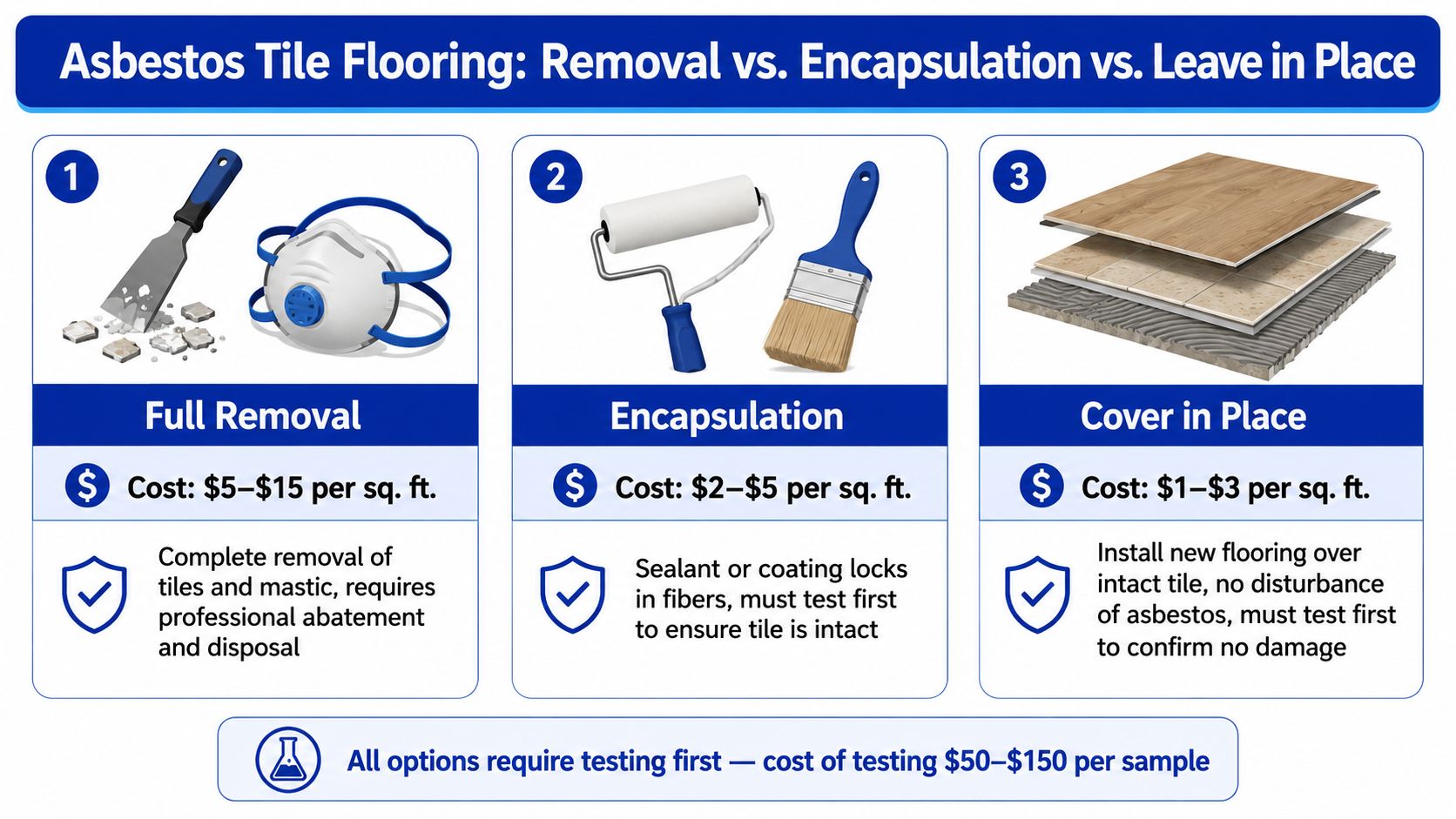
Three paths, three different budgets
Full removal is the highest-disturbance option and usually lands around $5 to $15 per square foot in major U.S. markets, with higher totals once containment and disposal are added (Angi flooring pricing). Choose it when the tile is damaged, the substrate has to be exposed, or the floor condition makes leaving the material in place impractical.
Encapsulation is the lower-cost option when the tile is intact and the condition supports it. Guides consistently treat encapsulation as a cheaper alternative to physical removal, and that matters when the survey shows the material is stable enough to stay put (Angi asbestos removal cost guide). This is a testing-driven decision.
Covering the floor in place can be the least disruptive choice when the tile is sound and the new finish can go over it without disturbance. Up front, it can look cheap. Later, it can create disclosure and renovation problems if the floor has to come up.
Best practice: if the survey says the tile is intact, don't spend removal money just to feel better. Spend it only if the condition or compliance situation is genuinely required.
The infographic shows the point plainly. Every option starts with testing. Owners who skip that step usually pay for the wrong scope first, then pay again to correct it.
Prep Work and Restoration Costs That Often Get Overlooked
Owners usually budget for the floor and forget the re-build. That's where projects drift upward. Once the asbestos-related work is done, the subfloor still has to support the new finish, and that can mean repair, leveling, and documentation before the next contractor arrives.
What happens after the floor comes out
The first check is the substrate. If the adhesive left gouges, the surface may need patching or leveling before new flooring can go down. That work isn't glamorous, but it's often essential if the owner wants a flat finish and a clean inspection record.
New flooring adds its own cost on top of the environmental work. For common residential finishes, replacement flooring installation adds $4 to $12 per square foot for vinyl or laminate, and more for tile or hardwood. If the project was bid as “removal only,” the budget starts to feel incomplete.
Documentation matters too. Buyers, lenders, and inspectors often ask for clearance letters, disposal manifests, and contractor-signed compliance paperwork. In a Los Angeles County project, that paper trail can matter as much as the physical work because it proves the floor was handled under the right rules.
| Restoration Item | Estimated 2026 Cost | Why It Matters |
|---|---|---|
| Subfloor repair | Project specific | Prepares the base for the new finish |
| Leveling and patching | Project specific | Prevents defects in the finished floor |
| New vinyl or laminate installation | $4 to $12 per square foot | Restores the room after testing or removal work |
| Clearance documentation | Project specific | Supports resale, lending, and compliance records |
| Disposal manifests | Project specific | Shows waste moved through the proper channel |
Skipping restoration in the original budget is the fastest way to get surprised. That's where projects run long, the room stays out of service, and the owner ends up paying twice, once for the environmental work and again for the finish contractor's return trip.
Budgeting Tips and Next Steps for Los Angeles Property Owners
Los Angeles and the surrounding counties don't price like a generic national market. SCAQMD Rule 1403 adds documentation pressure, and local labor, permitting, and disposal constraints can push costs above a simple per-square-foot estimate. A smart budget in Southern California starts with the survey, not the abatement quote.
The practical move is to carry a 15 to 20 percent contingency beyond the initial tile estimate. That buffer helps absorb containment upgrades, access issues, disposal changes, or restoration work that didn't show up in the first pass. If you're in LA County, Orange County, or Ventura County, expect some projects to sit above national medians because notification, labor, and disposal logistics are tighter here.

A better quote separates testing, containment, disposal, and restoration. If those pieces are all lumped together, it's harder to compare contractors or spot a weak scope. It also makes it harder to verify whether the work is aligned with the survey results and the Rule 1403 documentation trail.
For regulated projects, confirm that the contractor understands current South Coast AQMD requirements and can produce the right paperwork after the job. I'd also ask for the waste manifest and any post-removal air clearance report before final payment. Those documents matter for insurance, resale, refinancing, and project closeout.
Start with four steps:
- Confirm the flooring vintage. Older tile and mastic deserve a survey before anything moves.
- Commission accredited sampling. Don't let a remodel guess at asbestos content.
- Compare at least three licensed contractors. Compare the scope, not just the price.
- Document every cost category. Keep it all for resale, insurance, or lender review.
If you need asbestos testing Los Angeles property owners can rely on, Sensitive Environmental provides surveys, sampling, and documentation for renovation and demolition planning across Southern California. Contact Sensitive Environmental to schedule an asbestos survey or discuss whether your floor needs testing before you budget for removal.