Stucco is often treated as a harmless finish, something a contractor can drill, sand, or tear through without a second thought. That assumption is unreliable. Exterior stucco has repeatedly tested positive for chrysotile asbestos, and the visible surface may not be the layer that controls the project risk. The practical question isn't whether a wall contains asbestos. It's which layer a renovation will disturb.
A Los Angeles property may have a newer acrylic or cement finish over an older base coat, plaster skim coat, patch, or textured layer. One layer can test negative while another contains regulated asbestos. That's why a visual check, a construction-year guess, or a single chip from the outer face can't replace a layer-specific asbestos survey.
Table of Contents
- Stucco and Asbestos, and Why the Question Is Harder Than It Looks
- How Asbestos Ended Up in Stucco and Plaster Systems
- Layered Stucco and What Bulk Samples Show
- Why Construction Year and Appearance Are Not Enough
- How Professionals Test Stucco for Asbestos
- SCAQMD Rule 1403 and LA Demolition and Renovation Rules
- What Property Owners Should Do Before Disturbing a Suspect Wall
- Clear Next Steps and When to Schedule a Stucco Asbestos Survey
Stucco and Asbestos, and Why the Question Is Harder Than It Looks
Stucco is often called harmless because its main ingredients look like cement. Decades of field surveys show why that shortcut fails. Exterior stucco has repeatedly contained chrysotile asbestos, with documented samples reporting concentrations in the 1% to 10% range in documented survey materials. A 2026 pre-demolition assessment found positive results in 14 of 18 stucco samples, including exterior samples reported at 2% chrysotile.
These results do not mean every stucco wall contains asbestos. They do establish that color, texture, paint, and apparent solidity cannot screen it out. A painted, non-friable finish may still contain asbestos. Under California rules, materials above 0.1% asbestos are treated as asbestos-containing construction materials, or ACCM, according to the 0.1% ACCM threshold under California rules.
The visible finish may not be the material being disturbed
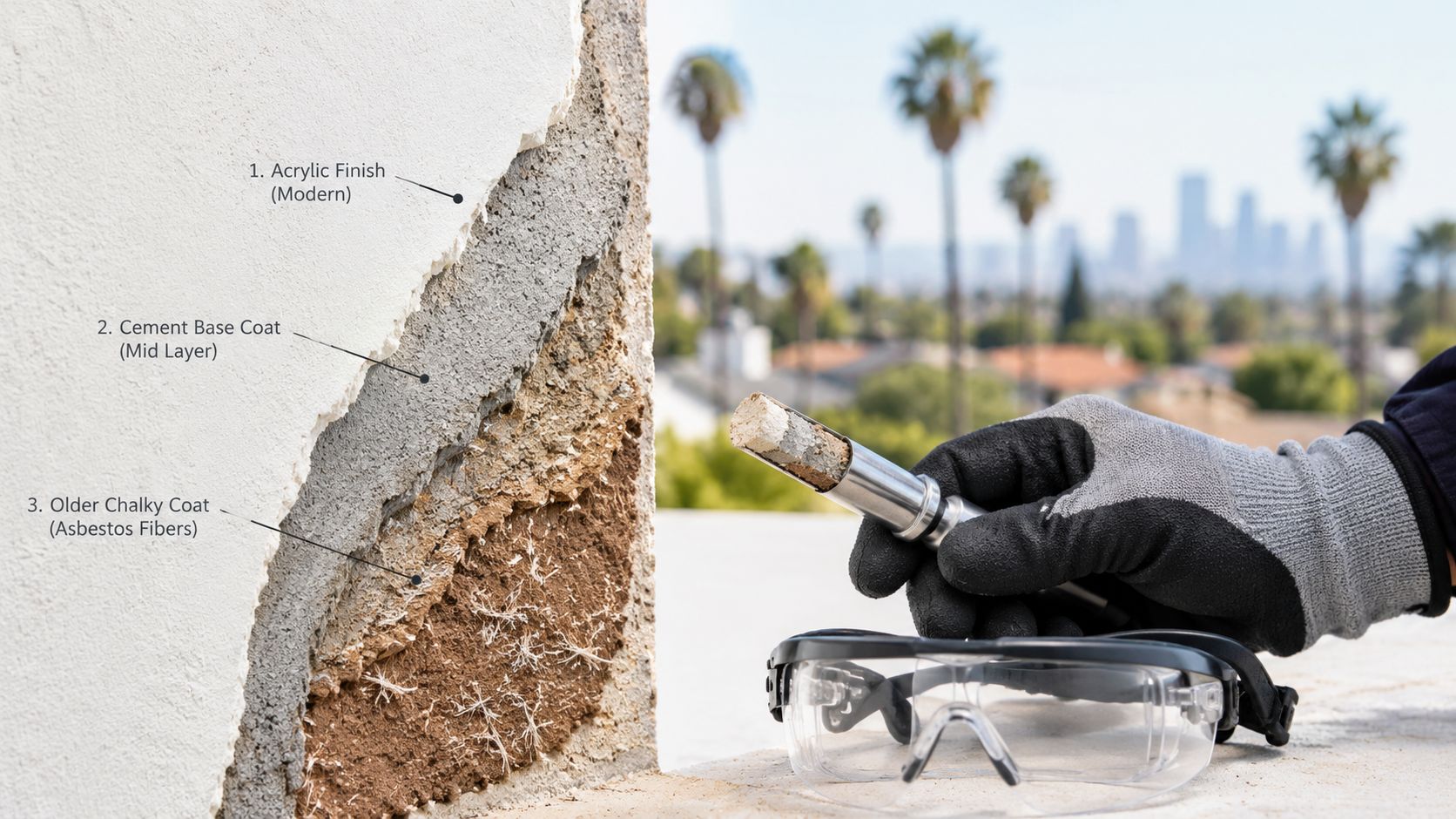
A stucco wall is often an assembly of layers rather than one product. An older plaster or brown coat may sit beneath a cementitious repair, while a newer acrylic finish covers both. A project limited to the outer surface can still reach a concealed layer through a saw cut, anchor hole, window opening, or demolition pass.
The practical question is therefore which layer the work will disturb. Property owners arranging exterior stucco work should identify that layer before construction begins. The work plan, not the wall's color or apparent age, determines what requires testing.
Practical rule: Treat each visible or concealed layer as a separate material until sampling shows otherwise.
A qualified asbestos inspection identifies the layers, collects representative bulk samples, and sends them for laboratory analysis. Each result applies to the material sampled. It does not automatically characterize every coat across the wall.
How Asbestos Ended Up in Stucco and Plaster Systems
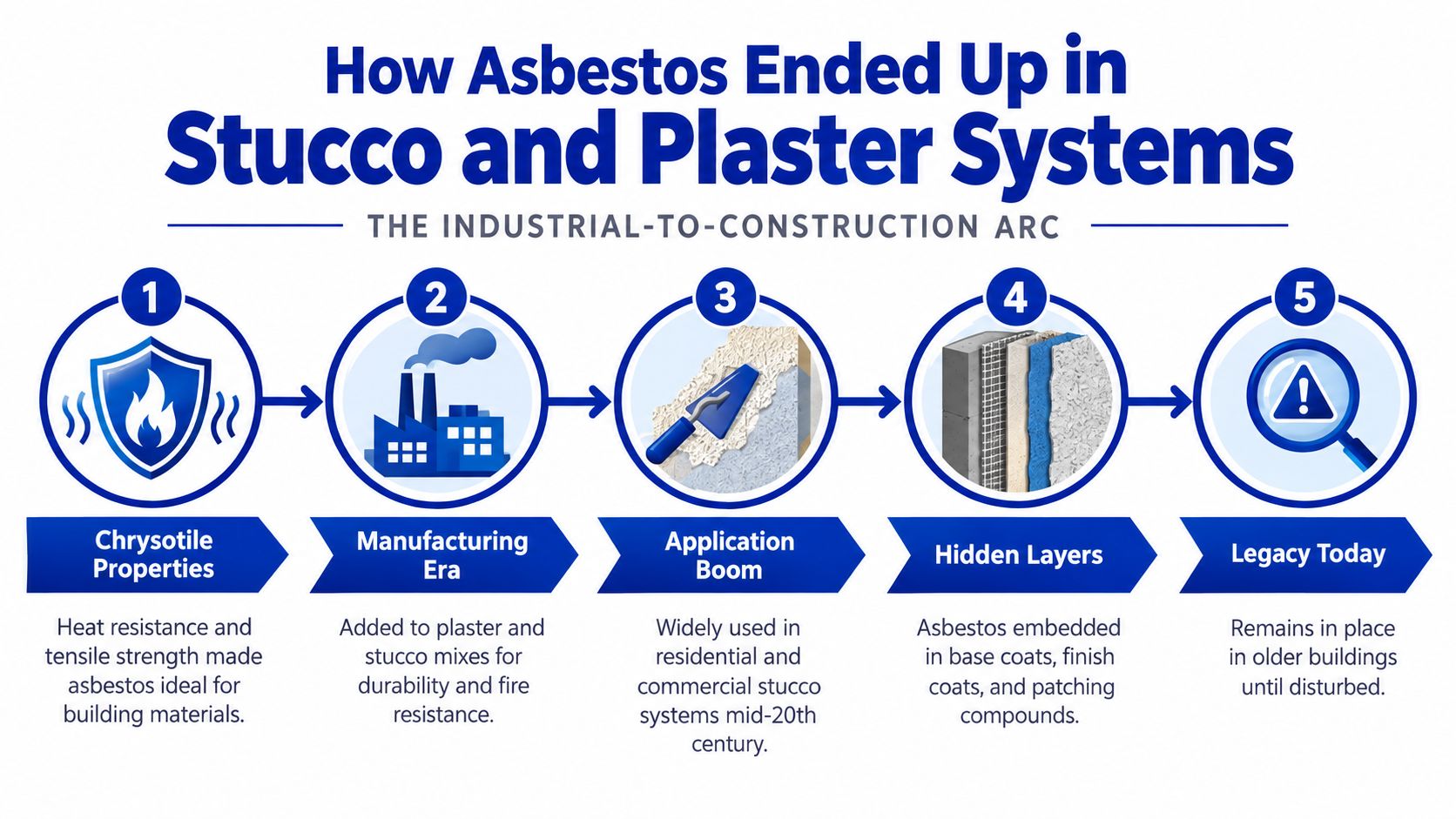
Manufacturers valued chrysotile for properties that suited construction products. Its heat resistance and tensile strength made asbestos useful in plaster, joint compounds, skim coats, acoustic textures, patching materials, and some exterior stucco finishes. The material moved from an industrial mineral into ordinary building assemblies, where it could become difficult to recognize after being mixed with cement, lime, sand, or plaster.
Legacy applications found in field surveys have included asbestos-containing plaster skim coats over wood lath or gypsum, spray-applied stucco textures on exterior façades, and patching compounds used during mid-century repairs. A later finish can conceal each of these applications. The wall may look uniform even though different trades installed different materials during different renovation periods.
Regulation changed, but buildings remained
The regulatory history is important because it explains why older materials remain in place. EPA actions included a 1973 ban on spray-applied asbestos surfacing materials, followed by a broader 1989 partial ban under TSCA Title II, as described in the asbestos regulatory record maintained by EPA. Those milestones reduced new use, but they didn't remove every product already installed in buildings.
The U.S. Geological Survey continues to track asbestos as a globally traded industrial mineral, while hazardous-material surveys document asbestos in stucco and related systems at concentrations including 2%, 3%, 5% to 10%, and isolated samples at 55% chrysotile in its asbestos statistics and information. The historical lesson for Los Angeles owners is straightforward: asbestos in stucco is a legacy-building-material issue, not a concern limited to one product, one neighborhood, or one visible finish.
When a wall is cut or demolished, age becomes more than background information. It becomes a reason to investigate concealed materials before disturbance.
Layered Stucco and What Bulk Samples Show
A stucco wall can contain more than one material, and a laboratory result matters only when it is tied to the layer collected. Under the applicable federal guidance, distinguishable plaster and stucco layers are treated as separate strata, with each layer sampled and reported independently under the applicable federal guidance. Asbestos may be concentrated in a skim coat, joint compound, or added finish while the underlying stucco is non-ACM.
A wall may contain several installation histories:
- Older base or brown coat: This layer may come from the original construction or an earlier repair.
- Later cementitious layer: A contractor may have placed a new coat over the original assembly.
- Modern acrylic finish: The outer surface may be clean while an older concealed layer contains asbestos.
A composite sample blends these materials. The result then becomes difficult to apply to the planned work because it does not identify which layer the saw, grinder, drill, or demolition tool will contact. The operational question is not whether the wall is positive or negative. It is which layer is about to be disturbed.
What the survey record should identify
A defensible report connects every result to a specific location and layer. It distinguishes the finish coat from the base coat, identifies patches or joints that differ, and states which material the project will disturb.
Documented survey material shows why that separation matters. Exterior stucco samples have tested at 2% chrysotile, while other exterior stucco samples contained less than 1% chrysotile in the referenced survey material. Neither result can be applied automatically to every layer on the wall. A lower result is not a visual conclusion, and a negative outer coat does not clear the substrate beneath it.
The 0.1% ACCM threshold also requires regulatory interpretation under the applicable California requirements. A laboratory percentage must be considered alongside the material classification, project activity, and governing rule, rather than treated as a stand-alone answer.
The report should answer two separate questions: What did this layer contain, and will the project disturb this layer?
For Los Angeles renovation planning, that distinction supports accurate work scoping, contractor communication, and compliance documentation. It also prevents a common error, labeling an entire wall negative because one surface sample was negative.
Why Construction Year and Appearance Are Not Enough
Construction year helps an inspector form a history, but it doesn't prove material status. Additions, repairs, window replacements, exterior resurfacing, and interior patching can introduce materials from different periods into the same property. A structure that appears to have one continuous wall may contain several installation histories.
Appearance is even less reliable. Gray color, chalky texture, cracking, patchiness, and a hard cement-like surface don't identify asbestos. Chrysotile fibers are microscopic and can be distributed through an ordinary-looking cement, plaster, or texture mixture. A clean-looking surface may conceal a positive layer, while a visibly weathered area may test negative.
Condition changes the concern
An intact, non-friable material isn't automatically harmless, but its condition affects how a project should be planned. Disturbance is the key practical change. Cutting, sanding, drilling, grinding, scraping, and demolition can break a material that previously remained in place and can expose workers or occupants to released fibers.
That makes a visual guess a poor basis for work authorization. The same wall may require no immediate action if it remains undisturbed, yet require formal testing before a contractor opens a new window, replaces a door, installs anchors, or removes a section for an addition.
Build year is a clue. Appearance is a clue. Neither is a laboratory result.
For homeowners, property managers, and general contractors, the defensible decision is to identify the exact assembly and test the layers the scope will contact. That approach avoids both false reassurance and unnecessary assumptions about what a positive result means for the entire property.
How Professionals Test Stucco for Asbestos
A professional stucco asbestos survey begins with the planned disturbance, not with a random scrape from the easiest surface. The inspector reviews available building and renovation records, project drawings, and the work scope, then maps the wall or ceiling assemblies that may be affected. The practical question is which layer the work will reach. A clean base coat over an asbestos-containing skim layer can make a single wall look harmless until drilling or demolition exposes the deeper material.
Separate the layers before sampling
The inspector records differences in color, texture, thickness, application, location, and apparent age. A stucco system may contain an outer finish, brown or base coat, original plaster skim, joint compound, wallpaper adhesive, paint, or a later patch. Distinguishable materials should be collected as separate specimens. Blending them can hide a positive layer and leave the laboratory result describing a mixture rather than the material the crew will disturb.
The sampling plan follows the work path. A window opening may expose more layers than an exterior repair. A drill anchor may pass through the finish and base coat. Demolition may reach an interior plaster skim that was invisible during a surface inspection.
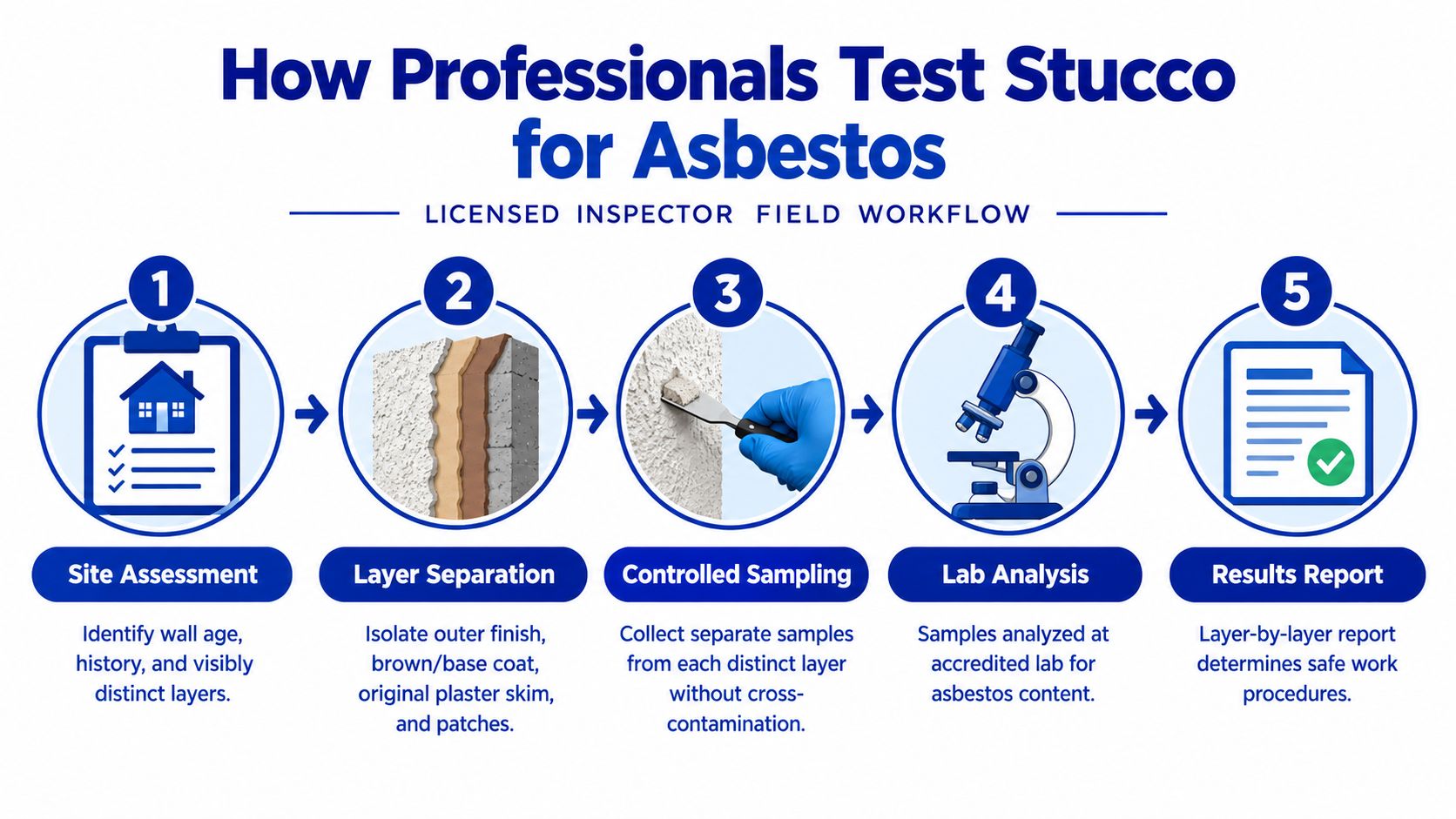
Controlled collection and laboratory analysis
Samples are collected to limit cross-contamination, then sealed, labeled, and tracked through chain-of-custody records. A laboratory commonly examines the specimens with polarized light microscopy, or PLM. The applicable federal method requirements are set out in 40 CFR Part 763.86, with the project and jurisdiction determining the specific compliance path.
If a PLM result is near the applicable reporting threshold, the laboratory may use point counting when the governing method or project requires it. That additional examination makes the result more precise for the specimen and regulatory decision. It does not turn a positive material into a reassuring one.
Owners comparing options for hiring a certified asbestos pro should ask what areas, layers, and planned activities the scope covers. The testing professional inspects, samples, analyzes, and reports. Qualified project and compliance professionals then use the findings to determine the appropriate response.
For renovation or demolition planning, asbestos testing in Los Angeles can provide layer-specific documentation before work is authorized. The next regulatory question is how those findings fit the local requirements.
SCAQMD Rule 1403 and LA Demolition and Renovation Rules
Stucco compliance is not decided by appearance. A wall can have a clean base coat over an asbestos-containing skim layer, so the practical question is which layer the project will disturb. South Coast AQMD Rule 1403 places the asbestos survey before demolition or renovation. It covers inspection, identification, and quantification of friable asbestos-containing material, along with Class I and Class II non-friable material. The survey must be documented, and the analytical work must follow the rule's specified methods and laboratory requirements, as described in the official Rule 1403 document.
The compliance advisory clarifies the field requirement. An onsite asbestos survey must be documented before renovation, with a limited exception for certain single-unit residential structures where less than 100 square feet of ACM surface area is removed or stripped. Demolition has no exception. The written survey must identify the ACM that work may disturb, its condition, and its friability, according to the Rule 1403 compliance advisory.
Rule 1403 obligations at a glance
| Trigger | Required Action |
|---|---|
| Demolition of a structure | Obtain and document an asbestos survey before demolition. |
| Renovation that may disturb suspect material | Inspect the affected area, identify materials, and document findings before work. |
| Stucco with distinguishable layers | Sample and analyze each relevant layer separately. |
| Compliance sampling | Follow Rule 1403 analytical procedures and qualified laboratory requirements. |
| Confirmed ACM in the work area | Use the results to plan applicable notifications, qualified work, and documentation. |
Proposed Rule 1403 language addresses the layered problem directly. It prohibits composite sampling of materials such as the base and scratch coat for quantification purposes in the proposed Rule 1403 language. Combining layers can dilute or conceal the result that matters to the crew opening the wall.
For commercial owners and contractors, the survey also becomes part of the project record. It can support bid documents, scheduling, designer communication, and coordination with qualified professionals. Guidance on asbestos testing before commercial renovation in Los Angeles explains why testing belongs in planning before construction begins.
What Property Owners Should Do Before Disturbing a Suspect Wall
The safest project sequence is also the most orderly one: survey first, plan second, disturb last. Owners and contractors should begin by collecting the building construction date, prior renovation records, permit information, and drawings. Those documents won't establish asbestos content, but they can reveal where different wall assemblies may exist.
A practical pre-work sequence
- Map the work area. Identify every wall, ceiling, patch, opening, and substrate the project may contact. Don't limit the review to the visible exterior face.
- Assume suspect material where history warrants caution. Older stucco and plaster should remain undisturbed until an inspector evaluates the assembly.
- Define the layers. The sampling scope should address the finish coat, scratch or brown coat, base coat, underlying plaster, drywall skim, joint compound, and patches when those materials are part of the work.
- Confirm laboratory requirements. Ask whether the samples will be analyzed by an NVLAP-accredited laboratory using PLM and point counting where required.
- Match results to the design. The final report should identify positive and negative layers, sample locations, material condition, and the relationship to the planned disturbance.
The order matters because an unsampled layer can appear only after work begins. If a contractor uncovers a different coat, patch, or substrate than the survey described, work should pause until the new material is evaluated. Continuing based on the original outer-surface result can leave the project with an incomplete record.
Share the report with the project designer, general contractor, bidders, property manager, and any qualified professional responsible for the next step. A positive result doesn't automatically mean the same response is required in every situation. It does mean the team has material-specific information for planning, compliance, and worker protection.
DIY kits and informal scraping don't solve the layer problem. A homeowner may collect the wrong coat, cross-contaminate specimens, damage an occupied area, or receive a result that doesn't identify the material the contractor will disturb.
Clear Next Steps and When to Schedule a Stucco Asbestos Survey
A stucco wall isn't necessarily one material. The layer that matters is the layer a project will cut, sand, grind, drill, patch, or demolish. For that reason, a pre-1990 Los Angeles property with stucco or plaster planned for disturbance warrants a formal asbestos survey before work begins, even when the visible finish looks modern.
Use the project scope to set the testing scope
A survey is essential when Rule 1403 applies, particularly for demolition and renovation that may disturb regulated materials. It can also be the prudent choice for smaller repairs, real estate transactions, maintenance work, and contractor bids where the work may reach concealed layers.
Ask for a survey that:
- Identifies each assembly: Separate exterior stucco, interior plaster, patches, and other distinct materials.
- Samples the disturbance path: Test the layers the tools will contact, not only the cleanest visible surface.
- Uses appropriate analysis: Send specimens to an NVLAP-accredited laboratory and document the method and results.
- Explains the findings: Tie every result to a location, layer, condition, and planned work area.
Sensitive Environmental's environmental testing services include asbestos testing and related inspections for property owners, contractors, and commercial teams throughout Los Angeles and Southern California. A project-specific survey gives the people making decisions a documented basis for the next step instead of relying on assumptions about a finish that may conceal older coats.
Contact Sensitive Environmental to schedule a stucco asbestos inspection and layer-specific sampling before renovation or demolition in Los Angeles or Southern California. Their environmental testing team can coordinate field inspection, laboratory analysis, and clear reporting so your project team understands which materials were tested and how the results relate to the planned disturbance.