An occupied commercial building can present several environmental questions at once. A contractor is preparing to open walls, a facilities manager has noticed an unusual odor, and a previous fire left residue in part of the property. Ordering unrelated tests without first defining the decisions they need to support can leave important gaps: the samples may not represent the work, the results may be hard to interpret, and the next steps may remain unclear.
An industrial hygiene monitoring plan connects the site conditions to appropriate inspections, sampling, laboratory analysis, and follow-up. It's not a generic safety brochure or a guarantee that a building is safe. It's a documented way to identify potential hazards, gather relevant evidence, and help qualified professionals decide what to do next.
Table of Contents
- Why Commercial Sites Need a Monitoring Plan
- Define Objectives and Assessment Boundaries
- Build Similar Exposure Groups
- Design a Representative Sampling Strategy
- Choose Instrumentation and Laboratory Support
- Set Action Levels and Build the Decision Process
- Document Results and Plan Follow-Up Testing
Why Commercial Sites Need a Monitoring Plan
Consider a commercial property where renovation is approaching while staff continue to occupy nearby offices. The building manager suspects asbestos in materials that may be disturbed, maintenance workers report changing indoor-air conditions, and a fire in an adjoining area has left visible residue. Each concern calls for a different assessment. A coordinated plan can establish which areas and activities need attention, what testing can answer the project's questions, and how results will be documented.
That coordination matters because a single result has limits. An area reading may describe conditions at one location without representing what a worker encounters during a specific task. A surface sample can help characterize a particular material or deposit, but it doesn't, by itself, establish airborne exposure throughout a building. Professional industrial hygiene testing starts with the question, then selects the inspection and sampling approach to suit it.
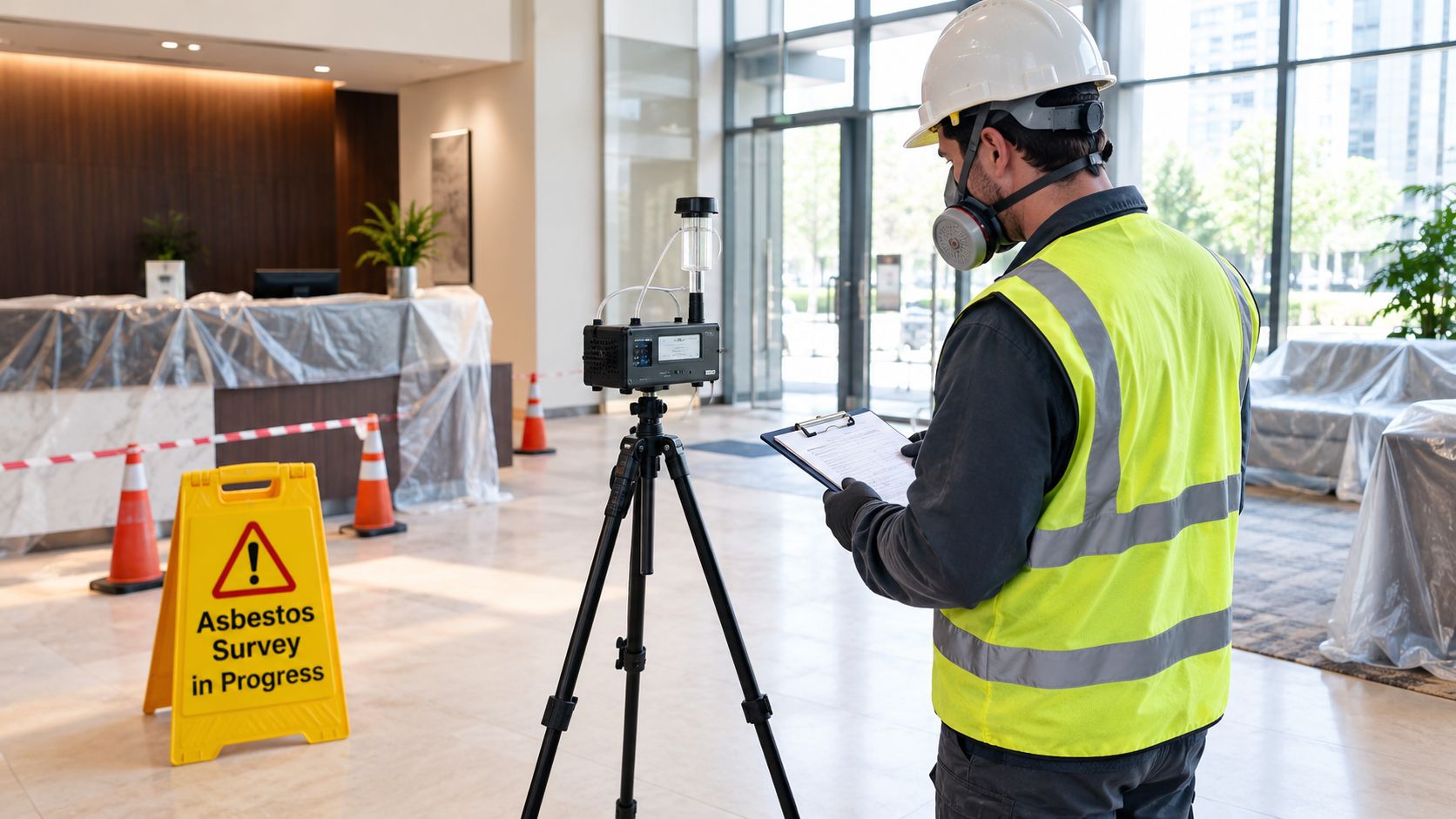
From a test request to a decision
For a workplace exposure question, the plan may call for personal breathing-zone sampling, task observations, instrument calibration, sample documentation, and laboratory analysis. For a building-related concern, it may instead begin with an asbestos survey, lead inspection, mold inspection, indoor air quality assessment, or post-fire evaluation. The methods aren't interchangeable. A credible assessment depends on collecting evidence that fits the material, contaminant, location, and decision at hand.
DIY screening can sometimes help a property owner decide whether to seek professional advice, but it isn't a substitute for representative sampling and clear documentation when project planning or compliance decisions depend on the results. A qualified professional can document where and how samples were collected, preserve chain of custody where applicable, and explain what a laboratory result does and doesn't establish.
For commercial buildings in Los Angeles, asbestos planning may need to be coordinated with renovation schedules and applicable requirements. This overview of asbestos management in Los Angeles commercial buildings offers related context for property teams considering documentation and project risks.
Practical rule: Define the decision before ordering the test. A result is useful when it answers a specific question, not simply because a sample was collected.
Define Objectives and Assessment Boundaries
Before choosing equipment or contacting a laboratory, write down what the assessment must establish. This short scoping step keeps a plan from combining unrelated concerns under a broad label such as “air testing,” and helps prevent one test result from being used to answer a question it wasn't designed to answer.
Set the scope
Start by describing the property and the people or activities involved. Identify the building areas, workers or occupants, work tasks, operating conditions, and timeframe of interest. Note whether the concern involves routine operations, planned construction, an unusual event, or a change in conditions. A renovation assessment, for example, may need to characterize materials before work begins, while a worker-exposure assessment may focus on a particular task and work period.
Next, name the hazard or uncertainty. Depending on the site, the scope might cover asbestos-containing materials, lead-based paint or dust, mold associated with water damage, indoor air quality, volatile organic compounds, airborne contaminants, or combustion byproducts such as ash and soot following a fire. Don't assume that one broad inspection can resolve every concern. The appropriate inspection and sampling methods depend on the materials, suspected contaminants, and decisions the results must support.
Assign responsibilities and decision points
A written scope should identify who will do what. The project sponsor or property manager can provide access, schedules, building records, and information about previous incidents. The industrial hygienist or environmental consultant can define the assessment approach and document site conditions. Samplers need clear field instructions, and the laboratory needs appropriate sample information and methods. Supervisors and contractors can describe actual work practices and inform the assessment team about changes during the project.
Before sampling, agree on the question each result will inform. Is the purpose to characterize a material before renovation, evaluate a worker's exposure during a task, investigate an indoor-air concern, or document conditions after a fire? Also establish who will review the findings and make decisions about project controls or next steps.
A positive test doesn't automatically authorize or require remediation, abatement, removal, or cleanup. The report should explain what was sampled, what the result means within the defined scope, what limitations apply, and when further professional evaluation may be appropriate. That boundary makes the plan more useful to owners, contractors, and qualified decision-makers.
Build Similar Exposure Groups
Job titles alone rarely describe how exposure occurs. Two employees with the same title may spend their shifts on different tasks, handle different materials, or work under different ventilation conditions. An industrial hygiene monitoring plan should organize workers around similar exposure groups (SEGs): people whose tasks and exposure profiles are expected to be comparable.
Begin with a task and agent inventory. List materials and processes, potential exposure routes, task duration and frequency, source strength, work cycles, controls, and worker behaviors. Include uncertainty, too. A process with variable production conditions or inconsistent ventilation may warrant closer attention than a stable task with well-understood controls.
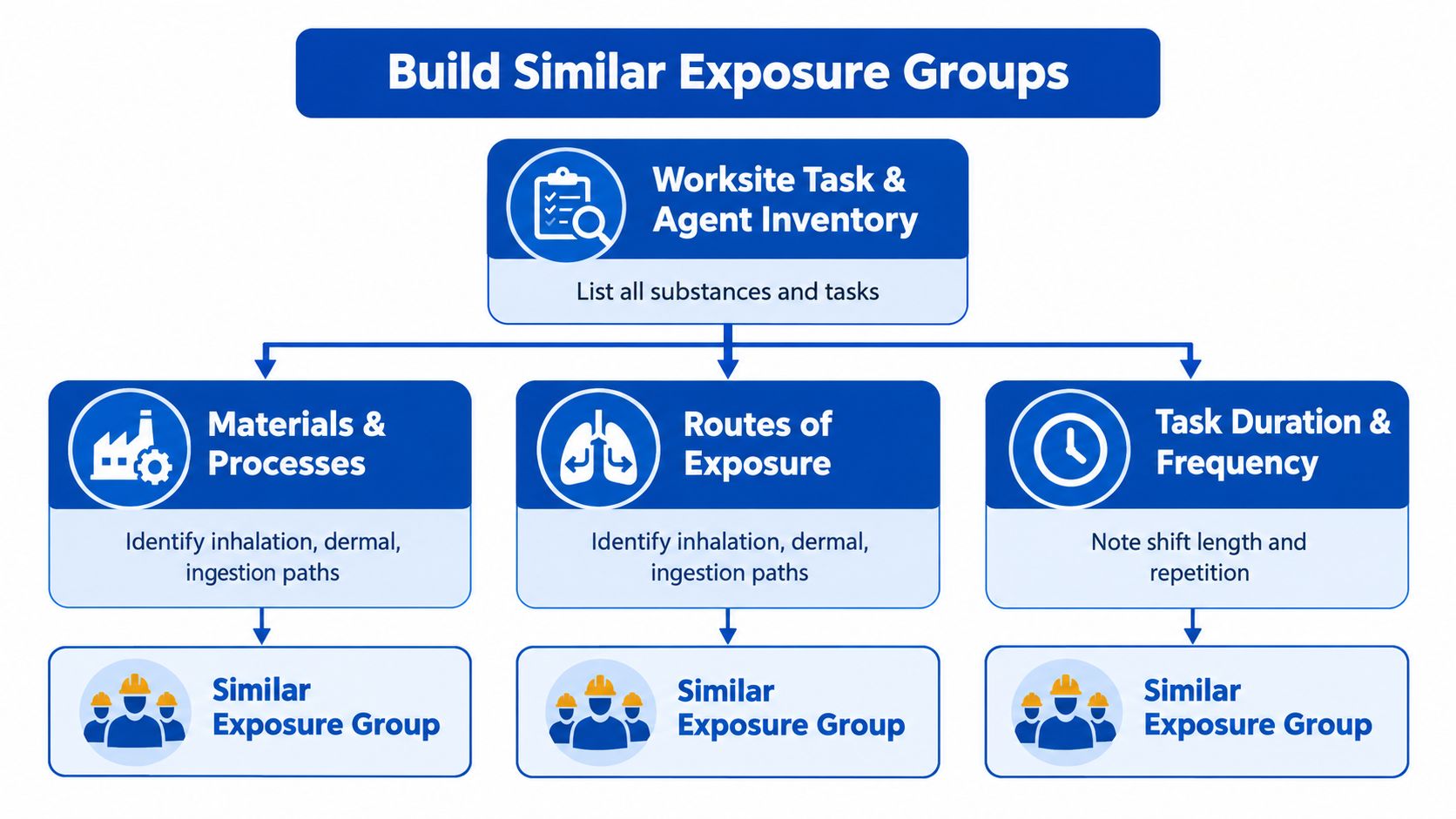
Group the work, not just the workers
A maintenance team might include staff who inspect equipment, clean components, and perform tasks that generate airborne contaminants. Those activities may not belong in one SEG because the employees share a department. During renovation, workers disturbing building materials can have a different exposure profile from staff who pass through the work area. In manufacturing, production conditions, material handling, and ventilation can vary across tasks. Welding, facility operations, and cleanup work each call for attention to the actual activity, materials, and controls rather than a job label alone.
Routes of exposure matter when setting the scope. Inhalation may be central to an airborne contaminant assessment, while surface contamination can lead to questions about contact and transfer. Task duration and repetition matter as well. A brief activity that creates a concentrated emission can call for a different sampling decision from a task that continues across a work period.
Prioritize the uncertain, higher-concern work
Monitoring priority should reflect both the potential significance of a hazard and uncertainty about exposure. Look first at tasks where the source, controls, or worker practices are poorly characterized, or where the expected exposure may be higher than for comparable work. Then select workers and periods that reasonably represent those conditions. Avoid sampling only the easiest worker to reach or the calmest operating period, since that can produce data that don't answer the project's question.
For each SEG, record the workers and tasks included, relevant materials or agents, expected exposure routes, operating conditions, controls, uncertainties, and the decision the monitoring is intended to support. If task observations show that workers grouped together perform substantially different work, revise the grouping before sampling. The purpose is not to make an org chart look tidy. It is to choose a sampling strategy that reflects how work happens.
Design a Representative Sampling Strategy
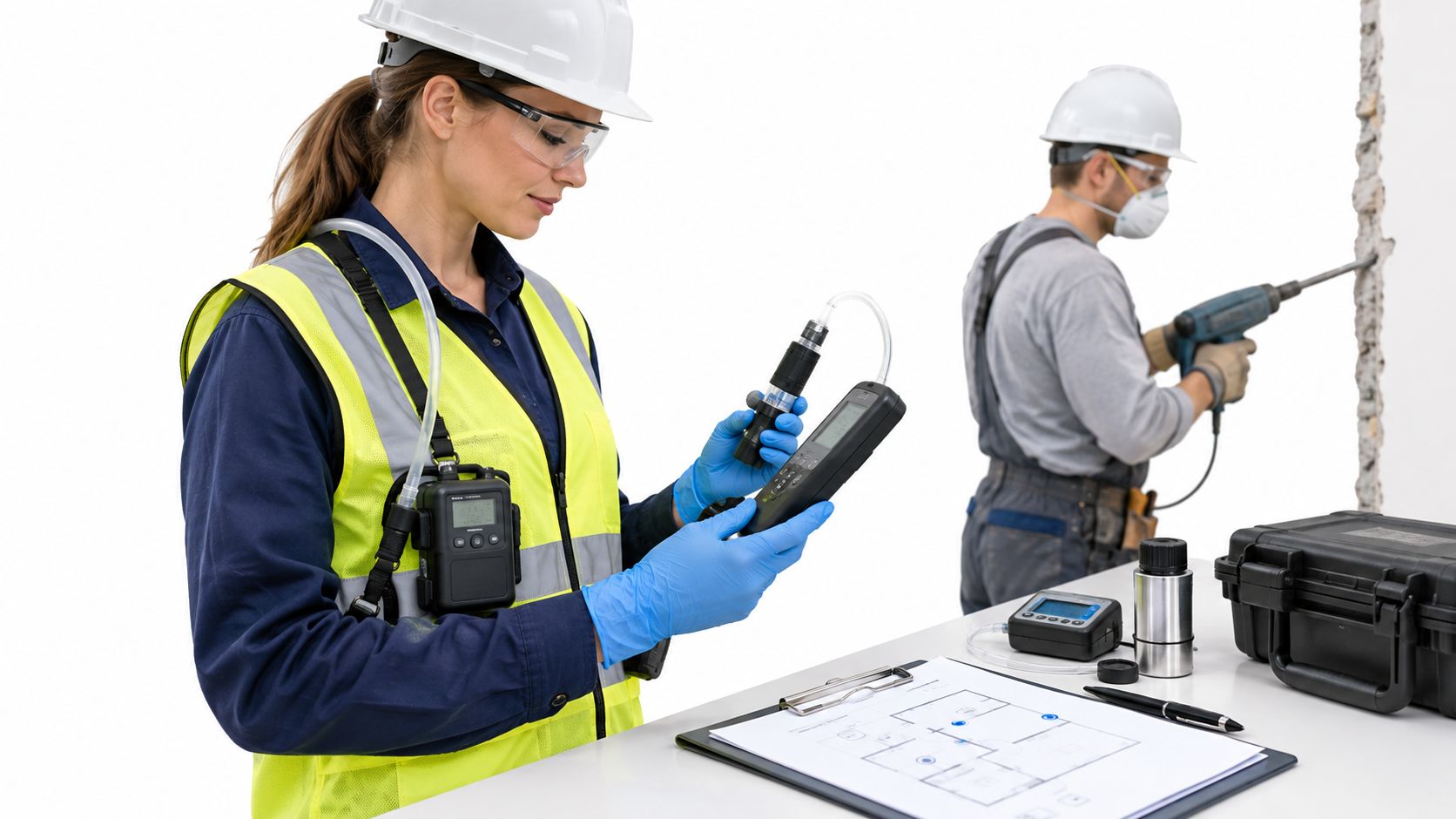
A representative sampling strategy starts with the exposure question, then matches the sampling location, worker, timing, and duration to that question. For quantitative worker-exposure estimates, personal breathing-zone sampling can measure conditions near the worker's breathing zone. Area sampling can add context about a location or background conditions, but it shouldn't be treated as a substitute for personal sampling when the decision concerns an individual worker's exposure.
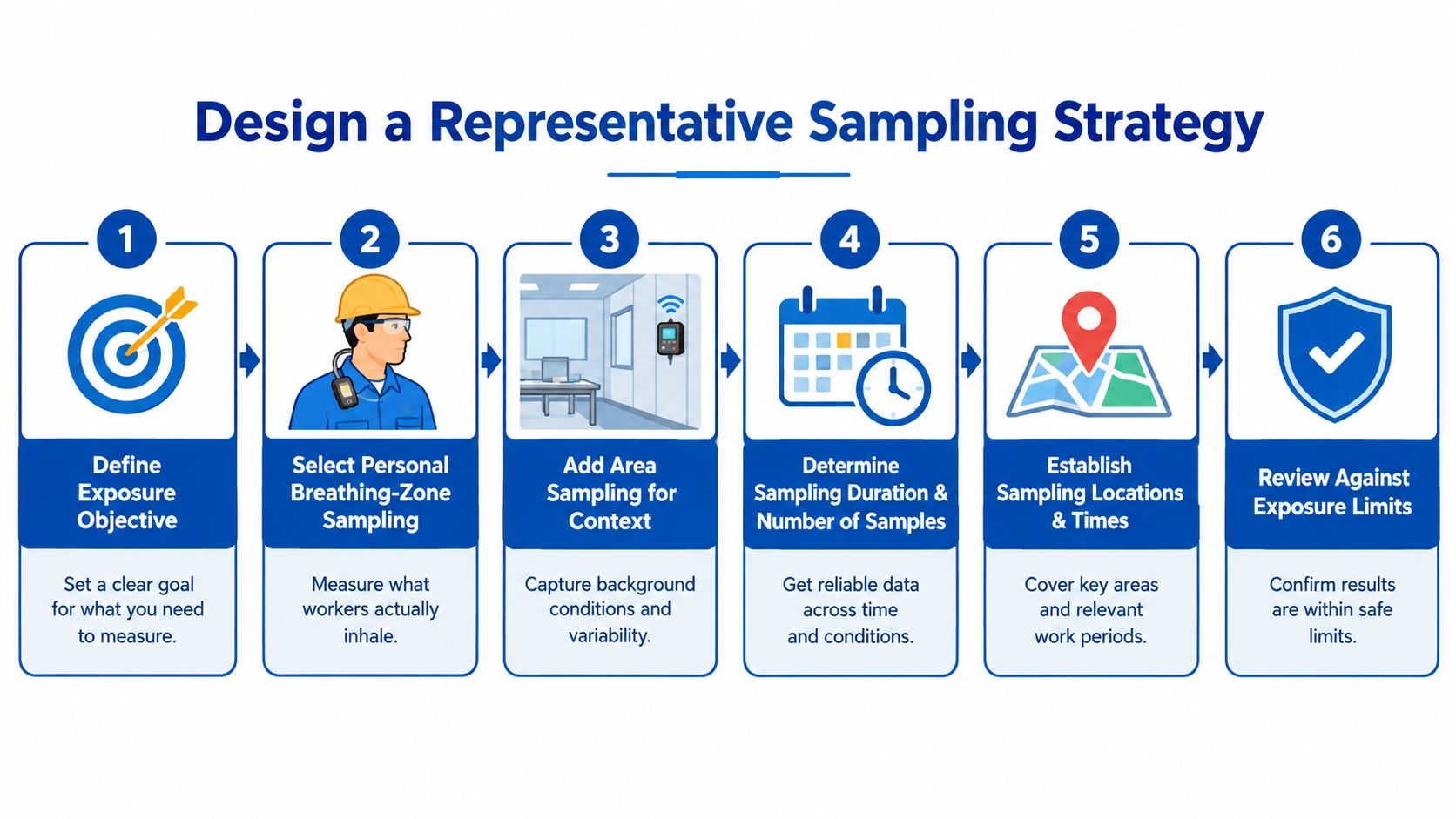
Match the sample to the decision
Identify a reasonably representative worker whose tasks are likely to reflect the SEG, including workers with the potential for higher exposure. Sample during conditions that reflect the work the plan needs to characterize. If production or task conditions vary, account for normal and higher-production periods rather than assuming one convenient shift represents every operating condition.
The sampling period should match the comparison being used. For an 8-hour time-weighted average (TWA), a full-shift sample is generally used; for a short-term exposure limit (STEL), sampling generally covers 15 minutes during an expected peak-emission period. Those durations aren't universal rules for every contaminant or assessment. Canadian federal guidance describes collecting at least 3 samples when evaluating compliance with a TWA or STEL, sampling the breathing zone of the most highly exposed employees, and using consecutive 15-minute samples when a contaminant is generated for 45 minutes or less. The federal hazardous-substances sampling guideline provides those details.
For a compliance campaign, a practical starting point may be at least 3 samples. A stronger baseline characterization often uses 6–10 personal samples per SEG, with the appropriate number depending on the decision and exposure variability. AIHA's exposure-assessment fundamentals discusses SEGs and representative assessment. Treat these sample counts as planning guidance, not a substitute for professional judgment.
Preserve the evidence behind each result
Before collection, specify the sampling method, locations, timing, task observations, laboratory requirements, and documentation. Each sample needs a traceable record, including chain of custody, field blanks where applicable, calibration records, and laboratory method information. If conditions change during sampling, record the change rather than assuming the original plan still applies.
Keep area and personal samples in their proper roles. Area data may help show whether a condition is localized or provide background context. Personal data better address what a selected worker encountered during the sampled period. For noise questions, a separate resource on noise exposure assessment tools can help readers understand that monitoring decisions depend on the exposure being assessed, not just on the availability of a particular instrument.
For project teams coordinating broader building investigations, commercial environmental testing in Los Angeles may include distinct assessments for different environmental concerns. Specify the question for each sample so results from one method aren't stretched to support an unrelated conclusion.
Choose Instrumentation and Laboratory Support
Instrumentation should follow the hazard and the decision, not the other way around. Laboratory-integrated sampling and direct-reading instruments do different jobs. One can provide a sample for laboratory analysis and project documentation; the other can help identify changing patterns while work is underway. Neither is a universal replacement for the other.
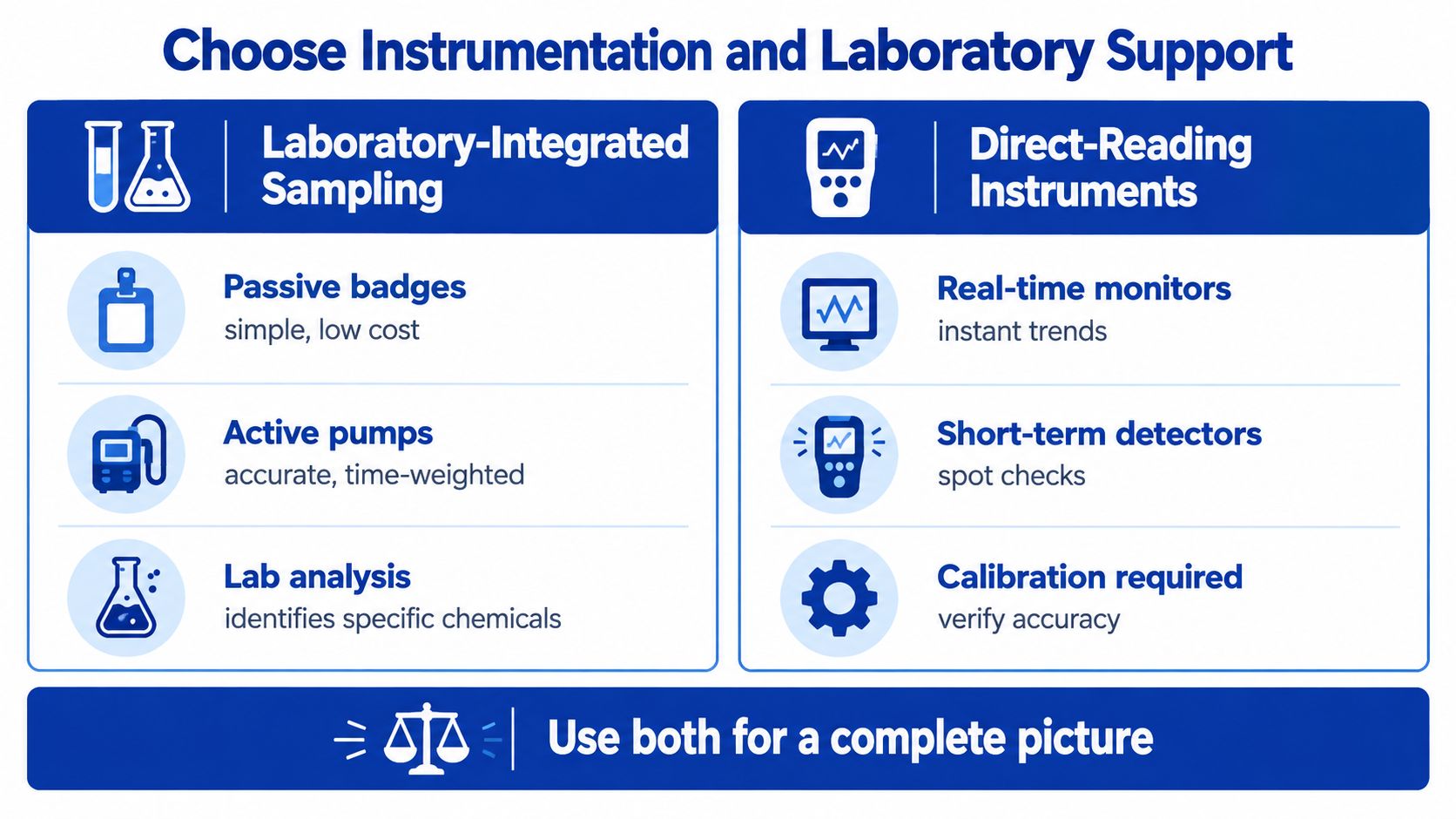
Use real-time readings to understand patterns
A direct-reading instrument can help a practitioner identify when conditions change, such as during a high-emission task or as ventilation behavior shifts. A short-term reading may help locate a peak period that deserves closer evaluation. Connected-worker systems and wearables may also provide information about changing conditions, but the data require calibration, task context, validation, privacy controls, and a defined response protocol. A sensor alert is a prompt for an appropriate review, not automatically a formal exposure conclusion.
Laboratory-integrated methods, including personal sampling with a pump or a suitable passive sampler, are chosen according to the agent and the required method. When a sample must identify a specific contaminant or provide defensible project documentation, collection and analysis need to follow the appropriate method and chain-of-custody process. The laboratory's capabilities and method information should be confirmed before samples are collected.
| Approach | Useful for | Important limitation |
|---|---|---|
| Direct-reading instrument | Seeing short-term patterns or identifying when conditions change | Readings require calibration, context, and interpretation |
| Laboratory-integrated sample | Analyzing collected material for a specified contaminant | Results represent the sample and conditions collected, not every possible task or period |
Decide what evidence you need
Suppose a facility manager wants to understand whether ventilation changes during a particular operation. A practitioner might use a direct-reading instrument to observe the timing of changing readings, while collecting personal samples for laboratory analysis when the decision requires contaminant-specific results. Instrument selection should account for the target location, anticipated duration, documentation needs, and whether confirmation is required.
Facility teams can also use a safety supplies guide for facilities to review general equipment considerations. That kind of guide doesn't replace a hazard-specific assessment or establish which sampling method is appropriate. For building-related concerns, indoor air quality testing in Los Angeles can help property teams identify when professional assessment and sampling may be appropriate.
A monitor that produces many readings isn't automatically more informative than a well-designed sample. The plan should state what an alert triggers, who evaluates it, how findings are documented, and when laboratory confirmation is needed.
Set Action Levels and Build the Decision Process
A measurement needs a comparison criterion and a documented interpretation. For worker exposure, that may be an applicable occupational exposure limit; for a property investigation, it may be a project-specific comparison criterion. The report should identify which criterion was used and explain why it fits the sample and decision. A number without its sampling duration, method, and context can mislead.
Interpret the exposure profile, not just one result
Exposure data commonly follow a lognormal pattern, reflecting variation in tasks, materials, controls, and environmental conditions. NIOSH's Occupational Exposure Sampling Strategy Manual describes statistical approaches for selecting workers and sampling times, analyzing results, and comparing measurements with exposure standards. Where enough representative data are available, a practitioner can evaluate the estimated upper exposure percentile and its uncertainty, rather than relying only on the maximum or arithmetic mean.
AIHA guidance describes an exposure profile as acceptable when the estimated 95th percentile is below the OEL with at least 70% confidence. For SEGs initially classified in exposure categories 2 or 3, 6–10 baseline personal samples can support traditional or Bayesian analysis and subsequent control decisions. AIHA's systematic-assessment guidance provides the framework. Those statistical conclusions aren't a guarantee of safety. They're tools for interpreting representative data, and they become less defensible if samples don't reflect different workdays and relevant operating conditions.
Nondetects also need careful handling. A result below a laboratory reporting limit isn't automatically zero. The report should identify reporting limits and address censored data, sampling duration, and uncertainty. If the available samples don't support a reliable conclusion, label the assessment preliminary and recommend further sampling rather than overstating what the data establish.
Connect findings to proportionate actions
A decision process can classify an exposure group as highly controlled, well controlled, nominally controlled, or poorly controlled, then connect that interpretation to appropriate follow-up. Depending on the evidence, actions might include maintaining controls with periodic verification, investigating unexpected variability, considering engineering or administrative controls, or using respiratory protection and interim measures where warranted. Notify the responsible parties and document the basis for the decision.
A positive test doesn't automatically mean that abatement or remediation is required. Results should inform qualified professionals' decisions about appropriate next steps. For building assessments, those steps may depend on the contaminant, affected material or area, project conditions, and applicable requirements. Keep the conclusion within the scope of the sampling and explain when confirmatory testing or another professional evaluation would be useful.
Document Results and Plan Follow-Up Testing
An industrial hygiene monitoring plan should produce a record another qualified professional can review. Documentation matters not only when a result raises a concern, but also when a future renovation, operational change, or property transaction makes earlier conditions relevant. OSHA's chemical-exposure health-data system contains personal, area, and bulk sampling records dating from 1984 onward, illustrating the value of retaining exposure evidence over time. OSHA's chemical health-samples system provides access to that historical record.
Keep a usable assessment record
For each assessment, retain the site and date, defined scope, exposure groups, tasks, methods, instruments, calibration information, and sample chain of custody. Include laboratory results, reporting limits and nondetects, task observations, deviations from the sampling plan, interpretation, decisions, communications, and follow-up dates. A reviewer should be able to understand what conditions the samples represent and what limitations apply.
Revisit the assessment when materials, processes, ventilation, staffing, subcontractors, controls, or work cycles change. Event-triggered sampling may be appropriate after a ventilation failure, water damage, fire or smoke residue, renovation, or an unusual short-duration task. Routine sampling alone can miss conditions that weren't present during the original assessment. Record why a decision to defer resampling is supportable rather than treating an unchanged schedule as evidence that conditions remain unchanged.
Address project-specific requirements early
For renovation and demolition in areas governed by South Coast AQMD Rule 1403, an asbestos-containing-material survey must be completed and documented before work begins. The rule generally requires the survey before renovation, with an exception for a single-unit residential structure when less than 100 square feet of asbestos-containing surface area will be removed or stripped; demolition projects have no exception. The survey must be performed by a Cal/OSHA-certified asbestos inspector or, where permitted, a facility employee with a current AHERA Building Inspector certificate from a Cal/OSHA-approved course. Its report must identify materials that could be disturbed, describe their condition, and determine whether they're friable. The Rule 1403 compliance advisory outlines these requirements.
A practical closeout check is straightforward: confirm that the report states the question answered, identifies the area and conditions assessed, includes methods and laboratory findings, describes limitations, and records decisions and follow-up needs. Sensitive Environmental provides professional environmental testing, inspections, sampling, laboratory analysis, and clear reporting, including industrial hygiene testing and assessments for properties in Los Angeles and Southern California.
If you're planning renovation, investigating workplace air concerns, or documenting conditions after fire or water damage, discuss the site conditions and documentation requirements with Sensitive Environmental. The team provides environmental testing and inspection services to help property owners, contractors, and facility managers make informed decisions from project-specific results.