For asbestos-containing popcorn ceiling removal, expect about $5 to $20 per square foot. If the ceiling tests clean, standard popcorn removal is usually much lower, around $1.25 to $3.50 per square foot.
That gap is why a lot of Los Angeles homeowners get blindsided. A dated ceiling in a San Fernando Valley ranch house looks like a simple cosmetic job until the first sample comes back positive, and then the project stops being a scraping job and becomes a regulated environmental decision.
Table of Contents
- Why Popcorn Ceiling Asbestos Costs Catch Homeowners Off Guard
- Breaking Down the Cost of Removing Asbestos Popcorn Ceilings
- How Asbestos Testing and Inspection Work
- Standard Popcorn Removal Compared to Asbestos Abatement
- Rule 1403 Surveys and LA-Area Compliance Basics
- What Changes the Price Across Southern California Projects
- Why a Positive Test Does Not Always Mean Full Removal
- Smart Next Steps for Los Angeles Property Owners
Why Popcorn Ceiling Asbestos Costs Catch Homeowners Off Guard
A homeowner sees a rough ceiling, gets a couple of phone quotes, and assumes the job sits somewhere near a basic interior repair. That's the wrong starting point. The budget question is whether the ceiling is tested before anyone touches it, because testing controls the project path long before scraping ever does.
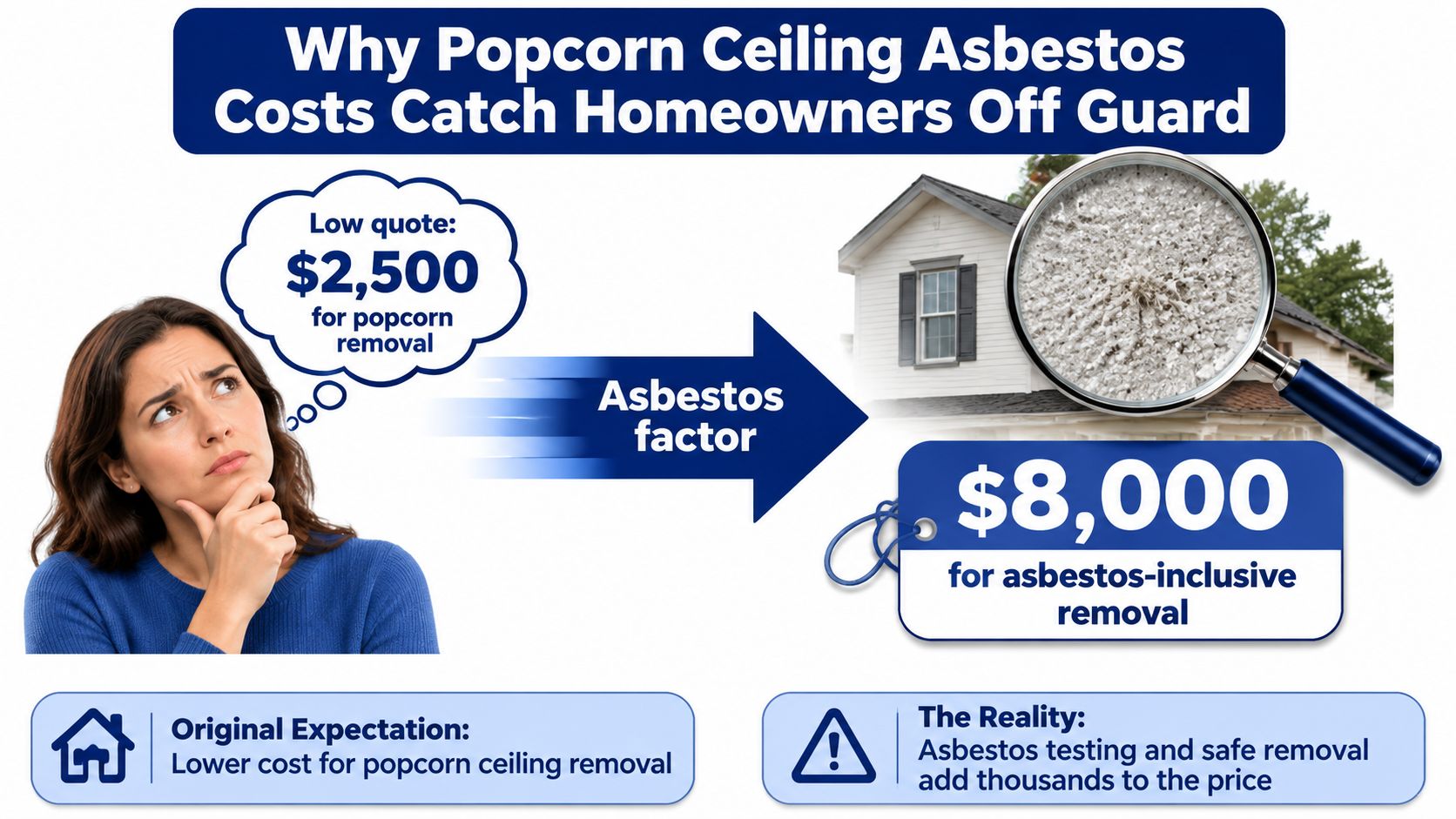
A clean ceiling can often stay in the lower pricing band, while a positive result pushes the job into licensed containment, regulated waste handling, and final repair. That's why the same square footage can move from the low thousands without asbestos to several thousand dollars more once asbestos controls are required, as summarized in industry cost references for both standard removal and abatement (The Asbestos Institute, Angi).
Practical rule: if the ceiling hasn't been sampled, you don't have a removal price yet, you have a guess.
A positive result changes the crew type, the site setup, the disposal path, and the finishing sequence. It also adds pre-work testing cost, which industry summaries place at about $250 to $850 before removal even starts (The Asbestos Institute). That's the part homeowners miss when they compare only scraping quotes.
The most common budget mistake I see in older Los Angeles properties is this, people want to price the cosmetic finish before they know whether the material is regulated. Once a sample comes back positive, the cost conversation changes shape fast, and the low quote from a general remodel crew is no longer a useful comparison.
California asbestos real estate disclosure guidance
Breaking Down the Cost of Removing Asbestos Popcorn Ceilings
A ceiling only looks cheap to remove until you test it. In asbestos work, the testing decision drives the budget more than the scraping does, because it determines whether the job stays a simple interior demo or turns into regulated abatement.
The cost stack starts with sampling, then moves to containment, labor, disposal, and finishing. Professional asbestos sampling for a small home is commonly budgeted around $200 to $600, with lab analysis adding $25 to $50 per sample. Containment materials and setup, including poly sheeting, negative air machines, and decontamination equipment, are part of the regulated sequence, not extras. Licensed abatement labor is commonly described at about $3 to $10 per square foot, while disposal at approved facilities often carries a $200 to $600 minimum before repair work begins. Refinishing, including re-texturing or drywall repair, is often $1 to $3 per square foot (The Asbestos Institute).
Those figures are compliance costs, not convenience costs. California projects cannot skip sampling, containment, waste handling, or post-work verification without adding liability, especially when the ceiling is part of a renovation scope.
| Cost Component | Typical Range | Notes |
|---|---|---|
| Professional sampling | $200 to $600 | Small-home testing and inspection |
| Lab analysis | $25 to $50 per sample | Confirms asbestos presence |
| Containment setup | Varies by scope | Poly, negative air, decontamination |
| Licensed abatement labor | $3 to $10 per square foot | Regulated removal work |
| Disposal | $200 to $600 minimum | Approved facilities and manifests |
| Refinishing | $1 to $3 per square foot | Re-texture or drywall repair |
A related interior demo example is bathroom demolition cost by size. The useful lesson is the same, setup, access, and disposal drive pricing more than the visible tear-out.
For a 1,500-square-foot single-story home in the LA basin, the clean way to budget is straightforward. Test first, then price containment and abatement from the confirmed scope, then add disposal and finishing. A homeowner who compares a removal quote before sampling is comparing a partial number to a complete one.
How Asbestos Testing and Inspection Work
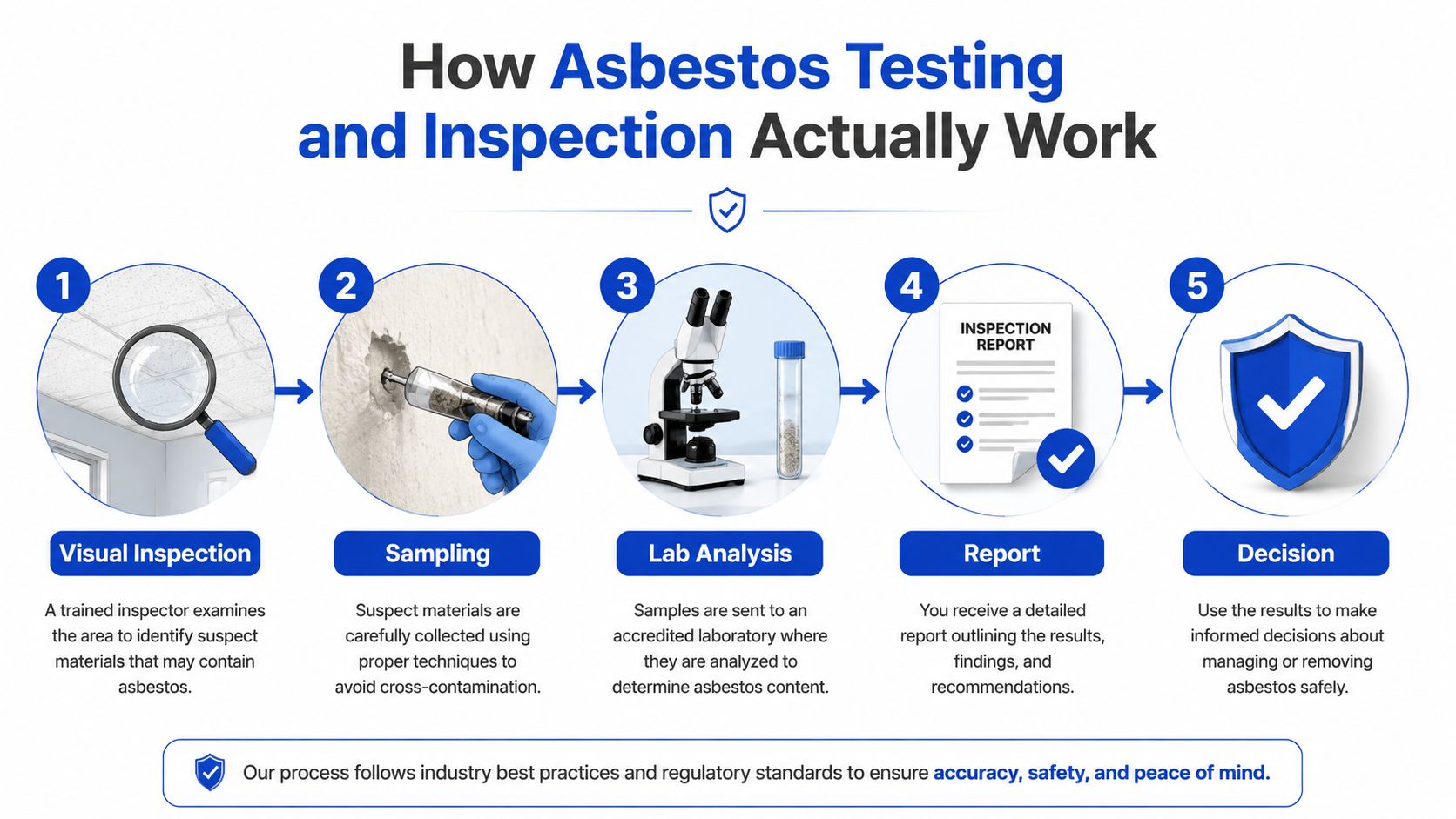
A popcorn ceiling test starts with inspection, not guesswork. A certified inspector maps the room, checks the ceiling as a uniform material, and chooses a sample point that can represent the texture across the space.
What the homeowner sees versus what the inspector handles
The visible part is small. The inspector wets the area, removes a controlled bulk sample, patches the spot, and limits disturbance. The value is the paper trail. Chain-of-custody records show exactly what was collected, where it came from, and when it changed hands.
Polarized light microscopy, or PLM, is the standard lab method for many building materials. Turnaround is usually fast enough to keep a renovation moving, which matters because contractors should not mobilize until the ceiling status is clear.
A DIY kit can give you an answer. It does not give you the same defensible record a certified inspector provides for contractors, regulators, or a job file.
If the first result is unclear, point counting may be used to settle the question when a material sits near the threshold but still looks suspicious. That is why a field report from a certified inspector carries more weight than a homeowner kit when the ceiling is tied to renovation or compliance work.
A good sampling decision also depends on the building context, not just the texture on the ceiling. You can see how a trained inspector frames that decision in this asbestos testing guide for popcorn ceilings, and the same documentation habits show up in the inspection guide for claim support.
Standard Popcorn Removal Compared to Asbestos Abatement
A ceiling job gets expensive fast when asbestos is in the mix, because the budget is driven by the workflow, not just the scraping. The split is whether the ceiling can be treated as a normal finish removal or has to be handled as regulated material.
| Factor | Standard Popcorn Removal | Asbestos Abatement |
|---|---|---|
| Cost per square foot | About $1.25 to $3.50 | About $5 to $20 |
| Contractor type | General remodel crew | Licensed, regulated abatement contractor |
| Timeline | Often a day or two | Multi-day sequence |
| Site disruption | Light plastic and scraping | Full containment, wet removal, clearance testing |
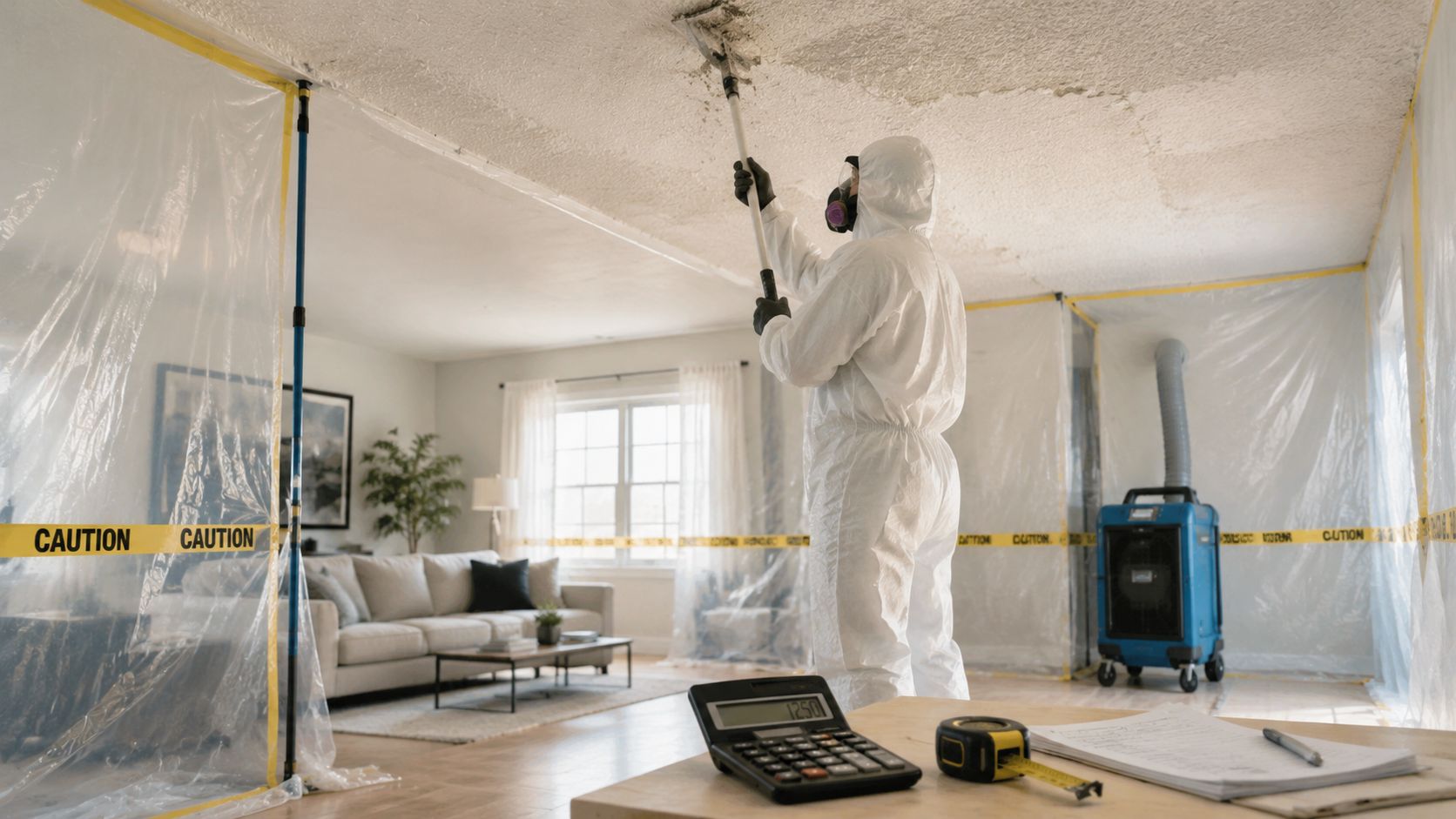
A non-asbestos ceiling is usually a simple interior trade job. Crews can scrape, skim-coat, and repaint with moderate protection, and the room often stays partly usable during the work. Once asbestos is confirmed, the ceiling area has to be isolated, air handling has to be controlled, debris has to be packaged as regulated waste, and the job does not end until clearance testing is done. That is the difference contractors build around, as outlined in this asbestos abatement guide for Los Angeles properties.
Testing controls which lane you are in. If the sample comes back clean, you can usually stay on the lower-cost path and avoid the containment and waste-handling load that comes with abatement. If the sample is positive, the ceiling is no longer a normal remodel item, and the price jump is tied to regulation, documentation, and the extra site control required to do the work safely.
That is why pre-removal testing is the cost-control lever, especially on older LA properties where the ceiling texture may look routine but the survey result decides whether the project stays simple or becomes a regulated abatement job.
Rule 1403 Surveys and LA-Area Compliance Basics
Los Angeles area projects have a separate compliance layer that homeowners often miss. SCAQMD Rule 1403 requires an asbestos survey before demolition, and it also requires a survey before renovation when the work will disturb more than 100 square feet or 100 linear feet of regulated asbestos-containing material in a facility (SCAQMD Rule 1403).
What the survey has to cover
The compliance advisory says the survey must be done by a Cal/OSHA-certified inspector, or in limited cases by an employee with an unexpired AHERA Building Inspector certificate from a Cal/OSHA-approved course, and the findings must be documented in writing (SCAQMD compliance advisory). There's a narrow residential exception for single-unit homes when less than 100 square feet of ACM surface area is removed or stripped, but demolition has no exception under the advisory.
AQMD guidance also says it does not recommend abatement of undamaged asbestos-containing materials like intact popcorn ceilings. The trigger is disturbance, especially when renovation or demolition is planned and fibers could be released into the air (SCAQMD Q&A).
Bottom line: a ceiling texture job in Los Angeles is rarely just a cosmetic project once Rule 1403 applies.
The rule language also makes one thing very clear, there are no exceptions based on construction date or age (Rule 1403 draft language). That means owners can't assume an older home is automatically exempt, and they can't assume a newer one is safe to skip either.
For a typical LA project, that means the asbestos survey and documentation come before bid collection, not after. Cal/OSHA worker protection rules still apply on top of that, so both the air district and labor compliance matter on the same job.
What Changes the Price Across Southern California Projects
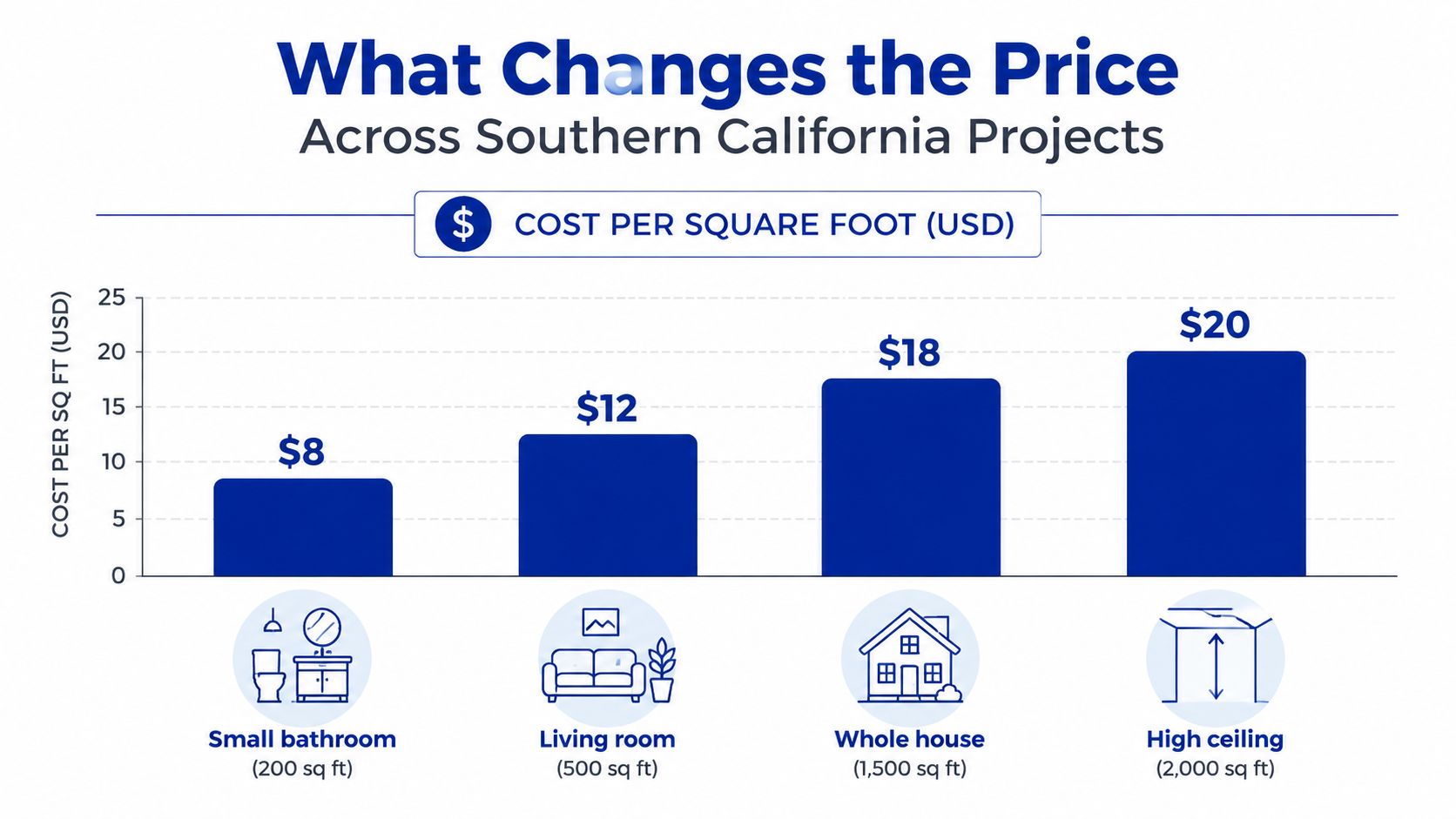
Square footage matters, but it doesn't tell the whole story. Small areas often carry a higher effective cost because mobilization, containment setup, and disposal charges get spread across less space, while larger projects can benefit from more efficient scheduling.
The project variables that push bids up or down
A bathroom or small bedroom can look expensive on a per-square-foot basis because the crew still has to set up containment, move equipment, and complete disposal and clearance work. Larger homes often come in at a more favorable unit price because the fixed steps are distributed across more area.
Ceiling height is another real driver. Higher ceilings usually mean more containment complexity, more ladder or scaffold work, and more time spent isolating the space. Room layout matters too, especially vaulted ceilings, tight hallways, or occupied rooms next door that can't be shut down easily.
Occupancy also changes the budget. A vacant property gives the contractor more freedom to isolate the work zone cleanly, while an occupied home usually requires more coordination and more protection of furnishings and living areas. In Southern California, labor availability, licensed crew scheduling, disposal facility access, and travel outside the immediate Los Angeles basin can all nudge the project toward the upper end of the range.
The right way to read a quote is to ask what the price includes, not just what the number is. If testing, containment, disposal, and finishing aren't all in the same scope, the quote is probably incomplete.
Why a Positive Test Does Not Always Mean Full Removal
A positive result is a decision point, not an automatic removal order. If the ceiling is intact, undamaged, and not part of planned renovation, leaving it in place can be the most sensible option.
Three realistic responses to a positive result
Full abatement is the obvious choice when a renovation will disturb the ceiling or when the material is already failing. Partial removal can make sense when only one room is being remodeled and the rest of the property is staying untouched. Encapsulation is the least disruptive path when the ceiling is in good condition and the owner wants to keep it stable instead of disturbing it.
Selling or refinancing doesn't automatically force removal. What matters is the condition of the material, whether it's friable or likely to be disturbed, and whether the next project will contact it. That's why inspectors focus on condition and planned work, not just presence.
A positive ceiling sample can still lead to a no-work recommendation if the material is stable and no renovation is coming. In other cases, the right answer is to leave it alone until a future project justifies a more involved approach.
Intact asbestos isn't the same thing as active exposure. Disturbance is what changes the equation.
That's the point homeowners should keep in mind when they're trying to budget. A lab result tells you what the material is, but it doesn't decide the full scope by itself.
Smart Next Steps for Los Angeles Property Owners
Start with age and renovation history, because those two details help frame the sampling plan. If the home has a textured ceiling and the project involves any disturbance, schedule a certified asbestos inspector for bulk sampling before you ask for removal bids.
Once the lab report comes back, have the inspector explain the condition of the material, the friability concerns, and what the result means for your specific room or project area. Then compare written quotes only from California-licensed contractors who can handle Rule 1403 notifications, containment, and disposal manifests if work is needed.
After that, plan for clearance air monitoring and post-work verification before refinishing starts. That step keeps the project defensible and prevents you from painting over a problem that hasn't been properly closed out.
The biggest cost savings come from testing first, scoping accurately, and bidding the right job the first time. That's true for a single room in Glendale, a ranch home in the San Fernando Valley, or a commercial property anywhere in Los Angeles County.
If you're weighing how much to remove popcorn ceiling with asbestos in Southern California, schedule a professional asbestos survey before you sign any removal contract. The lab result is what turns a rough guess into a real budget.
Sensitive Environmental provides professional asbestos testing, surveys, and sampling for Los Angeles and Southern California properties, including popcorn ceiling projects tied to renovation or compliance. If you need a clear, defensible answer before you bid the work, visit Sensitive Environmental to schedule asbestos testing and get the project scoped around real lab results.